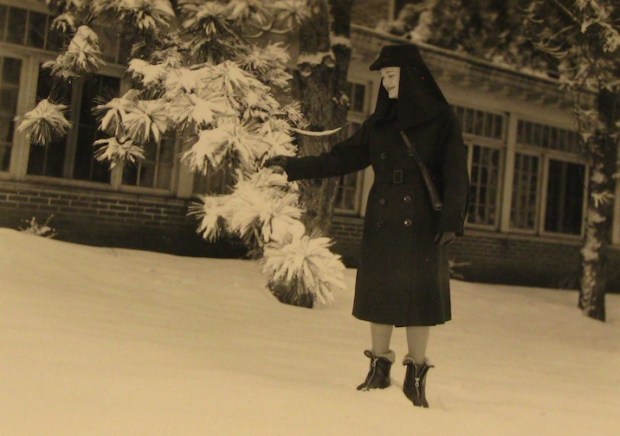
Is it snowing where you are? This photo from the University of Northern Iowa archives and special collections shows a WAVE trainee playing in the snow during a winter day in Cedar Falls, IA.
A Blog About Women Who Were Homefront Heroines: the WAVES of World War II
Is it snowing where you are? This photo from the University of Northern Iowa archives and special collections shows a WAVE trainee playing in the snow during a winter day in Cedar Falls, IA.

We don’t know about you, but we’re getting prepared for parties and celebrations this holiday season. So we thought we’d kick off our holiday-themed posts with this celebratory dinner circa 1943. It features WAVES, Navy officers and civilians gathering for what appears to be quite the opulent feast. From the collection of Frances Prindle Taft.

In this photograph from the Coast Guard, SPARs leader Dorothy Stratton is interviewing with Vice Admiral Russel R. Waesche, Coast Guard Commandant.

In this February 1943 National Archives photo, SPARs in yeoman training at Cedar Falls are relaxing after their daily activities.
The SPARs are (left to right): Maxine Renner, Mary J. Klein and Dorothy Horder.

Between 10,000 and 11,000 women volunteered to become a SPAR. The average enlisted woman was 22 years of age, and like the WAVES she held a high school diploma and had a few years of work experience.

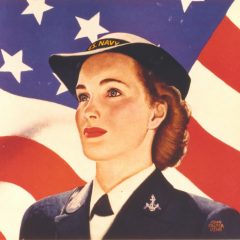
Among the artists used by the Coast Guard to promote the SPARs was celebrated pin-up artist Alberto Varga. This poster from the National Museum of the U.S. Navy features a Varga design.

The SPARs had a similar uniform to the WAVES, as shown in the photo above. Both were designed by couture designed Mainbocher. The key difference was in the lapel insignia. While the WAVES had the “fouled anchor” symbol of the Navy, the SPARs had a Coast Guard insignia on their collar.
This National Archives photograph shows World War I Yeomanette Sadie Flay comparing her uniform with World War II era WAVES and SPARs during a recruiting tour in Arizona.

Like the WAVES, the Coast Guard SPARs would have the same rank and pay as their male counterparts. And like Coast Guard men, the SPARs fell under Navy jurisdiction during World War II. Military protocol demanded that the Coast Guard be commanded by the Navy during wartime.
This recruitment poster comes from the National Museum of the U.S. Navy.
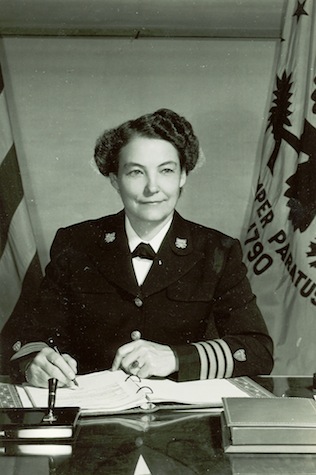
Coast Guard SPARs leader Dorothy Stratton moved from the WAVES when the Coast Guard SPARs were founded on November 24, 1942. She became the first SPAR. She is credited with giving the SPARs their name: writing in a member to Coast Guard Commandant Vice Admiral Russell Waesche:
The initials of [the Coast Guard motto Semper Paratus, Always Ready] are, of course SPAR. Why not clal the members of the Women’s Reserve SPARs? . . .As I understand it, a spar is. . .a supporting beam and that is what we hope each member of the Women’s Reserve will be.”
This photo comes from the U.S. Coast Guard.
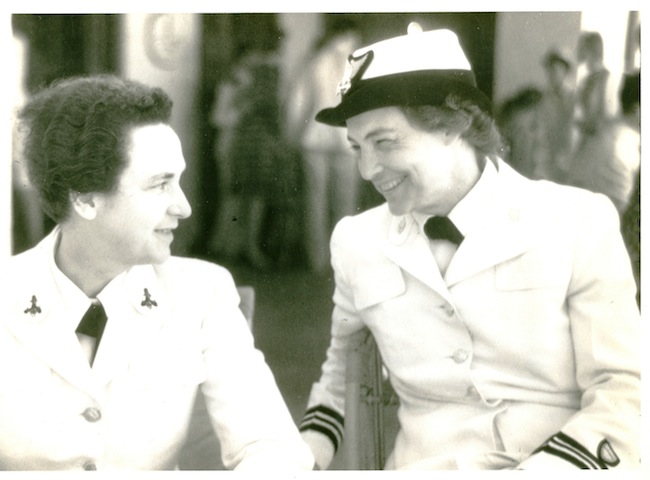
The SPARS, like the WAVES, turned to higher education for their leader. Dorothy Stratton was the first full time Dean of Women at Purdue University as World War II started. She left higher education to join the service, become a member of the first WAVES’ officer class at Smith College. She was then assigned as Assistant to the Commanding Officer of the WAVES radio training program at the University of Wisconsin, Madison.
This photograph of Stratton and WAVES commander Mildred McAfee comes from the U.S. Coast Guard.
 Hinges of History