The Luck of the Irish

We’re taking another break today from our series of military firsts. This time, we want to talk about St. Patrick’s Day.

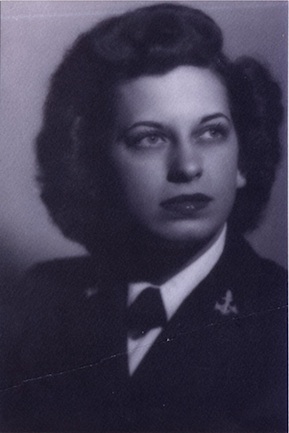
Spunky World War II WAVE Josette Dermody was a gunner’s mate based in San Francisco during World War II. And one St. Patrick’s Day she decided to celebrate her heritage by personalizing her uniform.

Everybody was talking about how they could wear green, a green slip or something. I put on – I didn’t have a hat. I had a little tiny green hair bow.  And I was down looking for my pay and went across a quarter deck. The master at arms, who didn’t like WAVES, was chasing me and I got on the stairway and he couldn’t touch me. There were all kinds of ways of learning about rules.  (laughs) Because it was out of his domain. And I was just toodling up the stairs and some lieutenant, some middle aged, it looked like a middle aged dentist who had been drafted to to dental work or something. A perfectly innocent looking man.  But he said, “Young lady, you’re out of uniform!”  They made fusses about things like that. And I said, I just looked at him, “No sir.  It’s St. Patrick’s Day. The skipper is Irish and this is the uniform of the day” (laughs). And then I scooted upstairs.

This photograph comes from the collection of Josette Dermody Wingo.

On the Front Lines

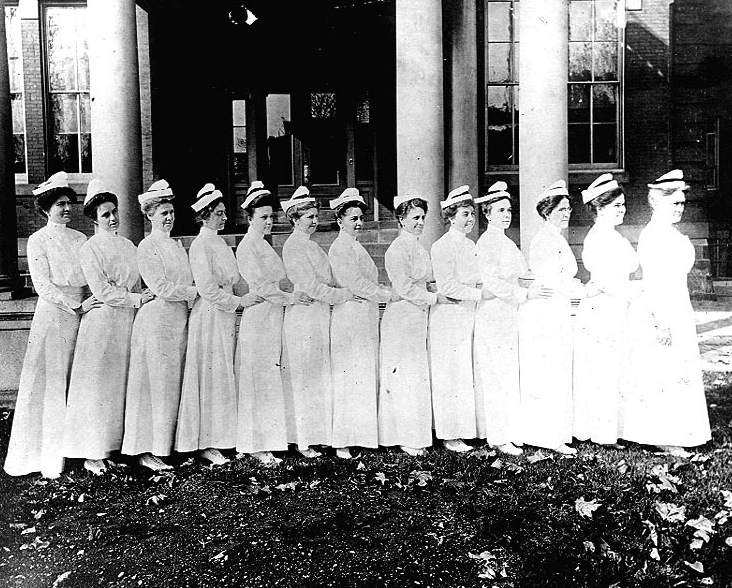
When World War I broke out in Europe in 1914, two Navy Nurses requested discharges and joined the Red Cross. There they served in the war zone, helping treat men who were injured in battles.

The women would spend a year on the front lines. In 1915, both returned to the United States and reenlisted in the Navy. Their experience was important, because it would help shape the role of women when the U.S. entered the “Great War” two years later, in 1917.

This photograph at the U.S. Naval Hospital in Norfolk, circa 1914, comes from the collection of the Naval History and Heritage Command.

Expanding the Nursing Corps

The group of nurses gradually grew from the “sacred 20,” the first group making up the Navy Nurse Corps. By the end of 1909, 37 nurses where in the Navy, scattered at stations across the continental United States.

Demand increased, and the Corps grew. By 1913, there were approximately 160 Navy Nurse Corp members. They were assigned to U.S. hospitals, but also to locations in Pearl Harbor (then a U.S. territory), the Philippine Islands, Guam, Samoa, Japan, Cuba and the Virgin Islands. For a brief time in 1913, Navy nurses served aboard ships: the USS Mayflower and the USS Dolphin.

This photograph at the U.S. Naval Hospital in Philadelphia, circa 1914, comes from the collection of the Naval History and Heritage Command.

The First Navy Nurses

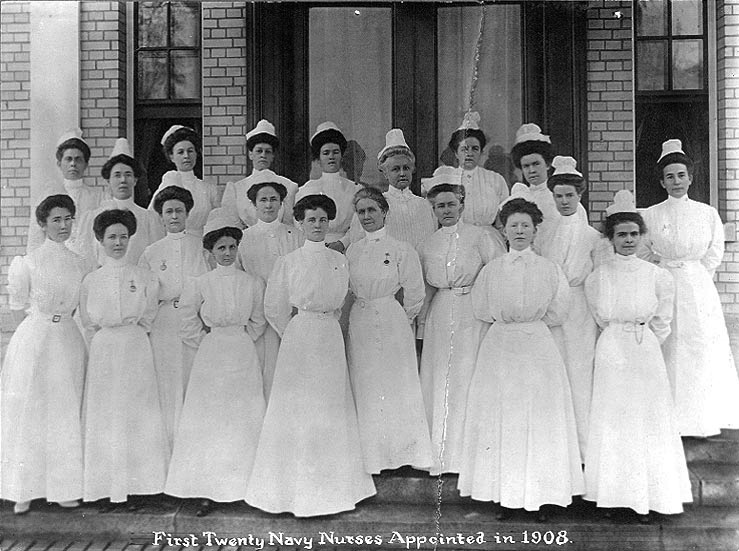
It wasn’t until 1908 that Congress allowed women to serve in the Navy – as nurses. On May 13th of that year, the Navy Nurse Corps was established.

Women had to have at least two years formal training as “graduate nurses” and also have relevant clinical experience to qualify.

Nineteen women were part of the first nurse contingent,. A 20th, Esther Vorhees Hasson, was a former Army nurse who was tapped to lead the women in the Navy Nurse Corps.

This photograph of the “sacred 20” comes from the collection of the Naval History and Heritage Command.

Mary Marovich Ryan

We’re taking a break today from the Navy historical firsts for women to honor an important women to the Homefront Heroines crew.

March 8th is the birthday of the woman who inspired the Homefront Heroines project. Mary Marovich was born in Chicago on March 8th 1921. She enlisted in the WAVES in 1943 and after boot camp at Hunter College she became a Pharmacist’s Mate based at Treasure Island in San Francisco.

Mary worked as a telephone operator in Chicago before enlisting in the Navy. She followed six of her brothers into the service – four were with the Army, and two were first class petty officers in the Coast Guard (her younger brother would serve in the military in the Korean War).

Mary said before enlisting:

I’d really like to wear a six star pin (to honor her brothers), but I can’t find a story that sell them!

Mary married James Warren Ryan, an Army Air Corps pilot, while she was in the service. She left in 1945 after V-J Day and died in 1992.

Happy birthday, Mother!

The Leader Resigns

Mildred McAfee would lead the WAVES until August of 1945. During that time, she amassed some pretty impressive military firsts:

  • First female line officer in the Navy (1942)
  • First WAVES Director (1942-1945)
  • First female Navy Captain (1944)
  • Recipient of the Distinguished Service Medal

After she resigned as Director of the WAVES, McAfee would remain active duty until February of 1946.

McAfee met and married the Reverend Dr. Douglas Horton while in the Navy and changed her name to Mildred McAfee Horton. After she left the WAVES, she would first return to the Presidency of Wellesley College, where she would remain until 1948. After she left Wellesely, she became involved with the General Council of Congregational Christian Churches. McAfee also served as a UNESCO delegate, was on the board of directors of the New York Life Insurance Company, the National Broadcasting Company, Radio Corporation of America, and the Ford Foundation’s Fund for the Advancement of Education. She later co-chaired the National Women’s Conference on Civil Rights.

This photograph comes from the Naval Historical Center.

Mildred McAfee

Mildred McAfee attended Vassar College in New York, where she studied economics, sociology and English. She was also active in team sports (hockey and basketball), the Christian association, and student government. She earned an M.A. in sociology from the University of Chicago.

McAfee spent 14 years working in various collegiate administration positions (including Dean of College Women at Oberlin College) before being selected as President of Wellesley College in 1936. She beat out 100 other candidates for the job. She was just 36 years old.

She told Wellesley students:

I envision the function of this college, or any college, to prepare an oncoming generation of students to disseminate truth. It is my conviction that truth is more easily given a hearing if it’s presented by a healthy, well-adjusted, effective human being who see truth in the light of a word philosophy that gives it meaning.

McAfee wasn’t the first female president of Wellesley (that would be Ada Howard, who was also the first president of the school.)

This photograph shows Mildred McAfee (left) with Rear Admiral A. E. Watson and Margaret Disert in August of 1942. It comes from the Naval Historical Center.

Women’s History Month!

March is Women’s History Month, and we decided that our blog a day will feature firsts or other accomplishments by the WAVES.  Please let us know if there’s something you’d like to know more about, or would like to see featured this month.

We begin with Mildred McAfee. She’s a pretty special woman to the WAVES we’ve talked with on this project. She was the leader of the WAVES for most of World War II.

McAfee was the daughter of a pastor and the President of Wellesley College before being asked to lead the WAVES. She said at the time that the Navy brass told her:

The Navy is going to admit women into the regular positions in the Navy. There’s not going to be any separateness about this. You’re going to be really in the Navy. That sounded very good to me and I used it all the rest of the way through the war.

McAfee was the first Navy female line officer in 1942 and was appointed a Navy Captain in late 1943 – the only WAVE Captain at the time.

We salute Ms. Mac!

This photograph comes from the Naval Historical Center.

“You’re Not an Individual”

Though there was resistance to allowing African American women to serve in the Navy, Jean Byrd Stewart says she didn’t encounter any racism once she was in the military. She ended up being stationed in the Chicago area, but remembers one time traveling to St. Louis. St. Louis was a segregated community, and while she could find a restroom for white women, she couldn’t find one for African American women.

I said to the gentleman in charge, “I am going back upstairs where I saw ladies rooms. And I’m going to use that.  If you hear any commotion, you know I’m in trouble.  Send a Shore Patrol because I might need help.” Because there is no ladies room here. And I did.  I went in and you know, you have to wait until there’s an open on.  And I did, I went into the ladies room, came out, when I came out, I sat down.  I took off my hat.  I fixed my hair, checked my make-up, stood up to leave, and of course they were around talking and saying.  And you say, “Goodbye.”  Or “I’ll see you later.”  And you get up and you leave.  Nothing happened.  It shouldn’t have, but you never know.

You know what they told us when we went in?  “You’re not an individual. Remember your home training and all the things you’re supposed to do and how you’re supposed to act.  You belong to a group.  You’re not an individual.  You belong to a group and remember your manners.”  And that was it.

This photograph comes from the collection of Jean Byrd Stewart.

“Send for Your Ice Skates”

Pat Pierpont met her husband-to-be, Dick Graves, while serving in the Navy. She was a WAVE and he was a sailor. They were both stationed in Jacksonville, Florida.

My sister was very much into boyfriends and things but I didn’t have any.  So I went down there (to Jacksonville) and just knew a lot of guys but didn’t go out hardly at all.  And then I met someone one day. He was in the hangar. And I just happened to meet him and he asked me once to go out.  The first time we ever went out was New Year’s Eve. We went to a movie. That was it.  Had dinner and went back to the base and then saw each other off and on, but we didn’t get married until we were both out of the Navy because that was the way it was.  We hadn’t known each other that long, you see,  He was from California and I was from Connecticut.

Their marriage was in February 1946. In Connecticut. Pat told them to prepare for the worst.

I said, “Send for your skates, your ice skates” because we always had ice everywhere. And virgin ice, clear beautiful.  On the lakes, everywhere. Well, of course, this was the year when they wasn’t any ice when they were there. Except the night we left from church.  Then it was raining and freezing. Dick learned to put on chains right away.

This photograph comes from the collection of Pat Pierpont Graves.