
WAVE Elvina Foland is checking the time table to see what time she’ll need to be there to catch her train, at the station in Norman, Oklahoma, c. 1943.
The photo comes from the National Archives.
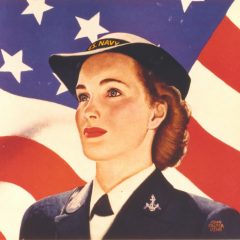
A Blog About Women Who Were Homefront Heroines: the WAVES of World War II
WAVE Elvina Foland is checking the time table to see what time she’ll need to be there to catch her train, at the station in Norman, Oklahoma, c. 1943.
The photo comes from the National Archives.

WAVES at boot camp learned about the various jobs open to them. Here, a display with posters and photographs shows what the women might be doing in various positions, such as Aviation Machinist’s Mates.
The photograph comes from the Schlesinger Library at the Radcliffe Institute for Advanced Studies.
 WAVE Violet Falkum bids farewell to sailor Matty Melidoni, after leaving Yeoman training camp at Norman, Oklahoma c. 1943. The caption for the photograph reads:
Last minute clutches and hurried good-bye kisses were in evidence everywhere for the Waves that were lucky enough to have their boy-friends at the station to see them off.
The photograph comes from the National Archives.

WAVES Elizabeth Bieser, Ann Boryk, and Virginia Bounds learn the ropes as machinist’s mates at the Naval Training Center in Norman, Oklahoma. They’re working on a hinge fitting plate.
The photograph comes from the National Archives.

The Navy caption to this photograph reads “Girls in the Classroom.” WAVES attend training at Cedar Falls, Iowa, c. 1943.
The photograph comes from the National Archives.
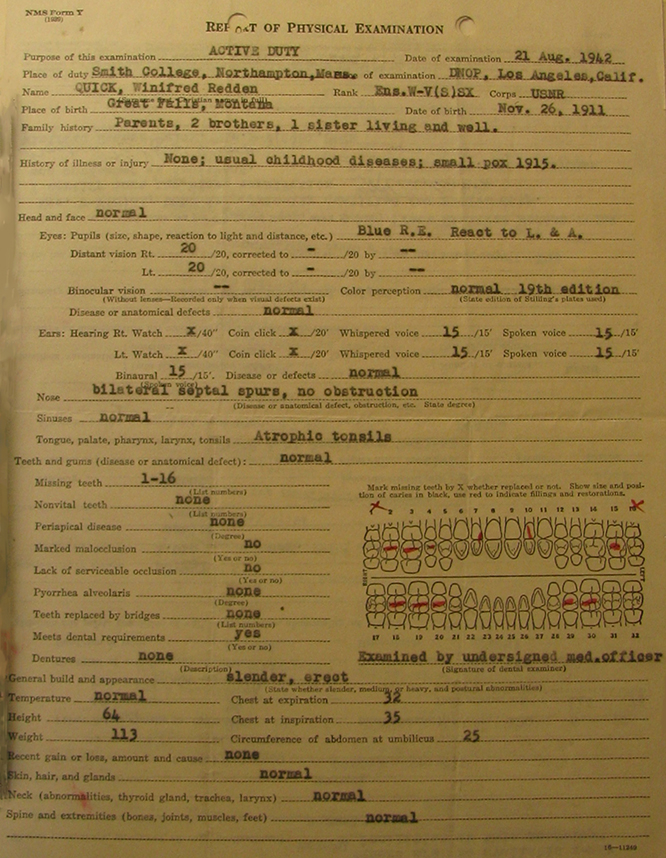
Ever wonder if you have what it takes to become a WAVE? Attached is the physical exam from August 21, 1942 for would-be WAVE officer Winnifred Quick.
You’ll note that her vision was perfect, she was 5’4″ and weight 113 pounds. She was 30 years old at the time of her exam.
Oh, and she passed the exam with flying colors – Quick would become one of the first WAVE officers, would be the first WAVE to serve outside of the continental United States (in the then-territory of Hawaii), and would become director of the WAVES from 1957-1962.

Gunnery training was many ways like an early form of video games. It included using a movie (seen being loaded in the previous photo) so that gunners could then use practice guns to “shoot” at virtual “targets.”
Here a WAVE training in gunnery instruction is at the trigger of a gun known as a “jamhandy.”
The photo comes from the Schlesinger Library at the Radcliffe Institute for Advanced Studies.
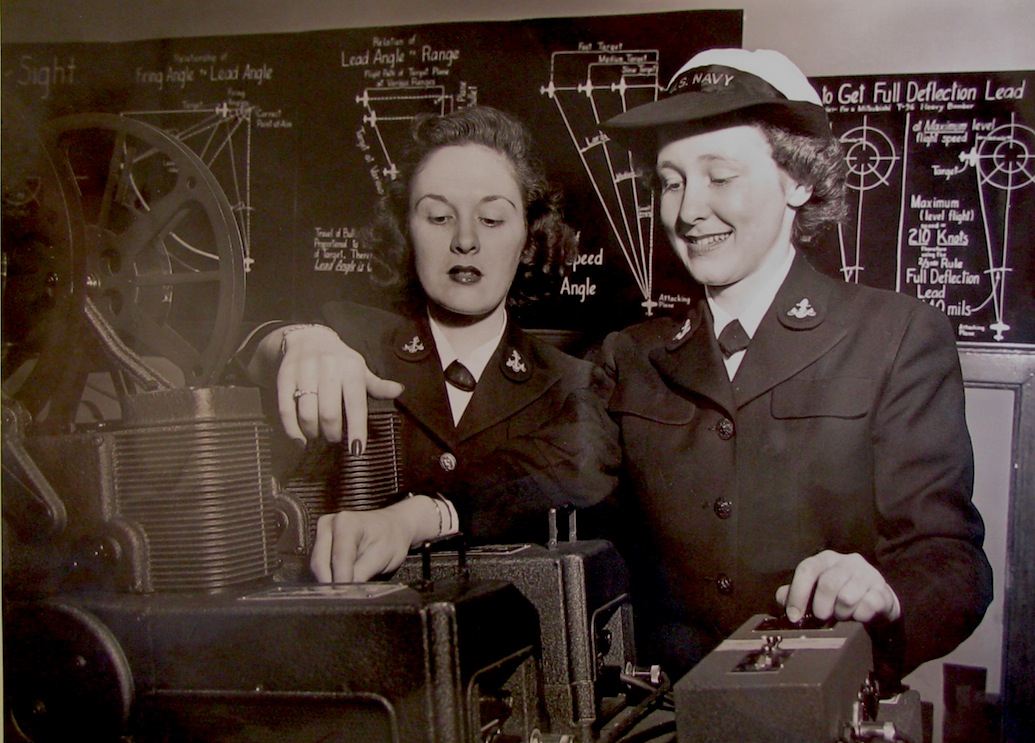
Here two unidentified WAVES are, in the words of the photo caption, “rolling a reel with a purpose.” The reel is for gunnery instruction, as you can see from the instructions on the blackboard behind the WAVES.
The photo comes from the Schlesinger Library at the Radcliffe Institute for Advanced Studies.

Two unidentified WAVES here take the wheel of the “ship” while at boot camp. The photo comes from the Schlesinger Library at the Radcliffe Institute for Advanced Studies.

Navy WAVE Naomi Sue Kleinberg Edmond Tofil, US Marine Corps, demonstrate the art of jiu jitsu during a demonstration at the Hunter College boot camp in 1943. She’s using a circle throw against her opponent.
Both Kleinberg and Tofil were experts in the martial art of jiu jitsu, which itself is a hybrid of judo. The confusion? The terms “judo” and “jiu jitsu” were originally largely interchangeable both inside and outside of Japan, where the martial art originated. But as of 1925, the Japanese government mandated that “judo” was the proper term to be used. Did the Navy use the term jiu jitsu during the war to help differentiate American martial arts fighters from the enemy Japan? Good question – and it’s not clear what the answer is. If anyone knows, let us know in the comments.
 Hinges of History