Dinner and a Dance

WAVE Merrily Kurtz Hewett remembers evenings in Hawaii:

The fellows liked to be asked to come.  Have meals with us.  You have your friends over for a meal.  Then they’d stay and usually it would be a dance night, I guess.  I can’t remember for sure exactly how many times a week we dances.

This photo shows WAVES Rita Bergan, Mary Burke, Rosalene Brown, Helen Beegle eating in the mess hall in Hawaii. It comes from the National Archives.

In Port!

The WAVES travelled aboard an L-S-T ship, or troop transport ship. It was mostly women aboard – the only sailors were the crew.

It was fun being aboard ship. We did zig-zag, we could see where we zig-zagged.  Didn’t need to, but taking precautions, I think.  This was early in ’44 — no later in ’44.  But anyway, a couple of the girls fell in love with the sailors. That was the disease, I think, with the women, with the sailors (laughs). Away from home. We had a good time aboard ship. We didn’t have any rough weather, I didn’t get seasick.

– Merrily Kurtz Hewett, WAVE

This photograph shows WAVES leaving their ship in Hawaii. It comes from the National Archives.

End of the War

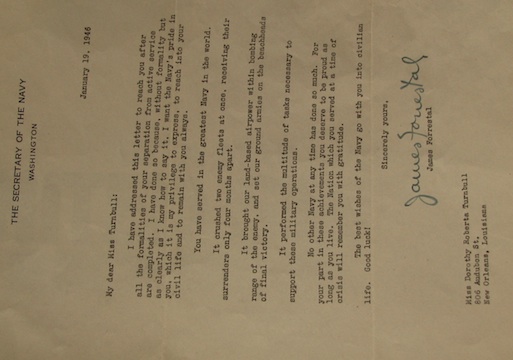
Dorothy Turnbull says the most meaningful thing she got from the Navy was this letter from Secretary of the Navy James Forrestal, which she received after she resigned from the WAVES at the end of the war.

There was no need for me to sell the Navy anymore. I mean to represent it. I felt that they were big now, they could take care of themselves (laughs). That I had nurtured them along?  No, the Navy did more for me than I ever did for it.

After the war, Dorothy returned to college to get an M.A. in counseling. She taught for years, and also counseled veterans.

Getting the Chiefs on Your Side

Dorothy Turnbull used her southern charm to win over even the most recalcitrant Navy man. She knew that the key to her success was making sure that those in command supported her.

Keeping these people on your team was the main reason for success.  If the old chiefs were with you, you had your foot in the door and you could get people that would maybe just casually call or see him someplace and ask them a question about Navy women or something. He would then be your salesperson, so to speak, even if he was just an old gruff fellow with no polish. He could still support the Navy and the women.

This photograph of Dorothy with two regional Navy commanders comes from the collection of Dorothy Turnbull Stewart.


Needing to Help

After her mother’s illness, Dorothy Turnbull returned to the University of Miami and finished school there.

After school. she came back to New Orleans, and felt like she needed to do something.

We had what was called “Sub-Deb Parties.”  The Roosevelt Hotel, it’s still going today I think, but it was one of our main features.  We had the Hawaiian Room where they had a waterfall and stuff. We had a Sunday afternoon tea dance for the officers that were stationed in the area. And we entertained. That’s what our war contribution (laughs). I decided when I graduated I was going to come back to New Orleans and join the Navy in New Orleans. So that’s what I did.

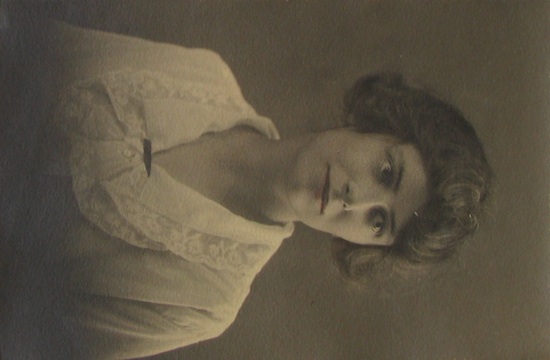
This photograph comes from the collection of Dorothy Turnbull Stewart.

Dorothy Stratton

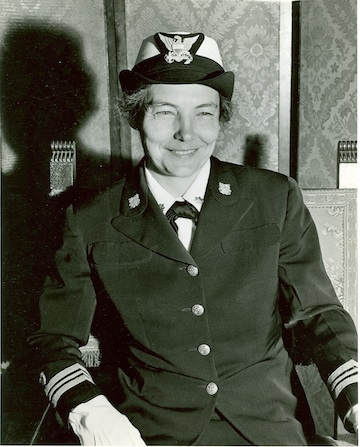
Dorothy Stratton, who had been dean of women at Purdue University before the war, was a member of the first WAVE officer class in August of 1942. A few months later she was asked to head another new women’s military group: the Coast Guard SPARs (from the Coast Guard Motto Semper Paratus, Always Ready).

She said of her appointment to lead the Coast Guard:

I knew nothing about the Coast Guard, nothing. I had never seen a Coast Guard officer. I didn’t know anything. I think I felt if that was the place where I could work, that was fine with me. In other words, I only cared about being where I could feel I was doing something useful, and I thought this was something useful.

About 12,000 women served in the SPARs during World War II. They were decommissioned at war’s end, and women weren’t allowed to join the Coast Guard again until 1949.

This photograph comes from the National Archives.
The Creative Spirit

Elizabeth Reynard initially struggled in the Navy. It wasn’t that she wasn’t qualified – it was more that her creative impulses clashed often with the regimentation of military life. She was also unhappy living away from her family and friends in New York.

When the Navy decided to open a training school for women in New York in late 1942, Reynard was appointed to help develop the education program. By all accounts, her work was a huge success. She came up with the idea of bringing models of ships, sample guns and Link trainers and other equipment the women might encounter on the job for their boot camp training at Hunter College.

This newspaper clipping comes from the Schlesinger Library, Radcliffe Institute for Advanced Studies. It is about a commendation Reynard received for her service with the Navy.

Elizabeth Reynard

Virginia Gildersleeve, Dean of Barnard College in New York, also asked one of her close personal friends to go to Washington and help work within the Navy develop a woman’s program. That woman was Elizabeth Reynard.

Reynard was a an English professor and graduate of Barnard College. She was a strange choice to lobby for a woman’s service because Reynard was by all accounts highly artistic and an unconventional thinker – not perhaps the best civilian woman to lobby for women’s military service. She moved to Washington in early 1942 and would eventually become one of the first women to join the WAVES.

This photograph comes from the Schlesinger Library, Radcliffe Institute for Advanced Studies.