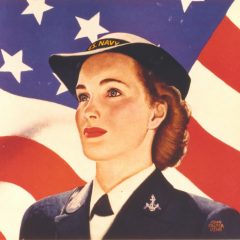
Personal Interview

Just as potential WAVES received a personal interview when they began in the service, the soon-to-be civilians would have an interview about options after they left the service.

The sage advice from the Navy?

Make sure you are fully informed.

This image comes from the Women’s Reserve Information Separation Pamphlet. It is held by the The Betty H. Carter Women Veterans Historical Project at the University of North Carolina Greensboro.

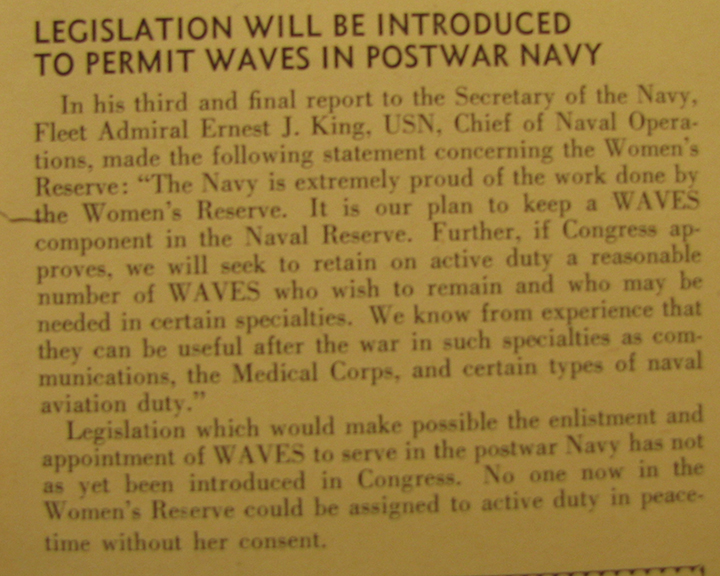
Post-War WAVES?

The reality is that a group of women hoped to remain with the Navy after the war – while others were looking forward to returning home. So in the articles discussing the possibility for a post-war Women’s Reserve, the Navy had to strike a careful balance, as illustrated by this article. While the article discusses how women might be able to continue to serve, it also reassures them that “no one now in the Women’s Reserve could be assigned to active duty in peacetime without her consent.”

It comes from the Schlesinger Library at Radcliffe College.

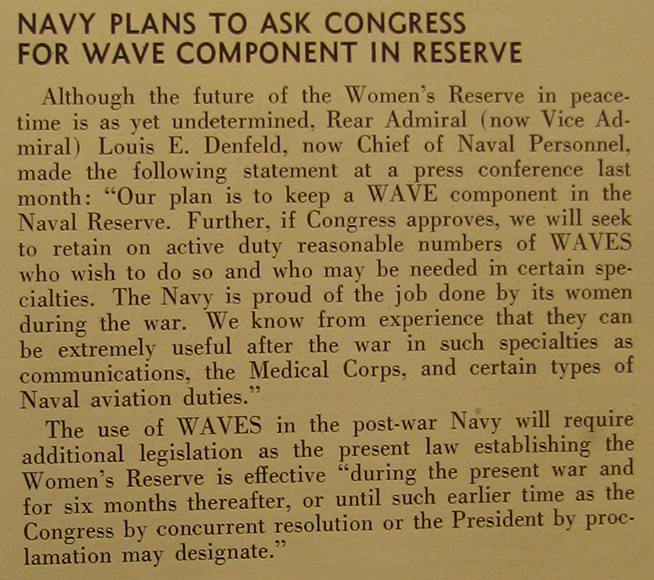
Post-War Planning

Even as the war was ending, the Navy was thinking ahead. The WAVES had been very successful in the various jobs in the Navy, and the Navy was hoping to be able to continue their service, as evidenced by this article from the WAVES’ newsletter in September 1942.

The clipping comes from Schlesinger Library at Radcliffe College.

Leaving

The WAVES were always scheduled to serve “for the duration plus six months.” By September of 1942, the Navy had developed a plan for releasing the women who served. As this article illustrates, it wasn’t as simple as just letting the women go. The reality was then Navy had hundreds of thousands of people – men and women – who would need to return to civilian life. And so a plan needed to be put into place,.

This clipping from the WAVES’ newsletter outlines the initial release plan, which was based upon time served and a complicated system of “points.”  It comes from Schlesinger Library at Radcliffe College.

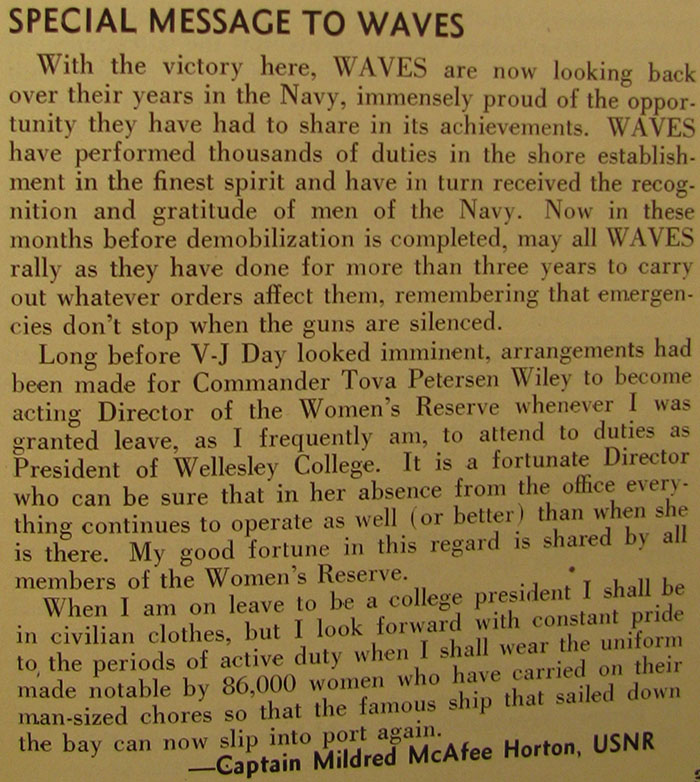
Special Message

As the war was ending, WAVE leader Mildred McAfee offered this missive to WAVES in mid-1945. It was then that she took a leave of absence to get married (and return to her post at Wellesley College; she would officially resign from the WAVES in 1946.
This clipping comes from Schlesinger Library at Radcliffe College.


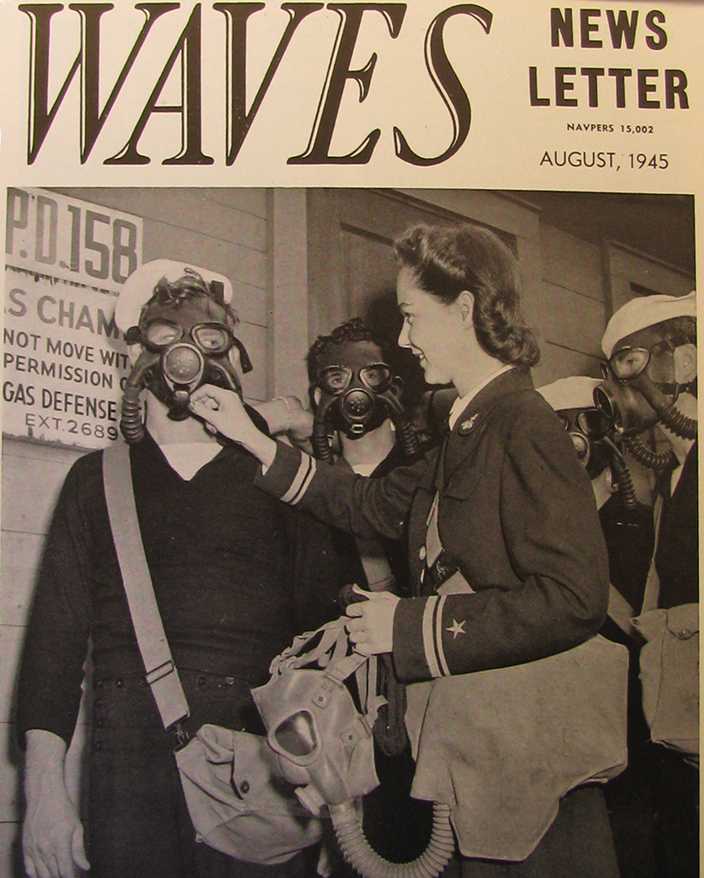
Writing on the Wall

While the war wasn’t over by the time the WAVES newsletter was released in August of 1945, the signs were there that peach would soon be at hand. The Allied troops had had a number of stunning victories in Europe throughout the summer, and by July 11th the Postdam Agreement had been signed, outlining terms for peace. Japan would agree to peace until a month later, after the nuclear attacks on Hiroshima and Nagasaki.

What’s interesting is this cover of the WAVES’ newsletter makes no reference to the peace agreements in Europe – but inside the newsletter demonstrates that the Navy was thinking about the post-war world – and the WAVES’ role in it.

In comes from Schlesinger Library at Radcliffe.