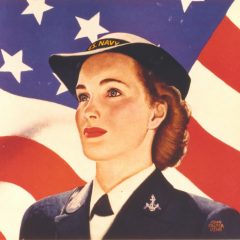
The YWCA Brochure

Dorothy Turnbull worked several cities in Southern Texas, including Beaumont, where she coordinated with the local YWCA to host events for recruits.
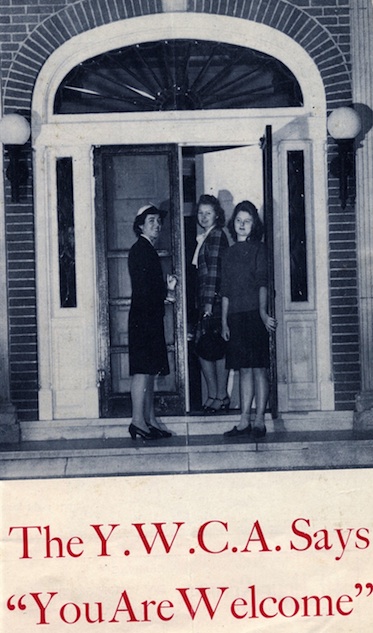
These ar two of my recruits.  Women who came in to be tested, see, they’d come from these little towns down to Beaumont. They’d come from Port Arthur, Orange. We’d arrange for them to take the tests with me there.  Bring the doctors over, or they’d come over to Houston to take the physical.  They’d do everything before the physical in Beaumont area. Then in Houston, they’d come over and if they passed the physical they could be sworn in right then.

This brochure comes from the collection of Dorothy Turnbull Stewart.
On the Job

Dorothy Turnbull first was stationed in New Orleans, but later transferred to southern Texas to work as a recruiter.

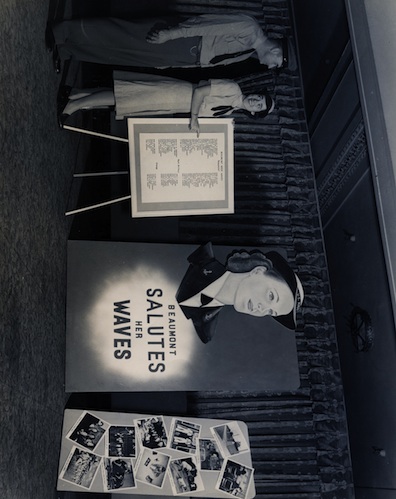
We never had to sell the Navy openly. To me, when I’d go to a radio station and talk about what the Navy women were doing and so forth, talking about their lives before they went in service — see, you had to show their families were behind them. That they were still young ladies, even though they had this uniform on. They weren’t going to be different from their sisters were.  This kind of thing.

This photograph shows Dorothy on stage at a recruitment event in Texas. It comes from the collection of Dorothy Turnbull Stewart.


Meeting Eleanor Roosevelt

Dorothy Turnbull joined the WAVES in 1943. She headed to boot camp at Hunter College and was selected to become a recruiter. Because of her connections in New Orleans, they wanted her to be stationed there. But when she finished boot camp there weren’t any openings, so she spent another eight weeks at Hunter making sure the new boots didn’t get into trouble as part of the Shore Patrol. She also helped out with visiting dignitaries.

Eleanor Roosevelt came to visit us when I was on Shore Patrol. Well, ship service is what they called us.  And here she is getting out and I think I might have been one of these.  My claim to fame is when she was going into the building from getting out here and going down here, I held the door for her (laughs).  With my backside as I’m (laughs).  That was my claim to fame.

This photograph comes from the collection of Dorothy Turnbull Stewart.

To New York

It was in 1943 when Dorothy Turnbull headed to boot camp at Hunter College. While she was there, they tried to discover what she could do in the Navy.

They interviewed you and tested you and did all of this with us.  And marched around, and I enjoyed that. So as I would be interviewed, I realized I couldn’t say I wanted, I was – I was good in numbers, but I sure didn’t want to go to bookkeeping or storekeeping, or whatever they called it.  I couldn’t imagine myself as selling anything or that storekeeping, you see (laughs). That’s what I thought it was.  All I could do was talk and tell them about things I believed in.  So they decided that that’s all I could do, and that’s what a recruiter does.

This photograph of Dorothy’s boot class comes from the collection of Dorothy Turnbull Stewart.

Needing to Help

After her mother’s illness, Dorothy Turnbull returned to the University of Miami and finished school there.

After school. she came back to New Orleans, and felt like she needed to do something.

We had what was called “Sub-Deb Parties.”  The Roosevelt Hotel, it’s still going today I think, but it was one of our main features.  We had the Hawaiian Room where they had a waterfall and stuff. We had a Sunday afternoon tea dance for the officers that were stationed in the area. And we entertained. That’s what our war contribution (laughs). I decided when I graduated I was going to come back to New Orleans and join the Navy in New Orleans. So that’s what I did.

This photograph comes from the collection of Dorothy Turnbull Stewart.

Too Close for Comfort

Dorothy Turnbull’s family brought her mother back to New Orleans from Florida as it became clear she wasn’t getting well. She passed away a short while later.

When she passed away, I was ready to go back to school. So I went to Newcomb because my father was still there. My brother was off in the Navy. I didn’t — I just — my father and I were too close. I didn’t want to go out when I knew he was going to be home. And he worried about when I was out, things like this. So we decided I would go back and finish my college degree at the University of Miami, for the last part of the senior years.

This photograph of Dorothy’s father comes from the collection of Dorothy Turnbull Stewart.

A Mother’s Illness

Dorothy Turnbull attended high school in New Orleans. She was a member of a high school sorority, and then after she graduated she went to Newcomb College in New Orleans and joined a sorority there.

It was when she was in her first year of college at Newcomb, that it was announced that the United States had been attacked at Pearl Harbor. Around the same time her mother was diagnosed with cancer.

We did have rationing.  All this stuff is going on. My mother, of course, wasn’t a house keeper at the time.  She was really bed ridden.  So we had help. (Then) my father decided it might be a good idea to bring her down to Miami. A change of climate and everything.

Dorothy stayed behind in New Orleans for a year or so, and then moved to Miami to be with her father and mother.

This photograph of Dorothy’s mother comes from the Dorothy Turnbull Stewart collection.

The Princess of Dew

Dorothy Turnbull was a member of the Mardi Gras court for the Bards of Bohemia crewe.

We had the sunshine, you see, we had the dawn and the night. Everybody is in costume.  You’re, as a member, you get so many what’s called call outs. Which means you can invite ladies to sit in a reserved place. And during the ball time when people are dancing the ushers come and call you out by name and escort you to the master on the floor. He gives you one of these souvenirs that represents the theme of the ball.  You dance around with him.  He brings you back to an usher and the usher seats you again and he calls another person. So it’s call outs.It’s simply social.  But that was just part of my father’s interest, and mother. Mostly my father. Because the men did all the work. The women enjoyed what they were doing, of course!  (laughs).

This photograph comes from the collection of Dorothy Turnbull Stewart.
The Mardi Gras Theme

Dorothy Turnbull’s father was a member of one of the crewes that planned New Orleans’ annual Mardi Gras celebrations. She says in the 1940s, it wasn’t like it is now.

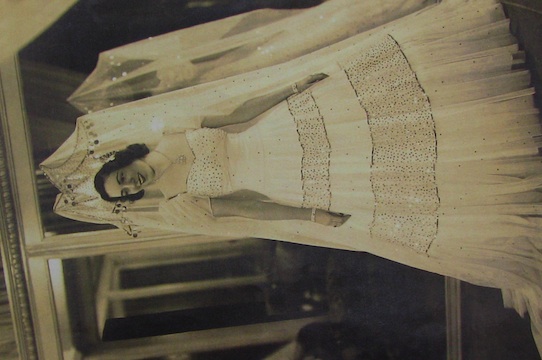
It’s a social business.  And they planned each year, they have meetings  and socials each year planning a carnival ball. They have to have a theme.   My father was one of the crewe. They go down and they have it at the great auditorium – public auditorium.  I don’t know what they’re doing today.  It looks like they’re on the street drinking constantly (laughs), but those aren’t the crews, you see.  But they plan a theme, and the theme that went along with this one, my father decided I should be in the court.

This is a photograph from the carnival ball in 1940, when Dorothy was a member of the crewe court. It comes from the collection of Dorothy Turnbull Stewart.
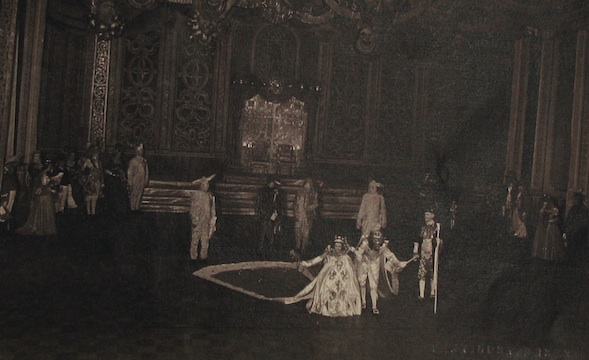
Mardi Gras Crewes

Because Dorothy Turnbull was from New Orleans, her family was involved in the pre-Lenten tradition of Mardi Gras. Her father belonged to one of the city’s crewes.

I never was a debutante. They have certain of the crewes, the big old celebration, but certain of them are for the debutantes, the elite of the elite. They pay more, of course, they have the bigger parades. They have all of the atmosphere.

This is a photograph of one of the Mardi Gras celebrations Dorothy participated in, c. 1940. It comes from the collection of Dorothy Turnbull Stewart.