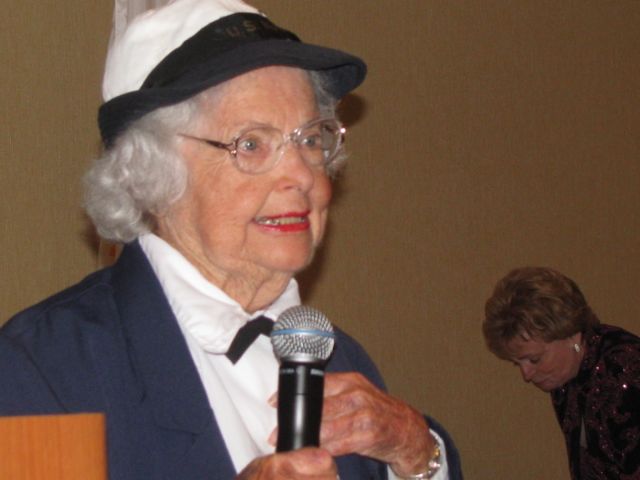
In this photo, WAVE Margaret Anderson Thorngate talks about how she first met Homefront Heroines Director Kathleen Ryan. This is at the film’s preview at the WAVES National Convention in Orlando, Florida.
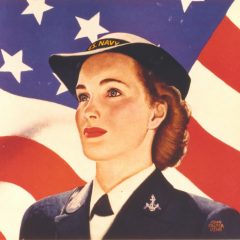
A Blog About Women Who Were Homefront Heroines: the WAVES of World War II
In this photo, WAVE Margaret Anderson Thorngate talks about how she first met Homefront Heroines Director Kathleen Ryan. This is at the film’s preview at the WAVES National Convention in Orlando, Florida.
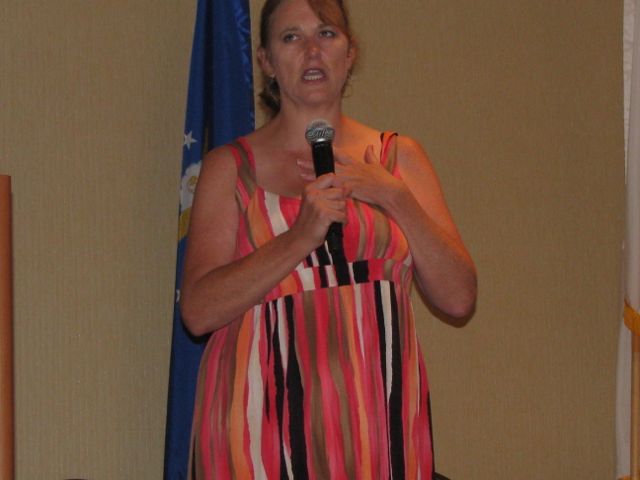
Homefront Heroines Director Kathleen Ryan speaks before the film’s preview at the WAVES National Convention in Orlando, Florida.

Margaret Thorngate, a World War II-era WAVE and regional representative of WAVES National, introduces Homefront Heroines director Kathleen Ryan at the preview for the film at the WAVES National Convention Friday September 21 in Orlando, Florida.

The May 1946 edition of the WAVES Newsletter included this tantalizing tidbit: that women might be welcomed into the peacetime Navy.
The Women’s Armed Services Integration Act would pass in 1948, granting women permanent status in the Regular and Reserve forces of the Army, Navy and Marine Corps as well as in the newly created Air Force.
This clipping comes from The Arthur and Elizabeth Schlesinger Library on the History of Women in America at the Radcliffe Institute for Advanced Study, Harvard University.

From the final edition of the WAVES Newsletter, published in May 1946. This clipping comes from The Arthur and Elizabeth Schlesinger Library on the History of Women in America at the Radcliffe Institute for Advanced Study, Harvard University.

The last edition of the WAVES newsletter was published in May of 1946. The WAVE is Lottie Coltoniak of Rochester, New York, on dduty in Washington, DC.
It comes from The Arthur and Elizabeth Schlesinger Library on the History of Women in America at the Radcliffe Institute for Advanced Study, Harvard University.
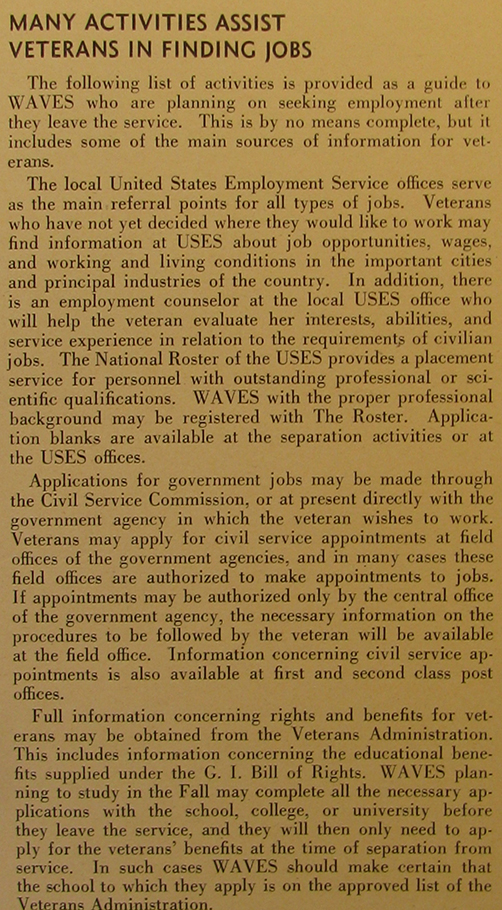
By April of 1946, most WAVES had been – or were being – released from military duty. One thing the Navy offered in its newsletter of that month were suggestions for how the newly-unemployed women could find work. Note the reminder: that WAVES are qualified for benefits, such as educational or loans, which all veterans would receive under the G.I. Bill of Rights.
This clipping comes from The Arthur and Elizabeth Schlesinger Library on the History of Women in America at the Radcliffe Institute for Advanced Study, Harvard University.
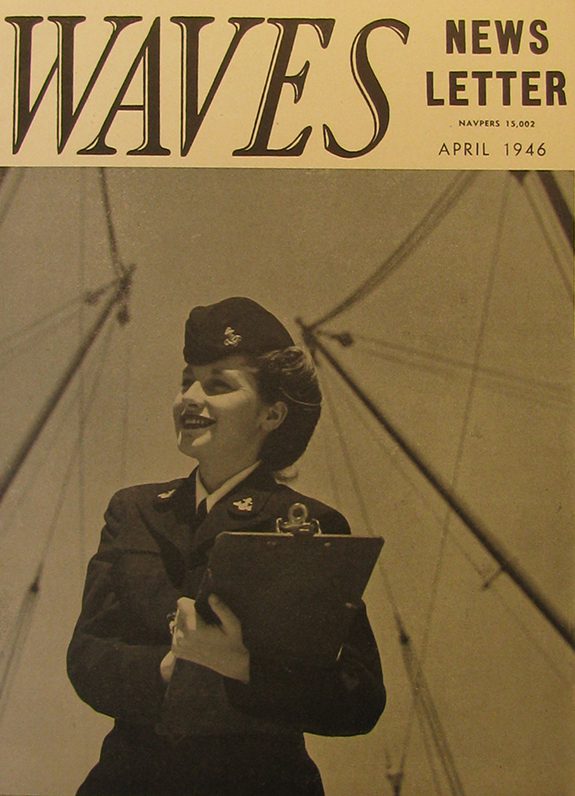
This is the second-to-last edition of the WAVES newsletter. The WAVE on the cover is wearing the dress blue uniform and the “overseas” regulation uniform hat.
The newsletter comes from The Arthur and Elizabeth Schlesinger Library on the History of Women in America at the Radcliffe Institute for Advanced Study, Harvard University.
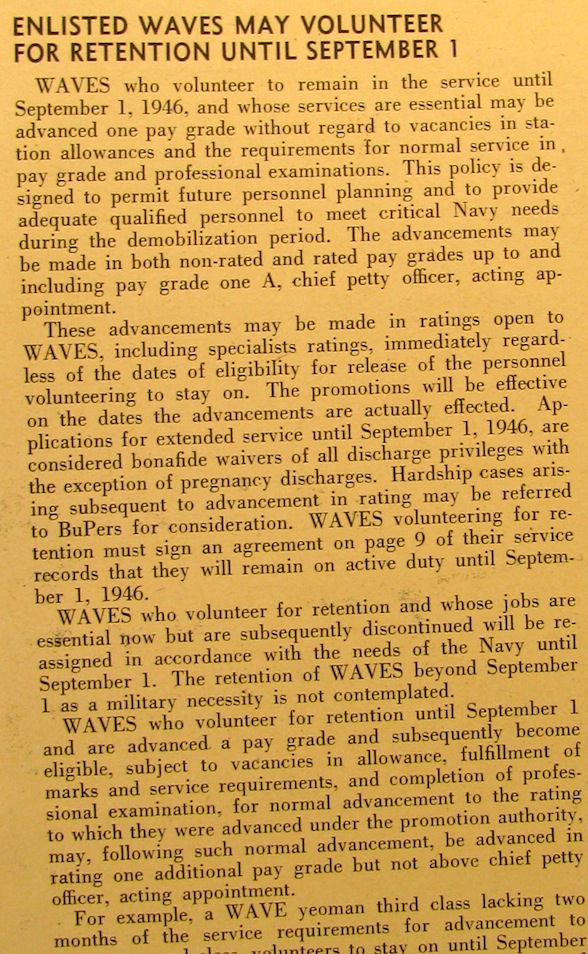
As the Navy was releasing women from service, it realized that it needed some women who qualified for discharge to remain in the Navy. So it created temporary volunteer assignments which would extend the women’s service beyond the initial “duration of the war plus six months” promised by Navy recruitment materials earlier in the war.
This clipping comes from The Arthur and Elizabeth Schlesinger Library on the History of Women in America at the Radcliffe Institute for Advanced Study, Harvard University.
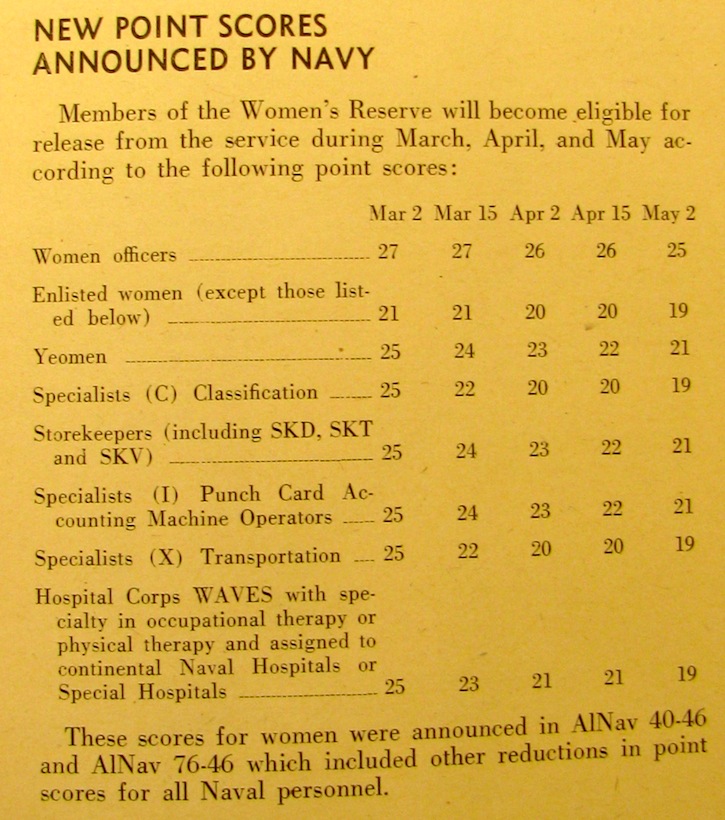
This clipping from a WAVES newsletter shows the point system the Navy was following to release women from the WAVES. Note that women officers and selected enlisted positions such as yeomen, storekeepers and the hospital corps had a higher point total they would need to gather to qualify for separation than other enlisted women.
It comes from The Arthur and Elizabeth Schlesinger Library on the History of Women in America at the Radcliffe Institute for Advanced Study, Harvard University.
 Hinges of History