The Advisory Council

Virginia Gildersleeve, Dean of Barnard College in New York, began working outside the Navy to lobby for women’s participation. She set up the Women’s Advisory Council, a group of fellow women who were leaders in education. They would continue their work during the war even after the WAVES were established, acting as a public relations outreach tool for the Navy.
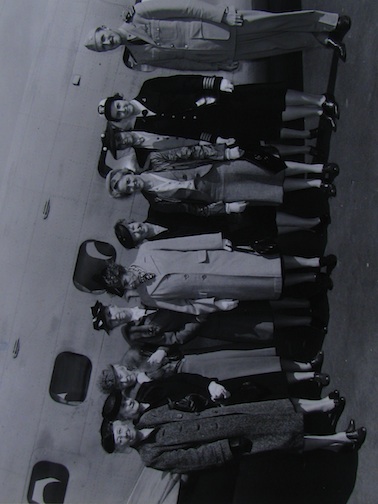
This is a photograph of the Advisory Council c. 1944. It shows, l-r:  Miss Alice Baldwin, Dean of undergraduate college for women, Duke University; Emma Barton Brewser Gates, University of Pennsylvania Women’s Club (and wife of Penn’s President Thomas S. Gates); Miss Meta Glass, president of Sweet Briar College; Mrs. Wallace Notestein (Notestein was a professor at Yale); Miss Virginia Gildersleeve, Ethel Gladys Graham, wife of UCLA political science professor Malbone Graham, Congresswoman Margaret Chase Smith; Miss Alice Lloyd, dean of women at the University of Michigan; Mildred McAfee; and Lt. Cmdr. Philip A. Tague Jr.  It comes from the National Archives.
“Yes They Are”

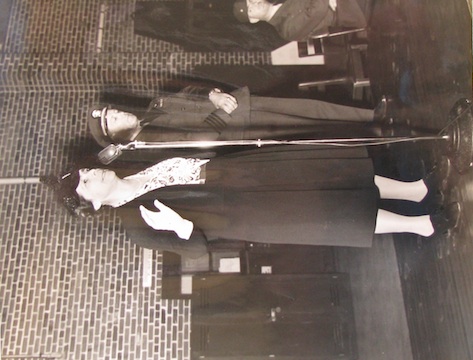
Virginia Gildersleeve, Dean of the all-women’s Barnard College in New York, believed that it was a duty for women to participate in helping the war effort. After the Pearl Harbor attack, she spoke to students at Barnard College about the opportunities women might have:

Are they really going to use women for ‘trained personnel’?  Yes, they are.  They have begun to realize that the ‘man power’ of the country includes also the woman power, and that the government and industry will be forced to use women for nearly every kind of work except the front-line military and naval fighting.

This photograph comes from the Schlesinger Library, Radcliffe Institute for Advanced Studies.

Virginia Gildersleeve

As the rumblings of World War II began in Europe, women in the U.S. began laying the groundwork for women to serve in the military here. Joy Bright Hancock began doing some of that work within the Navy, in her role as a civilian for the Naval Bureau of Aeronautics.

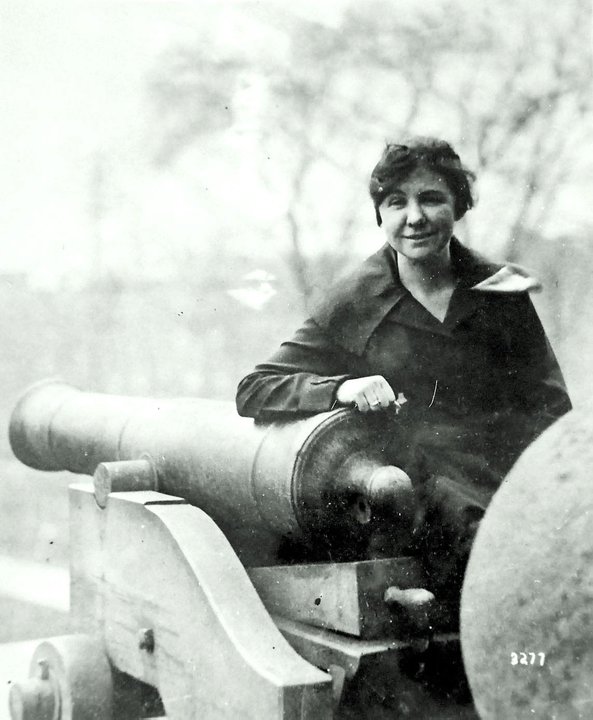
But other women also lobbied for for women’s military service. Virginia Gildersleeve was the Dean of Barnard College in New York. She wrote at the time:

It seemed as if Hitler were about to plunge Europe into war and I, having just returned from abroad, was profoundly distressed.  I felt that we ought to do something about it.  I was intensely interested in this problem … and the enormous contribution that women might make.

This photograph comes from the Schlesinger Library, Radcliffe Institute for Advanced Studies.

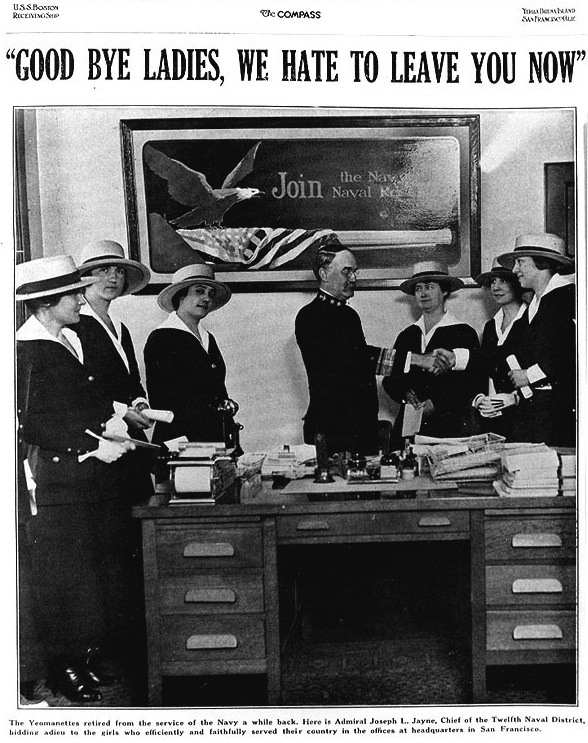
The End of the Yeomanettes

The Yeoman (F) served through the end of World War I and all were released for active duty by July of 1919. Many of the women were later appointed to Civil Service positions as civilians and continued their work with the Navy.

These women served in the 12th Naval District offices in San Francisco – it comes from the Naval publication The Compass, the district newsletter. The headline attests to the quality of the work of the Yeomanettes.

This photograph comes from the Naval History and Heritage Command.

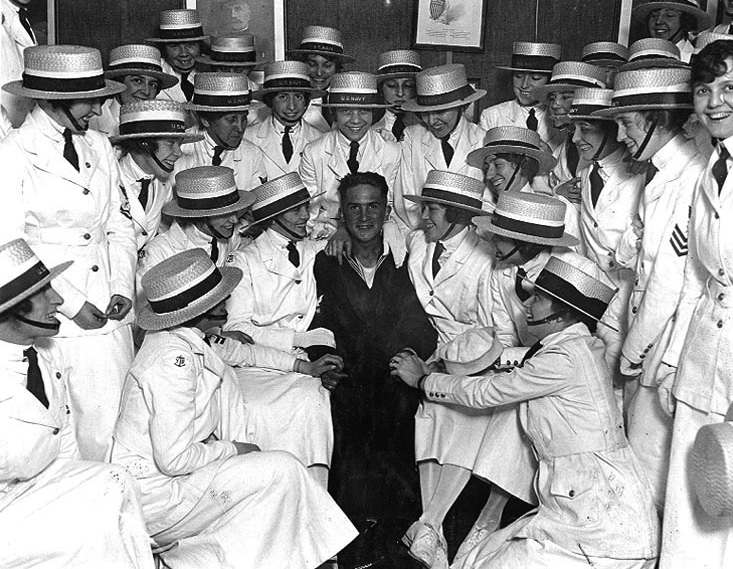
Recruitment Drives, Part II

These Yeomanettes participated in the Victory Loan drive in New York City on May 8, 1919. They are surrounding a sailor at an event sponsored by the League of Catholic Women at the Cardinal Farley Club, New York City.

The Yeoman (F) at the front has a shoulder patch with an anchor and the initials “Y” and “B”.

This photograph comes from the Naval History and Heritage Command.

Recruitment Drives

The Yeoman (F) not only worked alongside men in the Navy – the Navy found that they were also useful to help in Naval recruitment.

These women participated in the Victory Loan drive in New York City on May 8, 1919. They were instrumental in putting the drive “over the top” – i.e. earning more than the targeted goal. The structure the women are standing upon (and around) was built to look like a battleship’s superstructure. It also has two Howard Chandler Christy recruiting posters: “I Want You for the Navy” and “Gee!! I Wish I Were a Man”.

This photograph comes from the Naval History and Heritage Command.

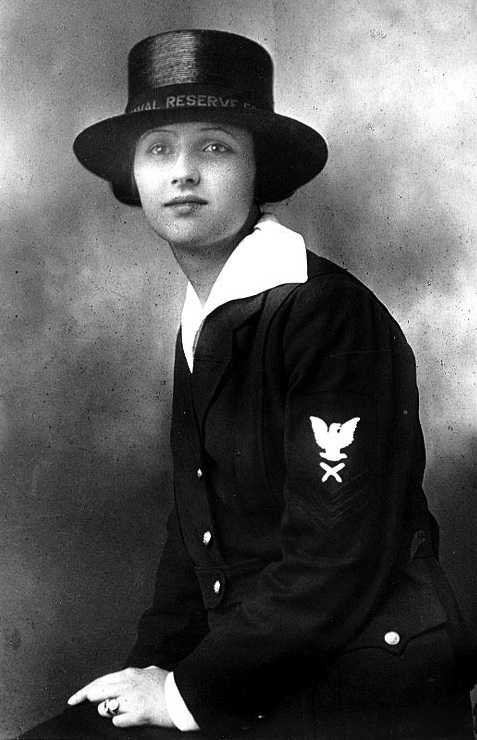
Joy Bright Hancock

One of the women who served as a Yeoman (F) was Joy Bright Hancock.  Hancock enlisted and was assigned to serve in the  the Office of the Naval Superintendent of Construction, New York Shipbuilding Corporation, Camden, New Jersey. She actually lived at home with her parents and commuted to the office during the war!

After World War I, Hancock remained with the Navy as a civilian, working in the Bureau of Aeronautics. She reenlisted during World War II as a WAVE officer, and would later become WAVES Director. She retired from the Navy in 1953, and died in 1986.

This photograph comes from the Naval History and Heritage Command.

On Inspection

The Yeoman (F) marked a new era for the Navy. Women were working alongside men, albeit because of a loophole in the Naval Reserve Act of 1916, which never said that Naval service was limited to men. Most of the women served in the Washington, DC, area, but they were ultimately stationed in bases across the country, as well as overseas in Puerto Rico, Guam, Hawaii and the Panama Canal Zone. Five women were sent to France with Naval Hospital Units.

This photograph, circa 1918, shows Yeomen (F) being inspected by Rear Admiral Victor Blue (left center), Chief of the Bureau of Navigation, on the Washington Monument grounds. It comes from the Naval History and Heritage Command.

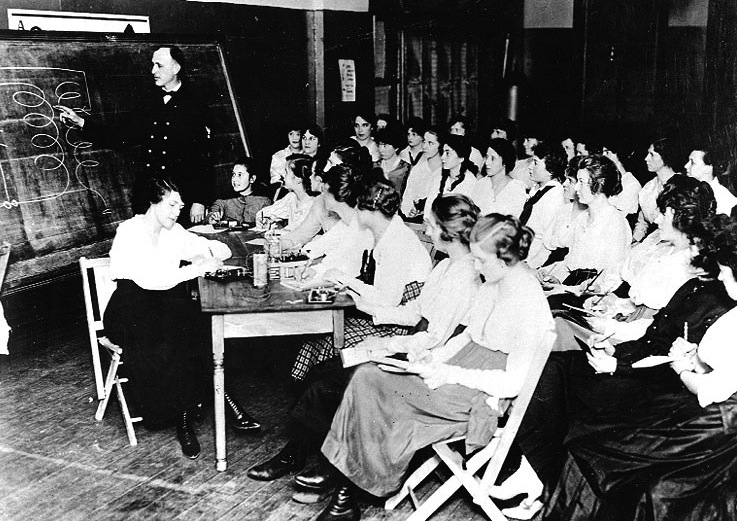
The Telegraph

The Yeomenettes greatly expanded the opportunities for women in the Navy.  One job the women learned was telegraphy, using a telegraph to send messages via wires over long distances using Morse Code. The Morse telegraph was invented in the United States in 1936, and by 1861, telegraph cables stretched not only across the United States but also under the Atlantic Ocean to Europe.

In this photograph, new enlistees receive training in telegraphy from a Chief Petty Officer, at the Naval Training Center, Great Lakes, Illinois, in 1917. Some of these women are in uniform while others are still wearing civilian attire.

It comes courtesy of the Naval History Heritage and Command.

The First Yeoman (F)

When looking at the history of the WAVES, and Navy women’s firsts during Women’s History Month, one can’t ignore the contributions of the World War I Yeomen (F). The Yeomenettes (as they were known) were the first women to serve in the Navy in a position other than nursing. They did a wide variety of work in the Navy, from clerical jobs to translations to fingerprinting and ship camouflage design.They were allowed in because of a loophole in the Naval Act, which never indicated that Naval service was limited to men.

Loretta Perfectus Walsh was the very first Yeomanette. She enlisted on March 17, 1917 at age 18. She became the first woman Navy Petty Officer on March 21st of the same year.

About 13,000 women were WWI Yeomanettes.

This photograph comes from the Library of Congress.