Aboard the Red Rover

During the Civil War, the the USS Red Rover. a hospital ship based in the Mississippi River, became the first Navy vessel to have women on board. The Catholic Sisters of the Holy Cross served as nurses aboard the ship.

This engraving from Harper’s Bazaar shows  a sister nurse attending a patient bedside in one of the wards. It comes from the U.S. Naval History and Heritage Command.

The First Shipboard Women

By the Civil War, the U.S. Navy realized that it would need help from women. And since nursing was an accepted profession for women, the Navy decided that women could serve aboard ships as an experiment.

But not just any women. Nuns. Specifically the Catholic Sisters of the Holy Cross, who served in aboard the pioneer Naval hospital ship the USS Red Rover.  The ship was based in the Mississippi River.

This engraving from Harper’s Bazaar shows at left a sister nurse attending a patient bedside. It comes from the U.S. Naval History and Heritage Command.

The Mystery of Lucy Brewer

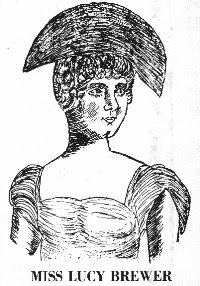
While Deborah Samson is a historically verifiable person, somewhat more mysterious is Lucy Brewer. According to legend, she enlisted in the Marines during the War of 1812, dressed as a man. She was reportedly based onboard the USS Constitution and participated in at least three dramatic sea battles as an expert marksman(woman?).

Brewer later published an autobiographical account of her “experiences.” The Marine Corps regards Brewer’s story as false, because the close living quarters aboard a ship would have made it near impossible to maintain the ruse.

But true or not she does weave a good tale.

This image is from the Marine Corps Web Log.

Who Was First?

Prior to World War II, women weren’t officially allowed in military services (except for nursing, which we’ll talk about in an upcoming blog). That doesn’t mean they didn’t serve. There are stories of women disguising themselves as men in order to serve as early as the Revolutionary War.

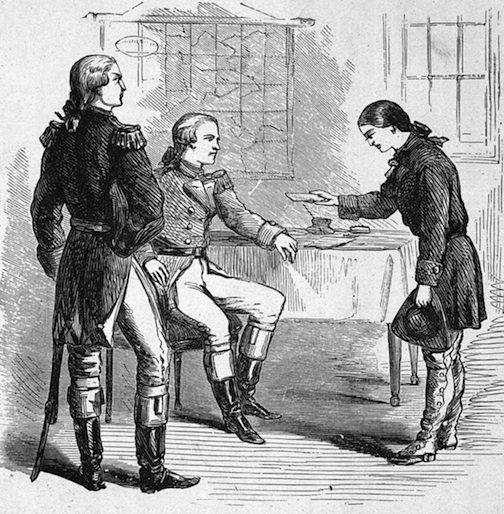
Deborah Samson was one of those women. She dressed up as a young man and volunteered to serve in the American Army in 1778. Samson, now known as Robert Shurtleff (or Shirtliff), served for three years and was wounded twice But she went undetected until she became sick with a fever. After that, she received an honorable discharge and eventually received a military pension.

The Leader Resigns

Mildred McAfee would lead the WAVES until August of 1945. During that time, she amassed some pretty impressive military firsts:

  • First female line officer in the Navy (1942)
  • First WAVES Director (1942-1945)
  • First female Navy Captain (1944)
  • Recipient of the Distinguished Service Medal

After she resigned as Director of the WAVES, McAfee would remain active duty until February of 1946.

McAfee met and married the Reverend Dr. Douglas Horton while in the Navy and changed her name to Mildred McAfee Horton. After she left the WAVES, she would first return to the Presidency of Wellesley College, where she would remain until 1948. After she left Wellesely, she became involved with the General Council of Congregational Christian Churches. McAfee also served as a UNESCO delegate, was on the board of directors of the New York Life Insurance Company, the National Broadcasting Company, Radio Corporation of America, and the Ford Foundation’s Fund for the Advancement of Education. She later co-chaired the National Women’s Conference on Civil Rights.

This photograph comes from the Naval Historical Center.

Mildred McAfee

Mildred McAfee attended Vassar College in New York, where she studied economics, sociology and English. She was also active in team sports (hockey and basketball), the Christian association, and student government. She earned an M.A. in sociology from the University of Chicago.

McAfee spent 14 years working in various collegiate administration positions (including Dean of College Women at Oberlin College) before being selected as President of Wellesley College in 1936. She beat out 100 other candidates for the job. She was just 36 years old.

She told Wellesley students:

I envision the function of this college, or any college, to prepare an oncoming generation of students to disseminate truth. It is my conviction that truth is more easily given a hearing if it’s presented by a healthy, well-adjusted, effective human being who see truth in the light of a word philosophy that gives it meaning.

McAfee wasn’t the first female president of Wellesley (that would be Ada Howard, who was also the first president of the school.)

This photograph shows Mildred McAfee (left) with Rear Admiral A. E. Watson and Margaret Disert in August of 1942. It comes from the Naval Historical Center.
Women’s History Month!

March is Women’s History Month, and we decided that our blog a day will feature firsts or other accomplishments by the WAVES.  Please let us know if there’s something you’d like to know more about, or would like to see featured this month.

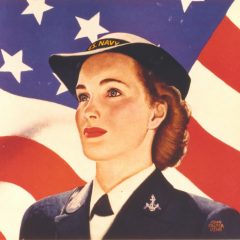
We begin with Mildred McAfee. She’s a pretty special woman to the WAVES we’ve talked with on this project. She was the leader of the WAVES for most of World War II.

McAfee was the daughter of a pastor and the President of Wellesley College before being asked to lead the WAVES. She said at the time that the Navy brass told her:

The Navy is going to admit women into the regular positions in the Navy. There’s not going to be any separateness about this. You’re going to be really in the Navy. That sounded very good to me and I used it all the rest of the way through the war.

McAfee was the first Navy female line officer in 1942 and was appointed a Navy Captain in late 1943 – the only WAVE Captain at the time.

We salute Ms. Mac!

This photograph comes from the Naval Historical Center.

A Strange Sight

One of the first things Frances Wills Thorpe did as an officer was to visit a Navy ship docked in Brooklyn. There she became acutely aware of her status as something unusual, as she recalled in her memoirs:

I became aware of a brown face, staring, wide-eyed from the galley opening.  I tried to appear casual as I smiled lightly in his direction.  The face disappeared and another brown one took its place immediately, equally wide-eyed.  Seconds later, it seemed, the soup was brought to the table.  The steward who had seen us first, came to me.  Nellie smiled at me, obviously trying to hold onto her dignity because she recognized that I was beginning to be embarrassed.  I thought that any moment she would fall into giggle but both she and Anna watched and waited demurely until the steward crossed to their side, as this were the expected way to be served. Only after I passed the third serving plate did I realize how I had almost missed a reaction which I would soon become accustomed to see in various places, with different people. It was the first time that these stewards (the only job available for many years for Afro-Americans in the Navy) had seen a person of color in officer’s uniform.  It may well have been the first time they had seen WAVES of any color since they had just returned from duty.

When asked, near the end of our training, to state a preferred location for assignment, I had written ‘East or West Coast.’ After I had completed my entire Navy duty no more than forty-five minutes from where I lived and had signed on, except for three days temporary duty in the distant ports of Philadelphia and Washington, I often wondered if my Navy experience might have been altogether different had I written ‘West Coast’ first.

Frances was assigned to the Hunter College boot camp for the duration of the war. This photograph comes from the National Archives.

“A Happy Smile”

Officer’s training was tough for Frances Wills Thorpe. Since she had started after the other women, she needed to work doubly hard to catch up. The same was true for Harriet Pickens. They would be part of the last officers’ training class at Smith College, graduating just before Christmas in December of 1944.

She recalls in her memoirs graduation day:

Navy photographers were everywhere.  Harriet and I were asked to pose pushing down together to close a suitcase.  Although the photograph itself was first-rate and has been shown many times in the years since that day it was entirely fictional.  By the time that the photographer approached and described the shot he wanted, both Harriet and I had long since stowed away all our gear and were waiting with the same undisguised eagerness as all of our classmates for train time.  It was not difficult to smile a happy smile.

This photograph comes from the National Archives.

Wills at Smith College

Frances Wills Thorpe arrived at Smith College in October of 1944. Classes had already begun for the group of officers. She and fellow African American trainee Harriet Pickens trailed the other recruits.

The first evening was disorienting, as Frances recalled in her memoirs:

We had hardly any time to wait in the brisk November weather before a young WAVES office appeared, greeted us and led us to a station wagon parked nearby.  We were driven forthwith to the uniform supply depot — only weeks later would we learn that this operation was under the famous Filene’s Department store of Boston.  We were measured for uniforms, raincoat and dress coat, but when we finally emerged from the ministrations of the fitters we were changed in appearance only by the brand new Navy blue hats which marked us unmistakably as Navy property.  Collected anew by our Navy escort and ushered back into the van, we were driven to the mess hall which was within hiking distance of the dormitory and only about a fifteen minute ride from Filene’s.  (These vital facts we learned within a few days.)

Dinner was already in progress when we were brought to the wide entrance of what appeared to be a ballroom fitted with dining tables.  Our escort pointed out two vacant seats which seemed to be in the exact center of the room — about a mile away.  At that moment all those women in uniform looked exactly alike and from another planet:  two brown-skinned women, one a head taller and a little darker than the other, in city suits and Navy hats.  Next day I realized that we were seated according to our room locations in the dormitory.  We also marched approximately in this order when we went from living quarters to classes or meals.  “Approximately” because we were expected, while in formation, to be more or less in size places.  After that first strange afternoon and evening Harriet and I never found ourselves marching or walking side by side.  She was several inches taller than I.

This photograph of Frances and Harriet dining comes from the National Archives.