Meeting Eleanor Roosevelt

Dorothy Turnbull joined the WAVES in 1943. She headed to boot camp at Hunter College and was selected to become a recruiter. Because of her connections in New Orleans, they wanted her to be stationed there. But when she finished boot camp there weren’t any openings, so she spent another eight weeks at Hunter making sure the new boots didn’t get into trouble as part of the Shore Patrol. She also helped out with visiting dignitaries.

Eleanor Roosevelt came to visit us when I was on Shore Patrol. Well, ship service is what they called us.  And here she is getting out and I think I might have been one of these.  My claim to fame is when she was going into the building from getting out here and going down here, I held the door for her (laughs).  With my backside as I’m (laughs).  That was my claim to fame.

This photograph comes from the collection of Dorothy Turnbull Stewart.

To New York

It was in 1943 when Dorothy Turnbull headed to boot camp at Hunter College. While she was there, they tried to discover what she could do in the Navy.

They interviewed you and tested you and did all of this with us.  And marched around, and I enjoyed that. So as I would be interviewed, I realized I couldn’t say I wanted, I was – I was good in numbers, but I sure didn’t want to go to bookkeeping or storekeeping, or whatever they called it.  I couldn’t imagine myself as selling anything or that storekeeping, you see (laughs). That’s what I thought it was.  All I could do was talk and tell them about things I believed in.  So they decided that that’s all I could do, and that’s what a recruiter does.

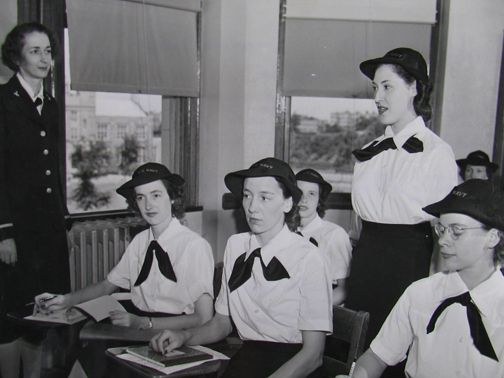
This photograph of Dorothy’s boot class comes from the collection of Dorothy Turnbull Stewart.

The Boot Camp Experience

Part of the Hunter College boot camp experience for the young WAVES was learning what it mean to be in the Navy. And that meant restrictions, as WAVE Virginia Gillmore remembered:

The hard adjustment was the way they treated a few people.  One of the really hard things was the fact that if we kept our hair off our collar that was the requirement.  And that if you did your hair up, your long hair up and kept it off your collar you’d be ok.  But one cold morning they mustered us outside our apartment house outside in the street — that means they lined us all up — or we lined up.  And they went behind all the girls with long hair and they pulled their bobbie pins or whatever was holding their hair up out and let their hair fall down, and then took scissors and clipped their hair off.  And these girls had been told they wouldn’t have to have their hair cut.  There was almost mutiny that morning.  None of us thought it was fair. Because the regulation was just keep your hair up off your collar.  But we all kept quiet.  So it was a little fear that I didn’t think was entire necessary in our training.  But I suppose we all have to go through something.

All in all, boot camp was a good, positive experience.  We felt lots of support from the instructors, as a whole group.  But we did have to toe the line.

This photograph comes from the National Archives.

Learning the Ropes

The last photo in the essay following one woman, Maria Ramona Espinosa, through boot camp at Hunter College shows the WAVES’ classroom activities.

The caption reads:

Maria Ramona Espinosa recites in one of the classes which occupy a large part of her time at the training school.

The photograph comes from the National Archives. It dates from September 1943.

Getting the Uniform

The second image in the photo essay of Maria Ramona Espinosa at boot camp at Hunter College followed as she was fitted for her Navy uniform.

The caption reads:

Apprentice Seaman Esponosa, her hair done up in regulation style, has her first uniform fitted.

The photograph comes from the National Archives. It dates from September 1943.

A Girl Joins the Navy

Part of the WAVES recruitment efforts were to show the experiences of women in the Navy, and boot camp was no exception. This photo essay followed one woman, Maria Ramona Espinosa, through boot camp at Hunter College.

In this photo, she arrives at the gate of the Navy facility, dressed in her civilian clothes. The caption reads:

Maria Ramona Espinosa goes thru some of the steps necessary to become a WAVE at Hunter College, Bronx, N.Y. Arriving at school she gets her first directions from a Shore Patrolman at the gate.

The photograph comes from the National Archives. It dates from September 1943.

The Map

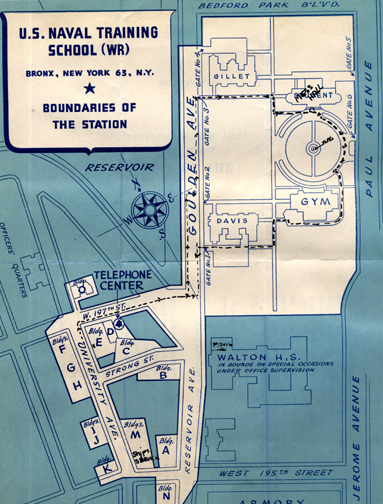
When women were stationed at the Hunter College boot camp, they received a map as part of their orientation packet. The map showed where the key buildings were, and included the surrounding apartment buildings.

This copy of the map comes from the collection of WAVE Margaret Anderson Thorngate. It shows the path she would take from the building where her quarters were located (Building D, a former apartment complex) to the Mess Hall, where meals were served.

Hunter College: Living Quarters

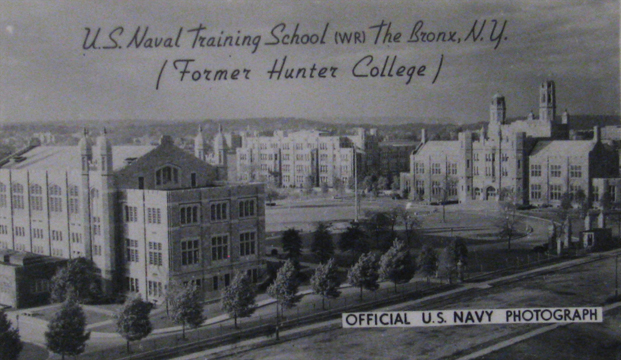
Hunter College was primarily a commuter college; there weren’t any dorms on the campus grounds. The Navy needed housing for 8,000-10,000 women at a time (plus instructors), so it turned to the Bronx neighborhood for help. Apartments surrounding the campus were commandeered by the Navy for the duration of the war.

An article in the New York Times talked about this development:

While … merchants on Kingsbridge Road, the nearest shopping center, all claimed their businesses would suffer, none complained.  Businessman Max Steubens, who ran a self-serve market, depended on the 13 apartments for most of his business, but when interviewed said, “I’m more than willing to do my share toward the war effort” (1.13.43) A few days after this, complaints arose because nearby apartments were raising rent for the occasion. The situation was investigated and The New York Times made sure to note that, “The complaints they received were logical and natural and not at all unpatriotic” (1.14.43)

This photograph comes from a postcard booklet designed for WAVES recruits to send it home to their parents, families and friends. It shows the converted apartments, where women lived 8-10 to a one bedroom unit.  It is from the Betty H. Carter Women Veterans Historical Project at the University of North Carolina Greensboro.
Hunter College: History

Hunter College was established in 1870 as part of New York City’s public university system. It was located on the Upper East Side of New York City. The Bronx campus (now known as Lehman College) first opened in the 1930s; by this time Hunter had locations in Brooklyn, Queens and Staten Island as well.

The Bronx campus remained under Navy jurisdiction until 1945. Then it briefly housed the United Nations, before being returned to the Hunter College system in 1946.

Hunter was the women’s college of the system through the 1950s. The Bronx campus was one of the first to go co-educational, and the entire system allowed women by 1964, The Bronx campus was renamed Lehman College in 1968.

This photograph comes from a postcard booklet designed for WAVES recruits to send it home to their parents, families and friends. It shows the Hunter College training station.  It is from the Betty H. Carter Women Veterans Historical Project at the University of North Carolina Greensboro.