Permanent Status

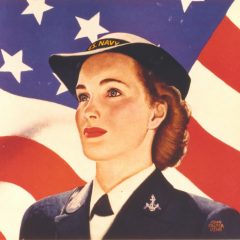
The Women’s Armed Services Integration Act of 1948 gave women a permanent role in the military. The WAVES went from being a wartime reserve to an actual branch of the Navy.

The Women in Military Service for America Memorial describes the limitations of the Act:

The act placed a two percent ceiling on the number of women in each of the services, restricted promotions to one full colonel or Navy captain as Chief of the Nurse Corps and/or Service Director, and limited the number of female officers who could serve as lieutenant colonels or Navy commanders. The law also granted the service Secretaries authority to discharge women without specified cause and restricted women from flying aircraft engaged in combat and from being assigned to ships engaged in combat.

Nonetheless, it was a start. Some of the World War II WAVES converted to the new permanent division.

This photograph shows the first six women being sworn into the regular U.S. Navy. It comes from the Naval History and Heritage Command.
The End of the Yeomanettes

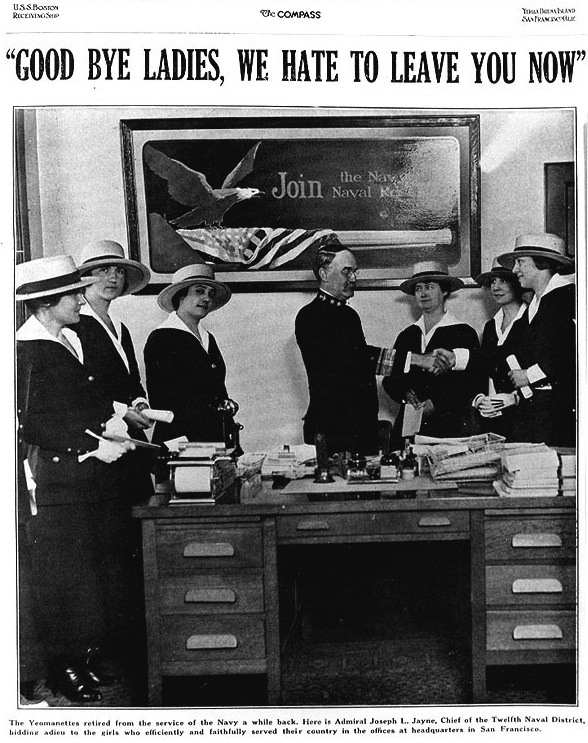
The Yeoman (F) served through the end of World War I and all were released for active duty by July of 1919. Many of the women were later appointed to Civil Service positions as civilians and continued their work with the Navy.

These women served in the 12th Naval District offices in San Francisco – it comes from the Naval publication The Compass, the district newsletter. The headline attests to the quality of the work of the Yeomanettes.

This photograph comes from the Naval History and Heritage Command.

Recruitment Drives, Part II

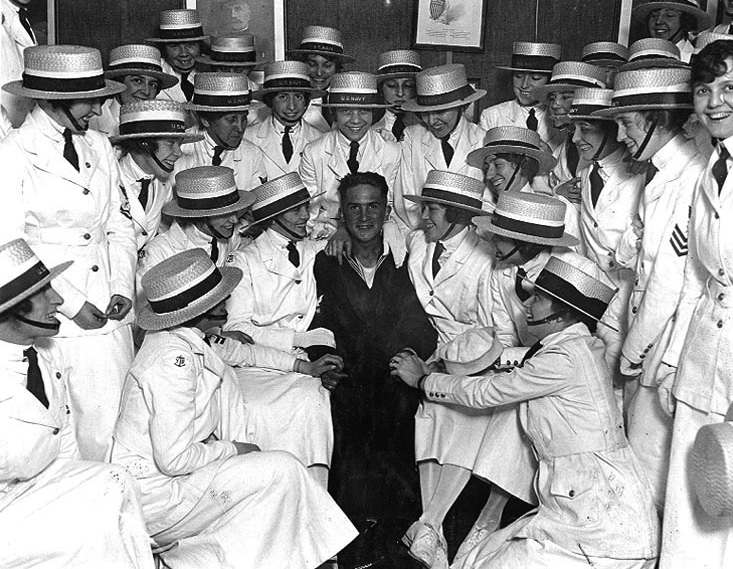
These Yeomanettes participated in the Victory Loan drive in New York City on May 8, 1919. They are surrounding a sailor at an event sponsored by the League of Catholic Women at the Cardinal Farley Club, New York City.

The Yeoman (F) at the front has a shoulder patch with an anchor and the initials “Y” and “B”.

This photograph comes from the Naval History and Heritage Command.
Recruitment Drives

The Yeoman (F) not only worked alongside men in the Navy – the Navy found that they were also useful to help in Naval recruitment.

These women participated in the Victory Loan drive in New York City on May 8, 1919. They were instrumental in putting the drive “over the top” – i.e. earning more than the targeted goal. The structure the women are standing upon (and around) was built to look like a battleship’s superstructure. It also has two Howard Chandler Christy recruiting posters: “I Want You for the Navy” and “Gee!! I Wish I Were a Man”.

This photograph comes from the Naval History and Heritage Command.

Joy Bright Hancock

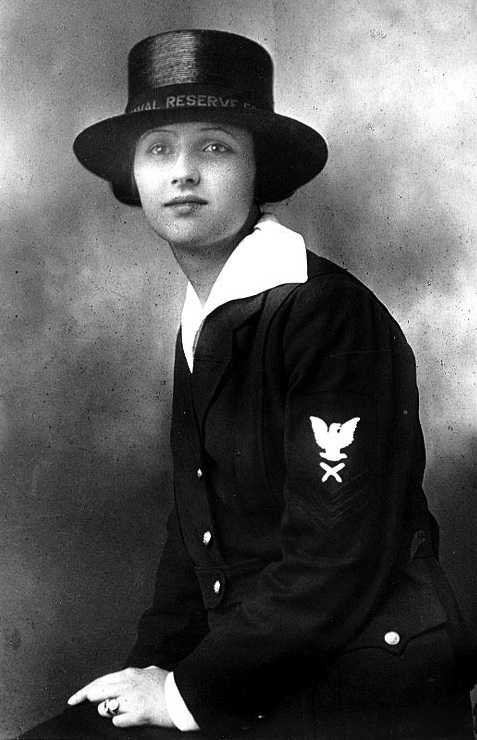
One of the women who served as a Yeoman (F) was Joy Bright Hancock.  Hancock enlisted and was assigned to serve in the  the Office of the Naval Superintendent of Construction, New York Shipbuilding Corporation, Camden, New Jersey. She actually lived at home with her parents and commuted to the office during the war!

After World War I, Hancock remained with the Navy as a civilian, working in the Bureau of Aeronautics. She reenlisted during World War II as a WAVE officer, and would later become WAVES Director. She retired from the Navy in 1953, and died in 1986.

This photograph comes from the Naval History and Heritage Command.
On Inspection

The Yeoman (F) marked a new era for the Navy. Women were working alongside men, albeit because of a loophole in the Naval Reserve Act of 1916, which never said that Naval service was limited to men. Most of the women served in the Washington, DC, area, but they were ultimately stationed in bases across the country, as well as overseas in Puerto Rico, Guam, Hawaii and the Panama Canal Zone. Five women were sent to France with Naval Hospital Units.

This photograph, circa 1918, shows Yeomen (F) being inspected by Rear Admiral Victor Blue (left center), Chief of the Bureau of Navigation, on the Washington Monument grounds. It comes from the Naval History and Heritage Command.
The Telegraph

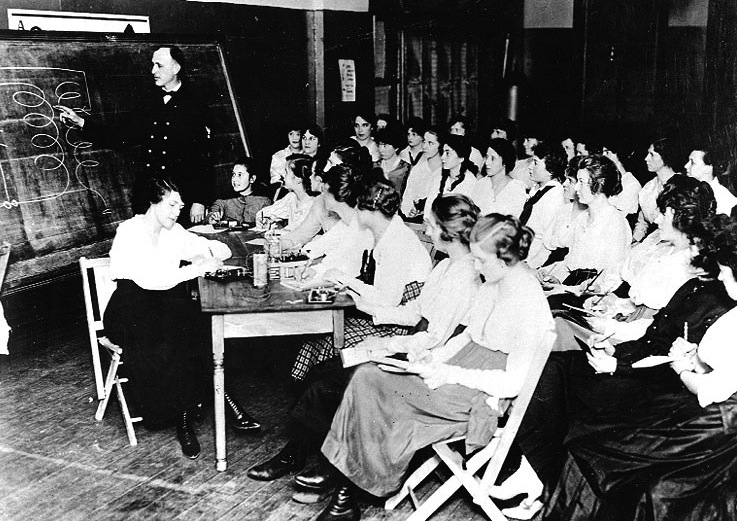
The Yeomenettes greatly expanded the opportunities for women in the Navy.  One job the women learned was telegraphy, using a telegraph to send messages via wires over long distances using Morse Code. The Morse telegraph was invented in the United States in 1936, and by 1861, telegraph cables stretched not only across the United States but also under the Atlantic Ocean to Europe.

In this photograph, new enlistees receive training in telegraphy from a Chief Petty Officer, at the Naval Training Center, Great Lakes, Illinois, in 1917. Some of these women are in uniform while others are still wearing civilian attire.

It comes courtesy of the Naval History Heritage and Command.

The First Yeoman (F)

When looking at the history of the WAVES, and Navy women’s firsts during Women’s History Month, one can’t ignore the contributions of the World War I Yeomen (F). The Yeomenettes (as they were known) were the first women to serve in the Navy in a position other than nursing. They did a wide variety of work in the Navy, from clerical jobs to translations to fingerprinting and ship camouflage design.They were allowed in because of a loophole in the Naval Act, which never indicated that Naval service was limited to men.

Loretta Perfectus Walsh was the very first Yeomanette. She enlisted on March 17, 1917 at age 18. She became the first woman Navy Petty Officer on March 21st of the same year.

About 13,000 women were WWI Yeomanettes.

This photograph comes from the Library of Congress.

On the Front Lines

When World War I broke out in Europe in 1914, two Navy Nurses requested discharges and joined the Red Cross. There they served in the war zone, helping treat men who were injured in battles.

The women would spend a year on the front lines. In 1915, both returned to the United States and reenlisted in the Navy. Their experience was important, because it would help shape the role of women when the U.S. entered the “Great War” two years later, in 1917.

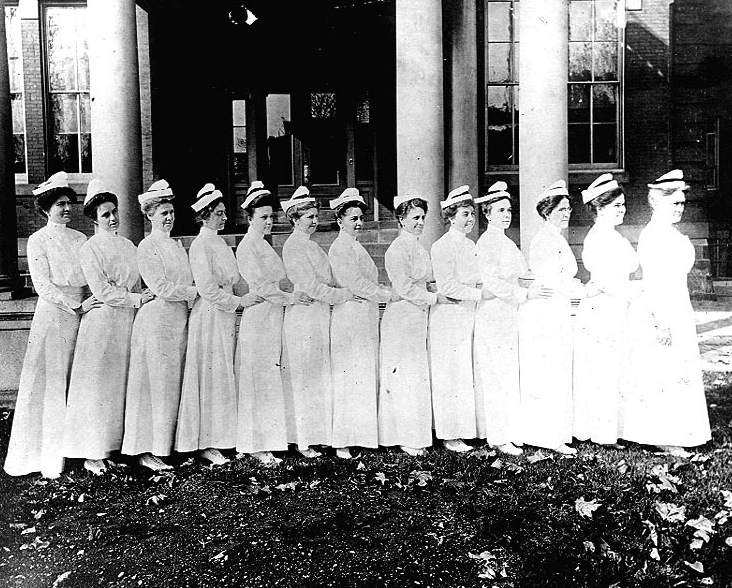
This photograph at the U.S. Naval Hospital in Norfolk, circa 1914, comes from the collection of the Naval History and Heritage Command.

Expanding the Nursing Corps

The group of nurses gradually grew from the “sacred 20,” the first group making up the Navy Nurse Corps. By the end of 1909, 37 nurses where in the Navy, scattered at stations across the continental United States.

Demand increased, and the Corps grew. By 1913, there were approximately 160 Navy Nurse Corp members. They were assigned to U.S. hospitals, but also to locations in Pearl Harbor (then a U.S. territory), the Philippine Islands, Guam, Samoa, Japan, Cuba and the Virgin Islands. For a brief time in 1913, Navy nurses served aboard ships: the USS Mayflower and the USS Dolphin.

This photograph at the U.S. Naval Hospital in Philadelphia, circa 1914, comes from the collection of the Naval History and Heritage Command.