Hup Two Three

This image holds a special spot in the hearts of the Homefront Heroines crew because both the director and producer are alum of the University of Oregon, aka the Ducks.

It comes from Marjorie Sue Green’s booklet From Recruit to Salty WAVE! The Ordeal of Seaman Green held by The Betty H. Carter Women Veterans Historical Project at the University of North Carolina Greensboro.

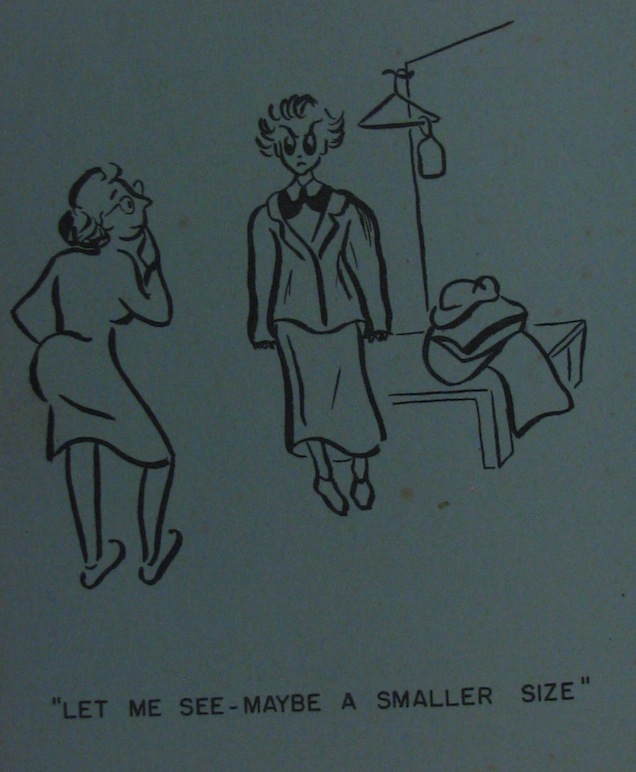
A Perfect Fit

WAVES fitters estimated the uniform size for women, and then the WAVES were expected to get their uniforms custom-tailored for a perfect fit. Tailoring was included in the stipend women received to purchase a uniform.

This image comes from Marjorie Sue Green’s booklet From Recruit to Salty WAVE! The Ordeal of Seaman Green held by The Betty H. Carter Women Veterans Historical Project at the University of North Carolina Greensboro.

To Training School

The initial Navy WAVES boot camp was at Iowa State Teacher’s College in Cedar Falls. It would be a boot camp in fall of 1942 through January 1943. In February 1943, the WAVES boot camp moved to Hunter College in the Bronx, New York.

This image comes from Marjorie Sue Green’s booklet From Recruit to Salty WAVE! The Ordeal of Seaman Green held by The Betty H. Carter Women Veterans Historical Project at the University of North Carolina Greensboro.

Seaman Green

The next step after signing the paperwork? Becoming a recruit, or seaman.

Marjorie Sue Green’s booklet From Recruit to Salty WAVE! The Ordeal of Seaman Green illustrates Green’s transformation from civilian to military.

It comes from The Betty H. Carter Women Veterans Historical Project at the University of North Carolina Greensboro.

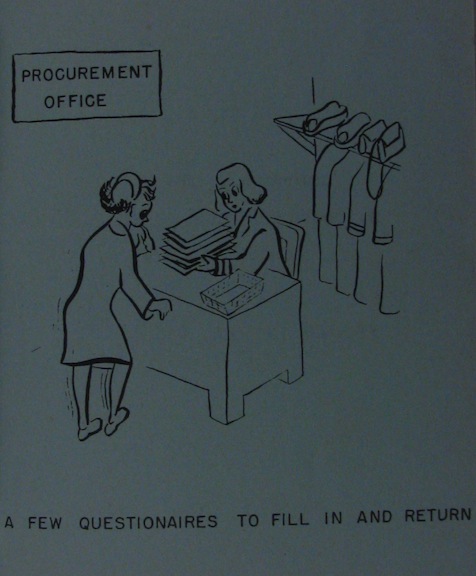
From Recruit to Salty Wave

Many WAVES wrote short books about their experiences, designed to make the transition from civilian to WAVE easier for other recruits.

Marjorie Sue Green’s booklet From Recruit to Salty WAVE! The Ordeal of Seaman Green is an example of one of those books. It’s a highly-illustrated account of Green’s transformation from civilian to military.

This is one of the first images in the book, showing the experience at the recruitment office.

It comes from The Betty H. Carter Women Veterans Historical Project at the University of North Carolina Greensboro.

“A Happy Smile”

Officer’s training was tough for Frances Wills Thorpe. Since she had started after the other women, she needed to work doubly hard to catch up. The same was true for Harriet Pickens. They would be part of the last officers’ training class at Smith College, graduating just before Christmas in December of 1944.

She recalls in her memoirs graduation day:

Navy photographers were everywhere.  Harriet and I were asked to pose pushing down together to close a suitcase.  Although the photograph itself was first-rate and has been shown many times in the years since that day it was entirely fictional.  By the time that the photographer approached and described the shot he wanted, both Harriet and I had long since stowed away all our gear and were waiting with the same undisguised eagerness as all of our classmates for train time.  It was not difficult to smile a happy smile.

This photograph comes from the National Archives.

Learning the Ropes

Jean Clark was sent to Atlanta in order to learn how to give proper instruction to potential pilots via the Link Trainer. But it wasn’t enough to simply learn how to give instruction. They had to learn everything about the trainer from top to bottom.

We also had to check the trainer. While we were at the air base, not only did we learn how to operate the trainer, we also learned how to repair it if anything went wrong.  There was an engine just outside of the building, the main, that had to be dismantled and cleaned every now and again so it was operating efficiently.  That was part of our duty.

At the end of the training session, the women received a certificate saying that they were qualified in their ranking.

This certificate comes from the Jean Clark collection.

Calisthentics

Depending upon the weather, WAVES could do their exercises either indoors or out. These WAVES are at the Naval Training School for Advanced Machinist’s Mates in Norman, Oklahoma. They’re working on a field outdoors (note the jumpsuits they’re wearing for their exercise).

But a cold winter day could drive the WAVES indoors. Jeanette Shaffer Alpaugh remembers being at training camp in Cedar Falls working one day inside in the gymnasium.

We were four abreast, one bunch of four after the other. The officer is charge was, somebody came to the door and called her over. She didn’t say “halt.” So we were marching ahead and this person kept talking to her. Now, we didn’t really know this. Anyway, I was in the second group of four,  We come to the end of the gymnasium and she hadn’t said, “halt” or “squad left” or right or anything.  And so there were stall bars at the end of the gymnasium.  I don’t know how this first group of four — I don’t think I would have thought of it, but they started climbing the stall bars (climbing bars on the walls of old gyms).  So here’s four people going up stall bars. We’re the second group of four, we started going up stall bars. She turned around and there were about four groups  (laughs) up on stall bars. I think that — you know, then she says. “Halt!”  It was really funny.

The photograph comes from the National Archives.
Does She Have What it Takes?

Not just any woman could get into the WAVES.  These ladies had to make the cut and after being accepted they went through a rigorous training process before becoming active duty members or officers. WAVES had to take a placement test, a physical fitness test, and had to submit letters of recomendation among other requirements (requirements for the WAVES).

Those who were accepted and enlisted became heroic figures in their hometowns and newspaper articles were written about their recruitment.

Some women did not graduate boot camp and were sent home.  Read about “washing out,” or failure here.

But those who did make it … went on from Hunter College, Smith College, Cedar Falls or wherever they trained to members of the U.S. Navy – a whole new realm for women of their time period. The ones who made the cut became the hinges of history.


Learn more about the training process and transition to military life by visiting the “Recruits to Boots” exhibit.