Dorothy Turnbull Stewart

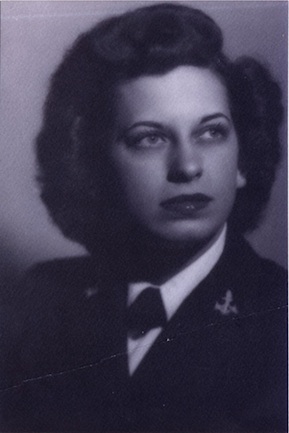
Meet Dorothy Turnbull (Stewart). Dorothy served as a WAVE during World War I. She was a recruiter based in southern Texas and she encouraged women to enlist in the WAVES during World War II.

Over the next few days, we’ll bring you Dorothy’s story, in her own words. She’s also featured in the film Homefront Heroines: The WAVES of World War II.

This is a photograph of Dorothy during her Navy career. It comes from the collection of Dorothy Turnbull Stewart.

First Officer on Ship

WAVES would continue to serve in the military through 1950s. And while enlisted WAVES were assigned to ships in 1953, it wouldn’t be until 1961 that the Navy would assign a WAVE officer to shipboard duty.

Lieutenant Charlene T. Suneson, received that honor. She reported for duty aboard the USS General W.A. Mann (AP-112).

This photograph comes from the Naval History and Heritage Command.

First Women on Ship

WAVES were allowed to go onboard ships in 1953. The women were all hospital corpsmen, meaning they were assigned to medical ward duties.

The women were (left to right): Hospital Corpsman Second Class Eileen Paluzzi, USN;  Hospital Corpsman Third Class Marie A. Myers, USN; and Hospital Corpsman Third Class Mavia Cain, USN. Louise “Billye” Wilde, the WAVES commander at the time, and Rear Admiral Clarence J. Brown, MC, USN, Deputy Surgeon General, are looking on while Vice Admiral Holloway, Jr. signs the orders.

This photograph comes from the Naval History and Heritage Command.

The Third Commander

Joy Bright Hancock, the former yeomanette, would become the third commander of the WAVES, succeeding Jean Palmer. She was appointed to her position in February of 1946, and would lead the WAVES through contractions of servicewomen in the 1940s and expansion in the 1950s.

Hancock was the WAVES leader when the women became a part of the regular Navy. She retired in 1953.

This photograph comes from the Naval History and Heritage Command.

Permanent Status

The Women’s Armed Services Integration Act of 1948 gave women a permanent role in the military. The WAVES went from being a wartime reserve to an actual branch of the Navy.

The Women in Military Service for America Memorial describes the limitations of the Act:

The act placed a two percent ceiling on the number of women in each of the services, restricted promotions to one full colonel or Navy captain as Chief of the Nurse Corps and/or Service Director, and limited the number of female officers who could serve as lieutenant colonels or Navy commanders. The law also granted the service Secretaries authority to discharge women without specified cause and restricted women from flying aircraft engaged in combat and from being assigned to ships engaged in combat.

Nonetheless, it was a start. Some of the World War II WAVES converted to the new permanent division.

This photograph shows the first six women being sworn into the regular U.S. Navy. It comes from the Naval History and Heritage Command.

W.A.V.E.S

Elizabeth Reynard is credited for being the woman who came up with the name for the WAVES. According to Virginia Gildersleeve, in her book Many a Good Crusade, the Navy wanted something that was “nautical, suitable, fool-proof, and attractive.” Reynard took up the challenge, as she wrote to Gildersleeve:

I played with those two letters [w and v] and the idea of the sea and finally came up with ‘Women Accepted for Volunteer Emergency Service’ — W.A.V.E.S. I figure the word ‘Emergency’ will comfort the older admirals, because it implies that we’re only a temporary crisis and won’t be around for keeps.

This photograph of Reynard comes from the Schlesinger Library, Radcliffe Institute for Advanced Studies.

The Luck of the Irish

We’re taking another break today from our series of military firsts. This time, we want to talk about St. Patrick’s Day.

Spunky World War II WAVE Josette Dermody was a gunner’s mate based in San Francisco during World War II. And one St. Patrick’s Day she decided to celebrate her heritage by personalizing her uniform.

Everybody was talking about how they could wear green, a green slip or something. I put on – I didn’t have a hat. I had a little tiny green hair bow.  And I was down looking for my pay and went across a quarter deck. The master at arms, who didn’t like WAVES, was chasing me and I got on the stairway and he couldn’t touch me. There were all kinds of ways of learning about rules.  (laughs) Because it was out of his domain. And I was just toodling up the stairs and some lieutenant, some middle aged, it looked like a middle aged dentist who had been drafted to to dental work or something. A perfectly innocent looking man.  But he said, “Young lady, you’re out of uniform!”  They made fusses about things like that. And I said, I just looked at him, “No sir.  It’s St. Patrick’s Day. The skipper is Irish and this is the uniform of the day” (laughs). And then I scooted upstairs.

This photograph comes from the collection of Josette Dermody Wingo.

Mary Marovich Ryan

We’re taking a break today from the Navy historical firsts for women to honor an important women to the Homefront Heroines crew.

March 8th is the birthday of the woman who inspired the Homefront Heroines project. Mary Marovich was born in Chicago on March 8th 1921. She enlisted in the WAVES in 1943 and after boot camp at Hunter College she became a Pharmacist’s Mate based at Treasure Island in San Francisco.

Mary worked as a telephone operator in Chicago before enlisting in the Navy. She followed six of her brothers into the service – four were with the Army, and two were first class petty officers in the Coast Guard (her younger brother would serve in the military in the Korean War).
Mary said before enlisting:

I’d really like to wear a six star pin (to honor her brothers), but I can’t find a story that sell them!

Mary married James Warren Ryan, an Army Air Corps pilot, while she was in the service. She left in 1945 after V-J Day and died in 1992.

Happy birthday, Mother!
The Leader Resigns

Mildred McAfee would lead the WAVES until August of 1945. During that time, she amassed some pretty impressive military firsts:

  • First female line officer in the Navy (1942)
  • First WAVES Director (1942-1945)
  • First female Navy Captain (1944)
  • Recipient of the Distinguished Service Medal

After she resigned as Director of the WAVES, McAfee would remain active duty until February of 1946.

McAfee met and married the Reverend Dr. Douglas Horton while in the Navy and changed her name to Mildred McAfee Horton. After she left the WAVES, she would first return to the Presidency of Wellesley College, where she would remain until 1948. After she left Wellesely, she became involved with the General Council of Congregational Christian Churches. McAfee also served as a UNESCO delegate, was on the board of directors of the New York Life Insurance Company, the National Broadcasting Company, Radio Corporation of America, and the Ford Foundation’s Fund for the Advancement of Education. She later co-chaired the National Women’s Conference on Civil Rights.

This photograph comes from the Naval Historical Center.

Mildred McAfee

Mildred McAfee attended Vassar College in New York, where she studied economics, sociology and English. She was also active in team sports (hockey and basketball), the Christian association, and student government. She earned an M.A. in sociology from the University of Chicago.

McAfee spent 14 years working in various collegiate administration positions (including Dean of College Women at Oberlin College) before being selected as President of Wellesley College in 1936. She beat out 100 other candidates for the job. She was just 36 years old.

She told Wellesley students:

I envision the function of this college, or any college, to prepare an oncoming generation of students to disseminate truth. It is my conviction that truth is more easily given a hearing if it’s presented by a healthy, well-adjusted, effective human being who see truth in the light of a word philosophy that gives it meaning.

McAfee wasn’t the first female president of Wellesley (that would be Ada Howard, who was also the first president of the school.)

This photograph shows Mildred McAfee (left) with Rear Admiral A. E. Watson and Margaret Disert in August of 1942. It comes from the Naval Historical Center.