Working in Paradise

WAVE Merrily Kurtz Hewett remembers being on the job in Hawaii:

 We all went to work about the same time, so it just seemed that — and you had to be in by 10.  So you had to be on the base by six, I think.  You could have company for the dances.  But it was al open air, too.  We didn’t have windows, it was just screens.  It was Hawaii. You know they talk about the bugs now.  And maybe mice or rats. And I don’t remember any of that at all. At all.
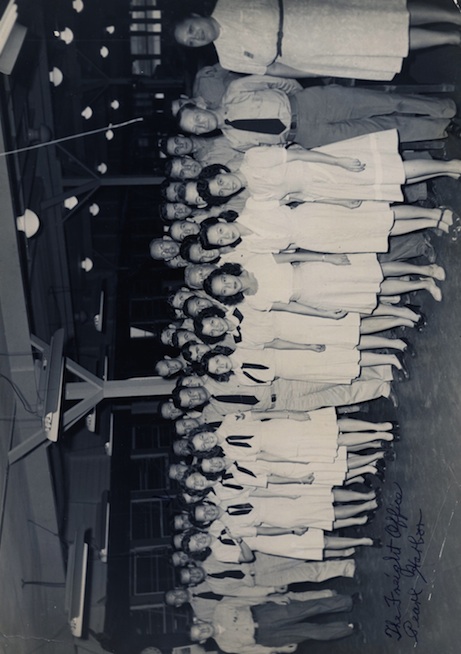
This photograph shows Merrily and her co-workers in Hawaii during World War II. It comes from the collection of Merrily Kurtz Hewett.
Top Secret Assignment

WAVE Patricia Farrington Siegner worked in an underground bunker when she was stationed in Hawaii, coding and decoding military messages:

I couldn’t tell my mother where I was.  I have, I have in these letters, I’ve got cut outs, paper dolls where the censor took stuff out.  And of course it went over once it looked like we were going to sign armistice they didn’t have so much censorship.  But I couldn’t tell her where I was. So I said, she wanted to know. And of course it would have been cut out. So I told her, “Think about your favorite fruit.” She loved pineapple (laughs). And she got it right away.  You see, it was a territory then. It was not a state, so it was different, entirely different.  Entirely different.  We were in the center of the Pacific Theater War.

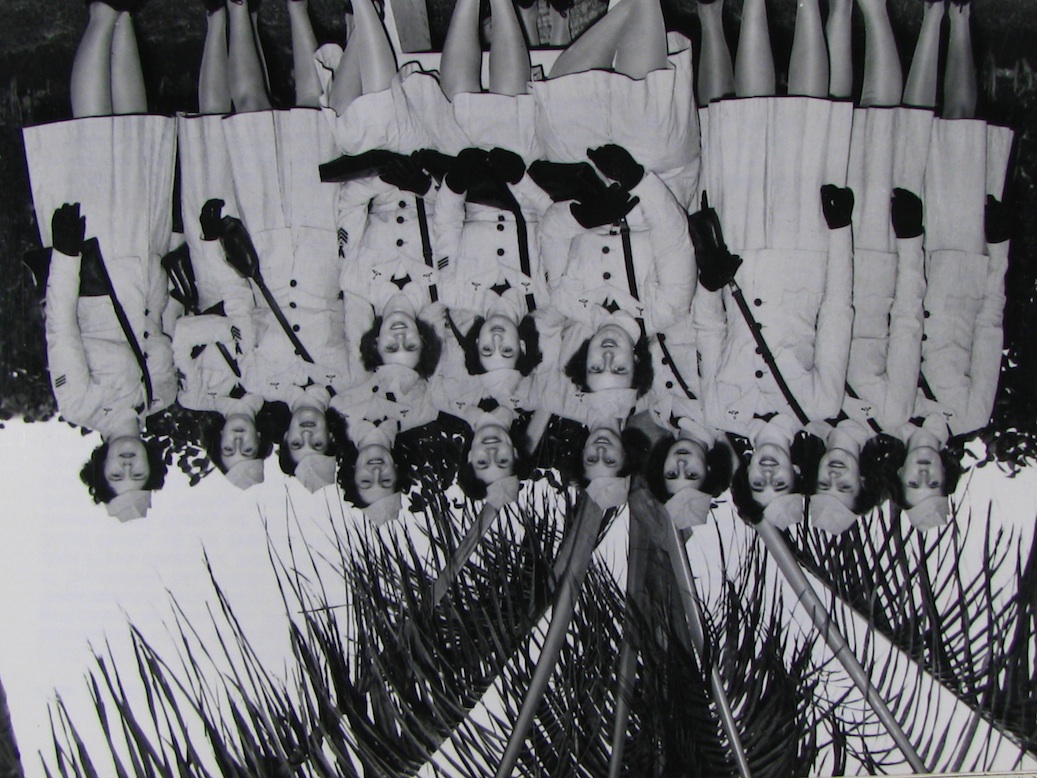
This photograph of WAVES in Hawaii comes from the National Archives.

Dinner and a Dance

WAVE Merrily Kurtz Hewett remembers evenings in Hawaii:

The fellows liked to be asked to come.  Have meals with us.  You have your friends over for a meal.  Then they’d stay and usually it would be a dance night, I guess.  I can’t remember for sure exactly how many times a week we dances.

This photo shows WAVES Rita Bergan, Mary Burke, Rosalene Brown, Helen Beegle eating in the mess hall in Hawaii. It comes from the National Archives.

Hawaii Quarters

WAVE Merrily Kurtz Hewett recalled the quarters for WAVES in Hawaii:

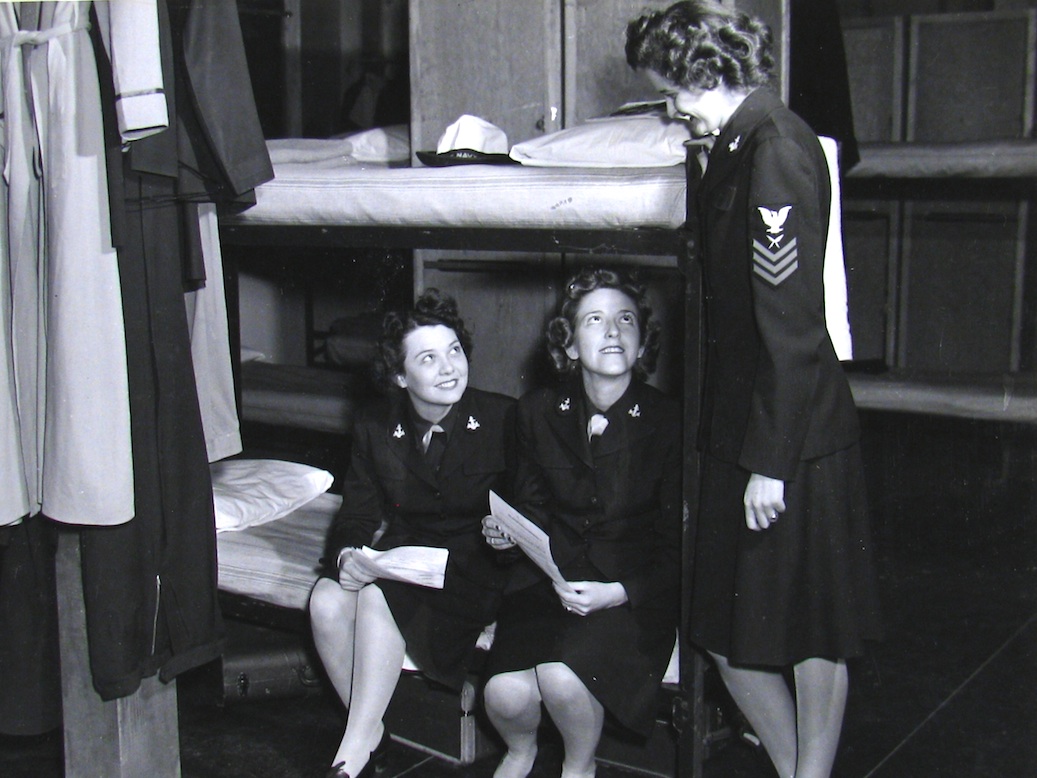
We would always have two bunks of two people each. And lockers. The Quonset huts, well you’ve seen quonset huts.  They were divided into cubicles only so far up. Then it was air.You have cubicles about so wide and you hung your uniform. And then, I guess there were drawers all the way down the side for the rest of your clothes.  I couldn’t do it now (laughs).  I have three closets full of stuff!

This photograph of WAVE bunks in Hawaii comes from the National Archives.

Unofficial Greeting

It wasn’t just the Navy officers who were happy to see the WAVES. The enlisted men were as well.

Just getting more familiar – some of those fellas had been over there three and four years and didn’t know what a woman looked like .. and of course we were pretty good lookin.’

– Merrily Kurtz Hewett, WAVE

This photograph shows the first enlisted WAVE to arrive in Hawaii, Mary Babine, being presented with the traditional lei and a welcoming kiss by sailor E.R. Baker.

Arrival!

Hawaii was a Pacific territory during World War II. But it wasn’t the manicured beaches and tourism mecca that we know today.

It was a territory, and it was laid back, you have to understand, very very primitive.  Primitive.  Kamaiamaia Highway was a dirt road and everything.

– Patricia Farrington Siegner, WAVE

This photo shows WAVES disembarking from their transport ship in January of 1945. It comes from the National Archives.

In Port!

The WAVES travelled aboard an L-S-T ship, or troop transport ship. It was mostly women aboard – the only sailors were the crew.

It was fun being aboard ship. We did zig-zag, we could see where we zig-zagged.  Didn’t need to, but taking precautions, I think.  This was early in ’44 — no later in ’44.  But anyway, a couple of the girls fell in love with the sailors. That was the disease, I think, with the women, with the sailors (laughs). Away from home. We had a good time aboard ship. We didn’t have any rough weather, I didn’t get seasick.

– Merrily Kurtz Hewett, WAVE

This photograph shows WAVES leaving their ship in Hawaii. It comes from the National Archives.