The Advisory Council

Virginia Gildersleeve, Dean of Barnard College in New York, began working outside the Navy to lobby for women’s participation. She set up the Women’s Advisory Council, a group of fellow women who were leaders in education. They would continue their work during the war even after the WAVES were established, acting as a public relations outreach tool for the Navy.
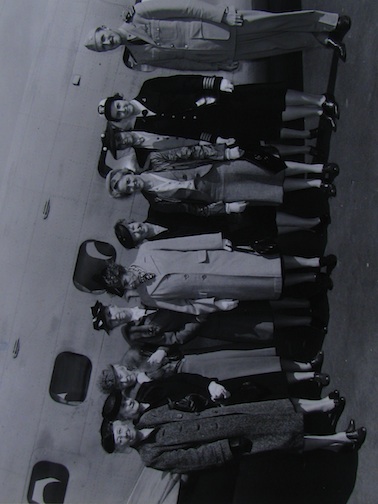
This is a photograph of the Advisory Council c. 1944. It shows, l-r:  Miss Alice Baldwin, Dean of undergraduate college for women, Duke University; Emma Barton Brewser Gates, University of Pennsylvania Women’s Club (and wife of Penn’s President Thomas S. Gates); Miss Meta Glass, president of Sweet Briar College; Mrs. Wallace Notestein (Notestein was a professor at Yale); Miss Virginia Gildersleeve, Ethel Gladys Graham, wife of UCLA political science professor Malbone Graham, Congresswoman Margaret Chase Smith; Miss Alice Lloyd, dean of women at the University of Michigan; Mildred McAfee; and Lt. Cmdr. Philip A. Tague Jr.  It comes from the National Archives.
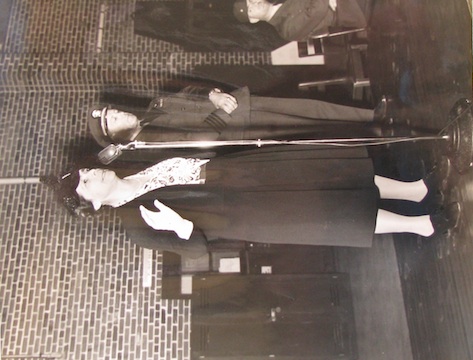
“Yes They Are”

Virginia Gildersleeve, Dean of the all-women’s Barnard College in New York, believed that it was a duty for women to participate in helping the war effort. After the Pearl Harbor attack, she spoke to students at Barnard College about the opportunities women might have:

Are they really going to use women for ‘trained personnel’?  Yes, they are.  They have begun to realize that the ‘man power’ of the country includes also the woman power, and that the government and industry will be forced to use women for nearly every kind of work except the front-line military and naval fighting.

This photograph comes from the Schlesinger Library, Radcliffe Institute for Advanced Studies.

Virginia Gildersleeve

As the rumblings of World War II began in Europe, women in the U.S. began laying the groundwork for women to serve in the military here. Joy Bright Hancock began doing some of that work within the Navy, in her role as a civilian for the Naval Bureau of Aeronautics.

But other women also lobbied for for women’s military service. Virginia Gildersleeve was the Dean of Barnard College in New York. She wrote at the time:

It seemed as if Hitler were about to plunge Europe into war and I, having just returned from abroad, was profoundly distressed.  I felt that we ought to do something about it.  I was intensely interested in this problem … and the enormous contribution that women might make.

This photograph comes from the Schlesinger Library, Radcliffe Institute for Advanced Studies.

The Luck of the Irish

We’re taking another break today from our series of military firsts. This time, we want to talk about St. Patrick’s Day.

Spunky World War II WAVE Josette Dermody was a gunner’s mate based in San Francisco during World War II. And one St. Patrick’s Day she decided to celebrate her heritage by personalizing her uniform.

Everybody was talking about how they could wear green, a green slip or something. I put on – I didn’t have a hat. I had a little tiny green hair bow.  And I was down looking for my pay and went across a quarter deck. The master at arms, who didn’t like WAVES, was chasing me and I got on the stairway and he couldn’t touch me. There were all kinds of ways of learning about rules.  (laughs) Because it was out of his domain. And I was just toodling up the stairs and some lieutenant, some middle aged, it looked like a middle aged dentist who had been drafted to to dental work or something. A perfectly innocent looking man.  But he said, “Young lady, you’re out of uniform!”  They made fusses about things like that. And I said, I just looked at him, “No sir.  It’s St. Patrick’s Day. The skipper is Irish and this is the uniform of the day” (laughs). And then I scooted upstairs.

This photograph comes from the collection of Josette Dermody Wingo.

“You’re Not an Individual”

Though there was resistance to allowing African American women to serve in the Navy, Jean Byrd Stewart says she didn’t encounter any racism once she was in the military. She ended up being stationed in the Chicago area, but remembers one time traveling to St. Louis. St. Louis was a segregated community, and while she could find a restroom for white women, she couldn’t find one for African American women.

I said to the gentleman in charge, “I am going back upstairs where I saw ladies rooms. And I’m going to use that.  If you hear any commotion, you know I’m in trouble.  Send a Shore Patrol because I might need help.” Because there is no ladies room here. And I did.  I went in and you know, you have to wait until there’s an open on.  And I did, I went into the ladies room, came out, when I came out, I sat down.  I took off my hat.  I fixed my hair, checked my make-up, stood up to leave, and of course they were around talking and saying.  And you say, “Goodbye.”  Or “I’ll see you later.”  And you get up and you leave.  Nothing happened.  It shouldn’t have, but you never know.

You know what they told us when we went in?  “You’re not an individual. Remember your home training and all the things you’re supposed to do and how you’re supposed to act.  You belong to a group.  You’re not an individual.  You belong to a group and remember your manners.”  And that was it.

This photograph comes from the collection of Jean Byrd Stewart.

“Send for Your Ice Skates”

Pat Pierpont met her husband-to-be, Dick Graves, while serving in the Navy. She was a WAVE and he was a sailor. They were both stationed in Jacksonville, Florida.

My sister was very much into boyfriends and things but I didn’t have any.  So I went down there (to Jacksonville) and just knew a lot of guys but didn’t go out hardly at all.  And then I met someone one day. He was in the hangar. And I just happened to meet him and he asked me once to go out.  The first time we ever went out was New Year’s Eve. We went to a movie. That was it.  Had dinner and went back to the base and then saw each other off and on, but we didn’t get married until we were both out of the Navy because that was the way it was.  We hadn’t known each other that long, you see,  He was from California and I was from Connecticut.

Their marriage was in February 1946. In Connecticut. Pat told them to prepare for the worst.

I said, “Send for your skates, your ice skates” because we always had ice everywhere. And virgin ice, clear beautiful.  On the lakes, everywhere. Well, of course, this was the year when they wasn’t any ice when they were there. Except the night we left from church.  Then it was raining and freezing. Dick learned to put on chains right away.

This photograph comes from the collection of Pat Pierpont Graves.

Link Job Description

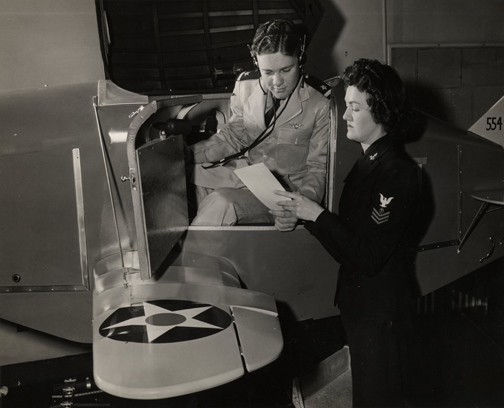
Link Trainer Instructors also got a “ratings description” booklet which told them of the details of the job.  Jean Clark’s booklet has her name typed on the front cover.

One of the things they trained pilots was in a skill known as a “square search”:

The go up in the air, some of these 90 day wonders (officers trained in 90 days), they’re flying around on a flight, wherever they’re going and they come back. They can see the field and make a landing. OK. Another day they go out and they go out and it fogged in.  They can’t see the field.  And they can really get into trouble. So we had to teach them what they call the square search. Where they were to fly in a direction for one minute and make a turn and fly, a left turn and fly in another direction until they could finally spot the field.  If they were lost in the fog and didn’t know where they were and were coming down and didn’t see it. That was mainly extra protection to keep them from flying into a mountain.

This booklet comes from the collection of Jean Clark.

Coveted Assignment

WAVES worked in a wide variety of jobs, but many of the women with teaching experience like Jean Clark ended up in instructional positions. Jean wanted to become a Link Trainer, which used an early form of flight simulation to train men in piloting skills.

We had to take aptitude tests.  Now, I’m going to brag a little bit. Partly, I think, because I’d been a teacher. All of the girls who were chosen to go to Link School had been in education. I think they felt, “They’ve already learned how to teach.  After that, we can teach them the subject matter and they can teach it.” That was their theory I’m sure. They said it was the top thing and if it was the top thing, that’s what I want (laughs).  So, everybody was envious if we got it. There were only 50 of us I think that got it. So not too many.

This is a photo of Jean training a man in the Link flight simulator. It comes from the collection of Jean Clark.

Enlisting in the WAVES

Jean Clark enlisted in the WAVES in December of 1942 at a recruiting station in Portland, OR, after her husband was sent overseas for the war. She heard about the WAVES through an article in her local newspaper.

And I just thought, “That’s what I’m going to do.” My husband said,  “Please don’t join the WAAC (Women’s Army Auxiliary Corps), because that’s what was going on around right then. He says they’ll probably send you overseas and you’ll be overseas when I get home!

Clark told the recruiter that she was teaching in Sweet Home, a small town in central Oregon. She asked the recruiter to let her finish out the school year, which would end in May.

He grinned and said, “Don’t worry about that.”  (laughs).  Well, then in January, I think it was, I got my first letter. It told me what things to expect. In February I got one, “Report.”

This photograph comes courtesy of Jean Clark.

Sneaking Onto Base

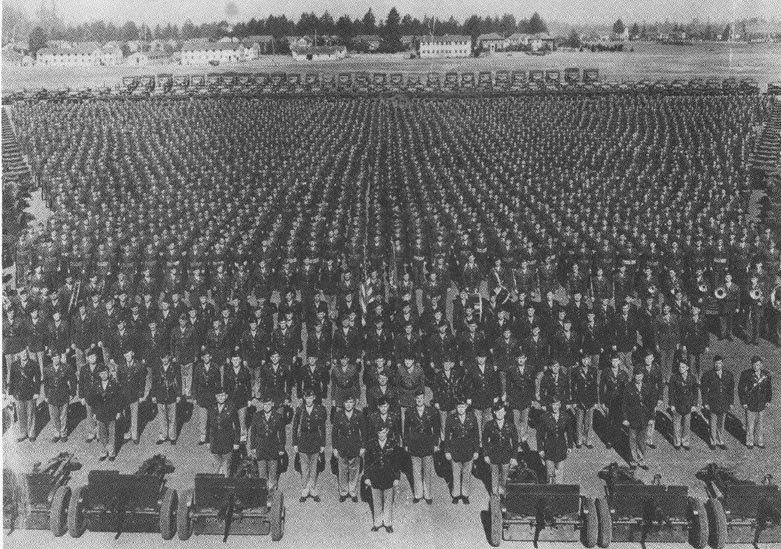
Jean Clark’s husband, Lou, had enlisted in the National Guard before the war. By December of 1941, he was in training at Fort Lewis outside of Tacoma, Washington. They got word they were shipping out in February, so Jean decided to head up to the base and visit.

At night they called a muster and they lined up with all their gear in line and we just watched them as they marched by. They came close enough that they could give us a hug and say goodbye but that was it. I stood there thinking, “Boy, I feel like I’m in a movie just (laughs)”

But there was a problem with this cinematic scene. The base was shut down and Jean was stuck inside with another woman who had also come to see her husband off.

We decided, “We might as well stay here. There’s no bus at this time of night.”  So, went into the place. There wasn’t a scrap of anything.  We found an old blanket. We said we didn’t want to sleep on the floor because it looked a little bit chewed (laughs).  My friend said, “My husband says they have rats in this place.”  So we got up on the meat block and spread out and put the blanket over us and went to sleep until morning when we heard this guard going — he was supposedly guarding. I don’t know what he was guarding, but everybody was gone (laughs).  But he was on guard duty.

He’d go one side of the building. Click. Turn in a military manner. Down the other side of the building. Click.  Down the other side. We watched him. We thought, “Wheres’ he going to be?” So while he was on the back side, we went out the door.  (laughs) And headed to the gate. She said, “Maybe they’ll think we’re civilian employees.”  And I think they did. We just walked out and got a bus.

This photograph comes the California State Military Museum.