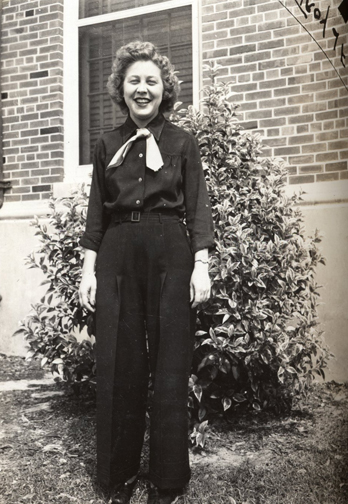
Mary Marovich Ryan

We’re taking a break today from the Navy historical firsts for women to honor an important women to the Homefront Heroines crew.

March 8th is the birthday of the woman who inspired the Homefront Heroines project. Mary Marovich was born in Chicago on March 8th 1921. She enlisted in the WAVES in 1943 and after boot camp at Hunter College she became a Pharmacist’s Mate based at Treasure Island in San Francisco.

Mary worked as a telephone operator in Chicago before enlisting in the Navy. She followed six of her brothers into the service – four were with the Army, and two were first class petty officers in the Coast Guard (her younger brother would serve in the military in the Korean War).

Mary said before enlisting:

I’d really like to wear a six star pin (to honor her brothers), but I can’t find a story that sell them!

Mary married James Warren Ryan, an Army Air Corps pilot, while she was in the service. She left in 1945 after V-J Day and died in 1992.

Happy birthday, Mother!

A Strange Sight

One of the first things Frances Wills Thorpe did as an officer was to visit a Navy ship docked in Brooklyn. There she became acutely aware of her status as something unusual, as she recalled in her memoirs:

I became aware of a brown face, staring, wide-eyed from the galley opening.  I tried to appear casual as I smiled lightly in his direction.  The face disappeared and another brown one took its place immediately, equally wide-eyed.  Seconds later, it seemed, the soup was brought to the table.  The steward who had seen us first, came to me.  Nellie smiled at me, obviously trying to hold onto her dignity because she recognized that I was beginning to be embarrassed.  I thought that any moment she would fall into giggle but both she and Anna watched and waited demurely until the steward crossed to their side, as this were the expected way to be served. Only after I passed the third serving plate did I realize how I had almost missed a reaction which I would soon become accustomed to see in various places, with different people. It was the first time that these stewards (the only job available for many years for Afro-Americans in the Navy) had seen a person of color in officer’s uniform.  It may well have been the first time they had seen WAVES of any color since they had just returned from duty.

When asked, near the end of our training, to state a preferred location for assignment, I had written ‘East or West Coast.’ After I had completed my entire Navy duty no more than forty-five minutes from where I lived and had signed on, except for three days temporary duty in the distant ports of Philadelphia and Washington, I often wondered if my Navy experience might have been altogether different had I written ‘West Coast’ first.

Frances was assigned to the Hunter College boot camp for the duration of the war. This photograph comes from the National Archives.

“A Happy Smile”

Officer’s training was tough for Frances Wills Thorpe. Since she had started after the other women, she needed to work doubly hard to catch up. The same was true for Harriet Pickens. They would be part of the last officers’ training class at Smith College, graduating just before Christmas in December of 1944.

She recalls in her memoirs graduation day:

Navy photographers were everywhere.  Harriet and I were asked to pose pushing down together to close a suitcase.  Although the photograph itself was first-rate and has been shown many times in the years since that day it was entirely fictional.  By the time that the photographer approached and described the shot he wanted, both Harriet and I had long since stowed away all our gear and were waiting with the same undisguised eagerness as all of our classmates for train time.  It was not difficult to smile a happy smile.

This photograph comes from the National Archives.

Wills at Smith College

Frances Wills Thorpe arrived at Smith College in October of 1944. Classes had already begun for the group of officers. She and fellow African American trainee Harriet Pickens trailed the other recruits.

The first evening was disorienting, as Frances recalled in her memoirs:

We had hardly any time to wait in the brisk November weather before a young WAVES office appeared, greeted us and led us to a station wagon parked nearby.  We were driven forthwith to the uniform supply depot — only weeks later would we learn that this operation was under the famous Filene’s Department store of Boston.  We were measured for uniforms, raincoat and dress coat, but when we finally emerged from the ministrations of the fitters we were changed in appearance only by the brand new Navy blue hats which marked us unmistakably as Navy property.  Collected anew by our Navy escort and ushered back into the van, we were driven to the mess hall which was within hiking distance of the dormitory and only about a fifteen minute ride from Filene’s.  (These vital facts we learned within a few days.)

Dinner was already in progress when we were brought to the wide entrance of what appeared to be a ballroom fitted with dining tables.  Our escort pointed out two vacant seats which seemed to be in the exact center of the room — about a mile away.  At that moment all those women in uniform looked exactly alike and from another planet:  two brown-skinned women, one a head taller and a little darker than the other, in city suits and Navy hats.  Next day I realized that we were seated according to our room locations in the dormitory.  We also marched approximately in this order when we went from living quarters to classes or meals.  “Approximately” because we were expected, while in formation, to be more or less in size places.  After that first strange afternoon and evening Harriet and I never found ourselves marching or walking side by side.  She was several inches taller than I.

This photograph of Frances and Harriet dining comes from the National Archives.

The Pharmacist’s Mate

Jean Byrd Stewart went to boot camp at Hunter College. Just 3 of her class of 1000 women were African American.

After training, Jean was assigned to become a Pharmacist’s Mate, just like half of her class. But she had hoped to do radio work.

I said, “I don’t see any singal, any insignia of radio.”  I said, “I’m going ask can I change.” So when I went to ask, who did they send me to but Harriet Pickens. She said, “Well, you know the hospital corps is the area where the Navy women are needed.” She said, “It’s a good field and what you want to do is nice and you do have a background for it.  But I think if maybe you had a higher mark, you might have made it, but because of the need for hospital corps.”  I don’t know whether I asked her or not, but do you know I had a three-point-nine — now how much higher can you get?  But I didn’t say anything, because I knew we were needed and I just left it. And thanked her, and went and that was it.

Jean worked with patients on the hospital ward. Some of the men’s injuries were devastating. She treated men with jaundice. One young man had TB of the spine. Another man had a brain injury and needed to stay quiet because his skull hadn’t healed yet.

He had a friend next door to where he was stationed and he knew it and wanted to see him.  At least he was happy he had come this far and wanted to say hello to his friend.  And they say, “No, we won’t let you go.”  They had to be careful of whoever took him. So while I was duty, I learned about him and him wanting.  I couldn’t give him an answer because I wasn’t in the position. But one day he wasn’t there. And what had he done?  He had gone next door to visit his friend.  He was so happy he knew what to do.  When he finished he came back.  He knew where he was, where he had come from and where he had to go.  And he came back and he was happy and contented.  And what could you do?  You didn’t want to smile and yet you were happy for him because — that was something.  That was something.

Jean left the Navy in May of 1946.

This is a copy of Jean’s graduation from the Hospital Corps school in Chicago, Illinois. It comes from the collection of Jean Byrd Stewart.

“I Can Make You Love Me”

Doris Cain had been married before she joined the WAVES in 1944. The marriage ended badly and she decided to enlist so she wouldn’t see her husband in the small farming community where they lived (he was deferred from military service because of the farm).

One day, she was at the USO for a dance and met a man who had been a pharmacist’s mate on Guadacanal. Doris was gunshy – she didn’t want to get into another bad romantic situation. And something the pharmacist’s mate did raised her suspicions:

He was wearing a Marine uniform when I met him. He made a date with me to pick me up for dinner or something, and he picked me up in a sailor uniform. I was really amazed because I didn’t know you could interchange uniforms like that. I almost quit going with him. We were working in a tight secure environment. I didn’t want to have anything to do with somebody who was messing around, do you know what I mean?  Well, you don’t know if they’re spies or if they’re crazy or what. So I went out with him for dinner but I wouldn’t make another date or anything. He kept bugging me. “Why? Why?”  And I told him.  I said, “Because you wear a Marine uniform one time and a sailor uniform.”  That’s when he told me that the Marines don’t have a medical department and the Navy supplies medical for them. He was stationed at Camp LeJeune, North Carolina.  That’s the reason he could go in either uniform. He wears a Navy patch in the Marine uniform that shows he’s a pharmacist. But outside of that you can’t tell.

Doris’ pharmacist’s mate was persistent. They began going out, and he began asking her to marry him.

He proposed to me, but I wasn’t sure that I wanted to get married again. I told him, I says, “I don’t love you.” And he said, “But I can make you love me.”  So I married him.

By this point it was late 1945 and the war was over. Doris left the service and she and her pharmacist’s mate got married shortly after. Once he was out of the military, they moved to California and had two children.

This photograph, “She Loves Me, She Loves Me Not,” shows WAVES and sailors on liberty in New Orleans, LA, c. 1944. It comes from the Naval History and Heritage Command.
A Whirlwind Romance

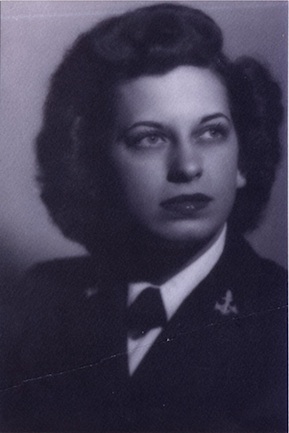
Romance often moved quickly during World War II. Phyllis Jensen Ankeney grew up in the same neighborhood as her husband-to-be. She remembered admiring his Navy uniform after he enlisted in the service, but romance didn’t blossom until after she had joined the WAVES and they were home on leave together.

He got pretty upset when he found out I had gone in the service (laughs). He didn’t think a woman shouldn’t be there either at that point. But anyway, we came on home on leave together, not knowing it. He came from the South Pacific and I came from Florida.  We happened to come home at the same time. We went together for the few days we were  at home. Other than that, I had not dated him.  And he said that we’d get married — that I’d get a ring for my birthday in January. This was in September.  We were married the seventh of October.

We talked every night. And he wanted to get married. I said, “I don’t have any leave coming, If we’re going to get married you’re going to have to come here.” So he came right on down there. But we did have a church wedding in Pensacola.  A Lutheran church.  No family, no one around.  Just the ones from the base that came in. The minister had a youth class there on Sunday night and he asked if I would invite them to be at the wedding, so I did.

They ended up moving back to their home town after World War II and Phyllis got pregnant almost immediately after she was discharged. Her husband did get called up into the Navy again, during the Korean War.

The photograph comes from the collection of Phyllis Ankeney.

Romance Week!

With the approach of Valentine’s Day, we’re turning our focus to romance during World War II.

Margaret Anderson Thorngate, who we’ve featured before in these posts, met her husband Fred during the war:

 I was a member of the Fourth Interceptor Command. That’s when they had that — no radar in those days, so you looked for airplanes in the air, at sea, whatever. I belonged to that.  Another girl and I had the duties on Sunday afternoons, which we picked because they we could sun ourselves on the sand dune where the observation post was.  And so Fred was stationed in the beach club down the street, down the little ways. He came trotting up one day, when I was — one Sunday afternoon when I was sitting there in my black bathing suit watching for airplanes (laughs). With my glasses picked him up right away.

Margaret and Fred wrote back and forth to each other during the war,  while he was stationed overseas and she was in the WAVES in California. Eventually she agreed to marry him.  So in late summer 1945, he got a leave between assignments, so he returned to California.

He came back from overseas and we were going to get married. I met him at my aunt’s in Glendale. He rang the front doorbell and I ran out the back. I was scared to death (laughs). And she (Margaret’s aunt) made me — she made me answer the door and I couldn’t talk.  I couldn’t talk!   Absolutely, for 20 minutes I couldn’t say anything.  And he was just laughing. I thought, “This is the dumbest thing you’ve ever done in your life!  You’re going to marry somebody you haven’t even seen in two years and barely know!”

They were on their honeymoon when the war ended.

Something worked about their unconventional romance – Margaret and Fred are still married.

The photo comes from the collection of Margaret Anderson Thorngate.

The Boot Camp Experience

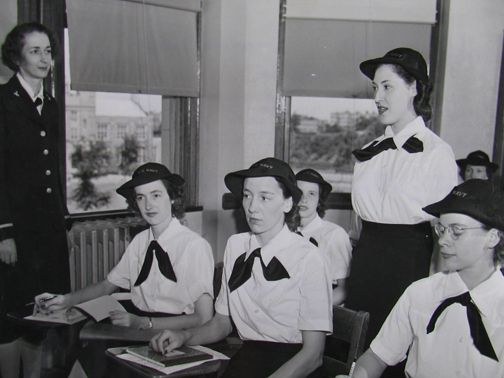
Part of the Hunter College boot camp experience for the young WAVES was learning what it mean to be in the Navy. And that meant restrictions, as WAVE Virginia Gillmore remembered:

The hard adjustment was the way they treated a few people.  One of the really hard things was the fact that if we kept our hair off our collar that was the requirement.  And that if you did your hair up, your long hair up and kept it off your collar you’d be ok.  But one cold morning they mustered us outside our apartment house outside in the street — that means they lined us all up — or we lined up.  And they went behind all the girls with long hair and they pulled their bobbie pins or whatever was holding their hair up out and let their hair fall down, and then took scissors and clipped their hair off.  And these girls had been told they wouldn’t have to have their hair cut.  There was almost mutiny that morning.  None of us thought it was fair. Because the regulation was just keep your hair up off your collar.  But we all kept quiet.  So it was a little fear that I didn’t think was entire necessary in our training.  But I suppose we all have to go through something.

All in all, boot camp was a good, positive experience.  We felt lots of support from the instructors, as a whole group.  But we did have to toe the line.

This photograph comes from the National Archives.

Learning the Ropes

The last photo in the essay following one woman, Maria Ramona Espinosa, through boot camp at Hunter College shows the WAVES’ classroom activities.

The caption reads:

Maria Ramona Espinosa recites in one of the classes which occupy a large part of her time at the training school.

The photograph comes from the National Archives. It dates from September 1943.