Snappy Uniforms

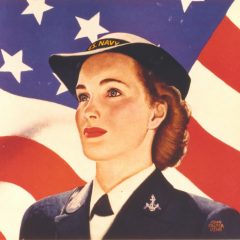
One reason Merrily Kurtz selected the Navy was because of the fashionable Mainbocher-designed uniform.

We had measurements and tried them on. They came up to us, oh gee!  You know, “What size are you?”  They’d look at you and give you a size approximately (laughs).  I didn’t have to have my altered. They gave me a buxom, and I’m glad.  I don’t think that I’m a buxom, but they through I was.  Evidently it gave me a little bit more room in the front.  I don’t remember having to be altered.  Then we got our shoes, and our hose and — it was so cold back in New York.  We went in February.  You marched everywhere, and the wind blowing off the reservoir was colder than blazes.  I don’t know what the temperature was, but it was awful cold.
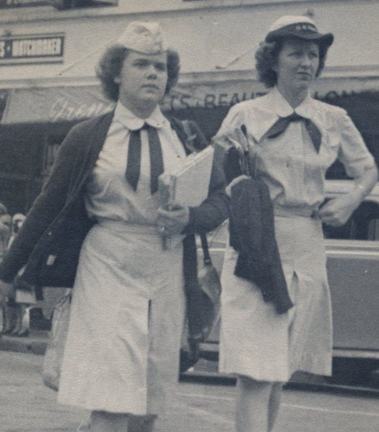
This photograph shows Merrily Kurtz and another WAVE marching. It comes from the collection of Merrily Kurtz Hewett.
 

Following in Daddy’s Footsteps

For Merrily Kurtz, joining the Navy was a family affair.

My dad had been in the Navy and he kind of encouraged me to go in the Navy. When we’d talk about it, he’d say what a good time he had. Saw the world.  Well, he didn’t see much of the world, Chicago, mostly, and the Great Lakes.  But he encouraged me to go in, through it would be good for me to see some of the world.  I signed up to go in the WAVES.

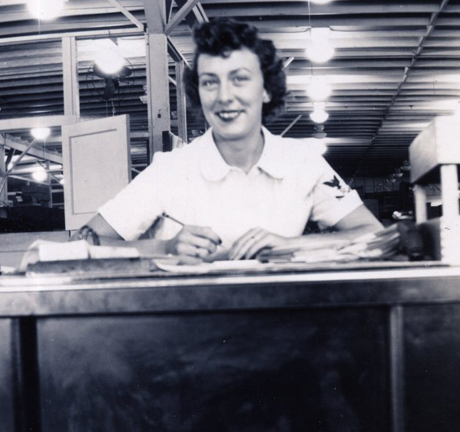
This photo shows Merrily Kurtz on the job. It comes from the collection of Merrily Kurt Hewett.

Working Girl

After Merrily Kurtz graduated from high school, she began working at a local department store.

Well, every girl in town almost worked in Meyer and Franks.  My first job was J.C. Penney’s. I went to a business college for awhile and got some training that way and  improved my typing.

Eventually, Kurtz was hired by Meyer and Franks, but by that time the country was at war.

Just outside of the building in the next block they (the military) had their stand where the people came up for the bond drives and you know encouraged people to sign up and they had famous people come and I remember seeing the three sisters… the Andrews Sisters I guess it was, you know, and you would go out and see that stuff and hear that “Rah rah.”

The photo comes from the collection of Merrily Kurtz Hewett.

Family Ties

The Depression put stresses on many families. For Merrily Kurtz, whose mother had died when she was just five years old, the Depression first meant her father working at a series of jobs trying to keep his family together. When he realized that the work was too much, he asked his wife’s parents to help raise his young children. They first lived in a Portland, Oregon, neighborhood, but then later moved to a farm in the country.


I don’t think I was aware the Depression was going on. I enjoyed life as it was. I had a good time. I had my meals, I never had to go hungry. Of course I didn’t have some of the niceties, but this is out in the country. There were a lot of blackberry vines.  I got to wear shoes that came up over your ankle and I had the largest size at that time and the next time, when my feet grew they couldn’t fit me. That hurt (laughing).

This photograph shows Merrily and her brother with her grandmother. It comes from the collection of Merrily Kurtz Hewett.

Moving Around

Merrily Kurtz was born in Portland and lived in the Laurelhurst District as a young child, but because of the depression her family moved around the metro area a lot when she was growing up.

We moved out to the logging camp (east of Portland). My father worked there with my grandfather, his father-in-law, and then we came back into Portland and then they bought the house in Multnomah and we lived out there several years. My mother died out there from diphtheria. After she died, Dad tried to keep the home going, but it didn’t work. And so he asked my grandmother if they would like to take my brother and I, and they said they would. So we lived in Grand High district for a year or two, and then we moved out to the country. I went to school in a one-room school for awhile and then graduated from grade school and went into high school at Sandy, Oregon, and graduated from there.

This photograph shows Kurtz’s mother and grandmother. It comes from the collection of Merrily Kurtz Hewett.

Meet Merrily Kurtz Hewett

Merrily Kurtz was one of the WAVES stationed in Hawaii – and so a perfect transition for us from our feature on Hawaii is a feature on Merrily.

This is a photograph of Merrily and some of her WAVE colleagues in Hawaii. She’s in the center. Merrily grew up in Portland, Oregon and was a storekeeper in the WAVES.  She served in Florida and Hawaii during her World War II military career.

End of the War

WAVE Patricia Farrington Siegner was based in Hawaii when the war ended:

 At the end of the war I came off, we first went to this bar and had a drink (laughs) and then went onto the night watch.  After we got off, we were required, mind you, having been on duty all night and watch, to be on regimental review!  And I thought, “What in the world is this?  It’s the end of the war!”  Then they suddenly got very GI, what we called all-Nav. We used to call it all-Nav. We had to stand regimental review and we thought it was ridiculous.

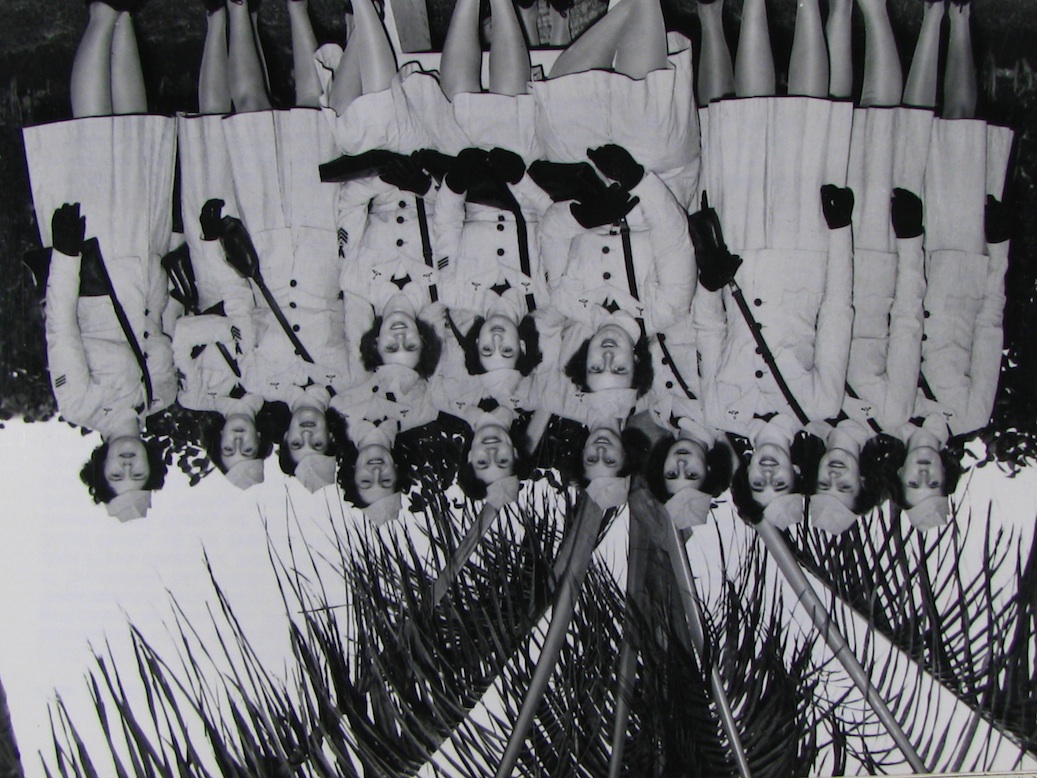
This photograph is of a group of WAVES from Oregon stationed in Hawaii during World War II. It comes from the National Archives.

Working in Paradise

WAVE Merrily Kurtz Hewett remembers being on the job in Hawaii:

 We all went to work about the same time, so it just seemed that — and you had to be in by 10.  So you had to be on the base by six, I think.  You could have company for the dances.  But it was al open air, too.  We didn’t have windows, it was just screens.  It was Hawaii. You know they talk about the bugs now.  And maybe mice or rats. And I don’t remember any of that at all. At all.

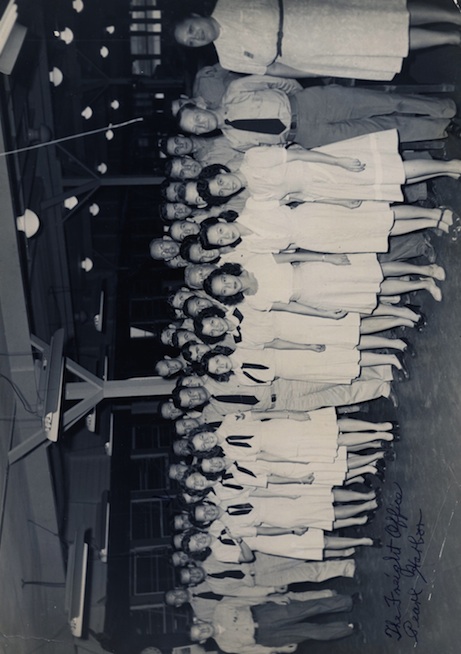
This photograph shows Merrily and her co-workers in Hawaii during World War II. It comes from the collection of Merrily Kurtz Hewett.

Top Secret Assignment

WAVE Patricia Farrington Siegner worked in an underground bunker when she was stationed in Hawaii, coding and decoding military messages:

I couldn’t tell my mother where I was.  I have, I have in these letters, I’ve got cut outs, paper dolls where the censor took stuff out.  And of course it went over once it looked like we were going to sign armistice they didn’t have so much censorship.  But I couldn’t tell her where I was. So I said, she wanted to know. And of course it would have been cut out. So I told her, “Think about your favorite fruit.” She loved pineapple (laughs). And she got it right away.  You see, it was a territory then. It was not a state, so it was different, entirely different.  Entirely different.  We were in the center of the Pacific Theater War.

This photograph of WAVES in Hawaii comes from the National Archives.

Dinner and a Dance

WAVE Merrily Kurtz Hewett remembers evenings in Hawaii:

The fellows liked to be asked to come.  Have meals with us.  You have your friends over for a meal.  Then they’d stay and usually it would be a dance night, I guess.  I can’t remember for sure exactly how many times a week we dances.

This photo shows WAVES Rita Bergan, Mary Burke, Rosalene Brown, Helen Beegle eating in the mess hall in Hawaii. It comes from the National Archives.