Joy Bright Hancock

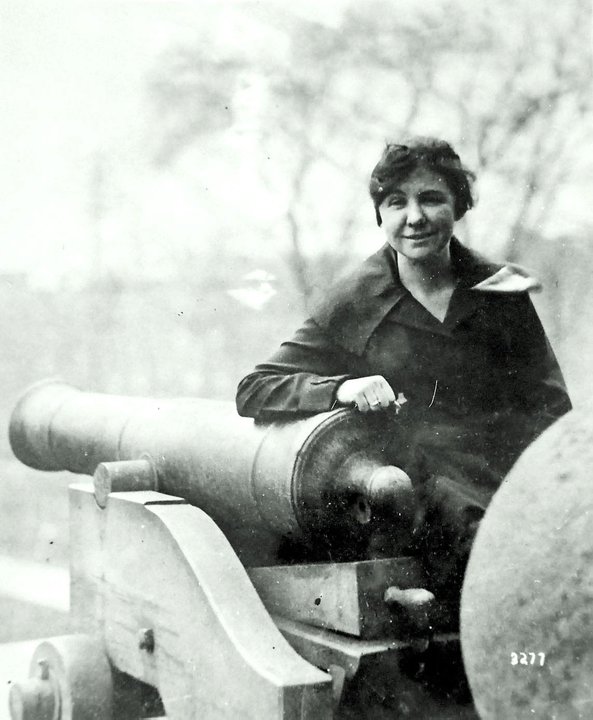
One of the women who served as a Yeoman (F) was Joy Bright Hancock.  Hancock enlisted and was assigned to serve in the  the Office of the Naval Superintendent of Construction, New York Shipbuilding Corporation, Camden, New Jersey. She actually lived at home with her parents and commuted to the office during the war!
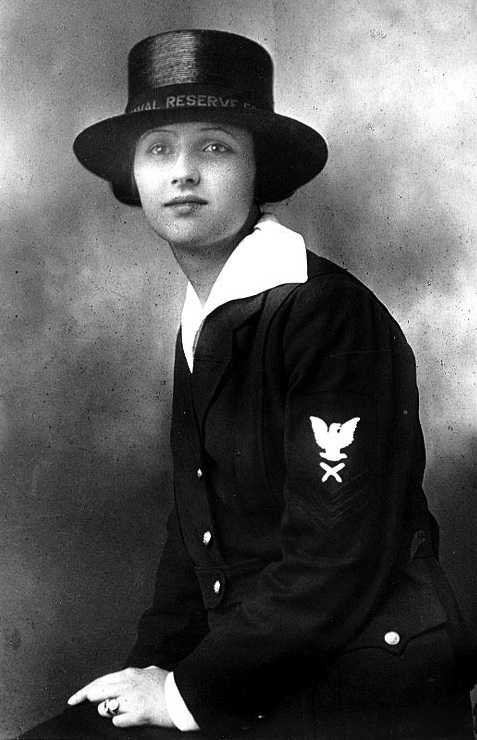
After World War I, Hancock remained with the Navy as a civilian, working in the Bureau of Aeronautics. She reenlisted during World War II as a WAVE officer, and would later become WAVES Director. She retired from the Navy in 1953, and died in 1986.

This photograph comes from the Naval History and Heritage Command.

On Inspection

The Yeoman (F) marked a new era for the Navy. Women were working alongside men, albeit because of a loophole in the Naval Reserve Act of 1916, which never said that Naval service was limited to men. Most of the women served in the Washington, DC, area, but they were ultimately stationed in bases across the country, as well as overseas in Puerto Rico, Guam, Hawaii and the Panama Canal Zone. Five women were sent to France with Naval Hospital Units.

This photograph, circa 1918, shows Yeomen (F) being inspected by Rear Admiral Victor Blue (left center), Chief of the Bureau of Navigation, on the Washington Monument grounds. It comes from the Naval History and Heritage Command.
The Telegraph

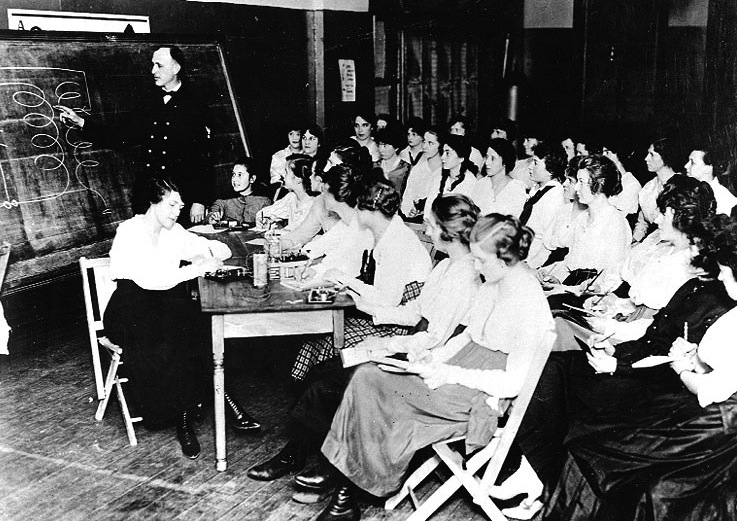
The Yeomenettes greatly expanded the opportunities for women in the Navy.  One job the women learned was telegraphy, using a telegraph to send messages via wires over long distances using Morse Code. The Morse telegraph was invented in the United States in 1936, and by 1861, telegraph cables stretched not only across the United States but also under the Atlantic Ocean to Europe.

In this photograph, new enlistees receive training in telegraphy from a Chief Petty Officer, at the Naval Training Center, Great Lakes, Illinois, in 1917. Some of these women are in uniform while others are still wearing civilian attire.

It comes courtesy of the Naval History Heritage and Command.

The First Yeoman (F)

When looking at the history of the WAVES, and Navy women’s firsts during Women’s History Month, one can’t ignore the contributions of the World War I Yeomen (F). The Yeomenettes (as they were known) were the first women to serve in the Navy in a position other than nursing. They did a wide variety of work in the Navy, from clerical jobs to translations to fingerprinting and ship camouflage design.They were allowed in because of a loophole in the Naval Act, which never indicated that Naval service was limited to men.

Loretta Perfectus Walsh was the very first Yeomanette. She enlisted on March 17, 1917 at age 18. She became the first woman Navy Petty Officer on March 21st of the same year.

About 13,000 women were WWI Yeomanettes.

This photograph comes from the Library of Congress.

The Luck of the Irish

We’re taking another break today from our series of military firsts. This time, we want to talk about St. Patrick’s Day.

Spunky World War II WAVE Josette Dermody was a gunner’s mate based in San Francisco during World War II. And one St. Patrick’s Day she decided to celebrate her heritage by personalizing her uniform.

Everybody was talking about how they could wear green, a green slip or something. I put on – I didn’t have a hat. I had a little tiny green hair bow.  And I was down looking for my pay and went across a quarter deck. The master at arms, who didn’t like WAVES, was chasing me and I got on the stairway and he couldn’t touch me. There were all kinds of ways of learning about rules.  (laughs) Because it was out of his domain. And I was just toodling up the stairs and some lieutenant, some middle aged, it looked like a middle aged dentist who had been drafted to to dental work or something. A perfectly innocent looking man.  But he said, “Young lady, you’re out of uniform!”  They made fusses about things like that. And I said, I just looked at him, “No sir.  It’s St. Patrick’s Day. The skipper is Irish and this is the uniform of the day” (laughs). And then I scooted upstairs.

This photograph comes from the collection of Josette Dermody Wingo.

On the Front Lines

When World War I broke out in Europe in 1914, two Navy Nurses requested discharges and joined the Red Cross. There they served in the war zone, helping treat men who were injured in battles.

The women would spend a year on the front lines. In 1915, both returned to the United States and reenlisted in the Navy. Their experience was important, because it would help shape the role of women when the U.S. entered the “Great War” two years later, in 1917.

This photograph at the U.S. Naval Hospital in Norfolk, circa 1914, comes from the collection of the Naval History and Heritage Command.
Expanding the Nursing Corps

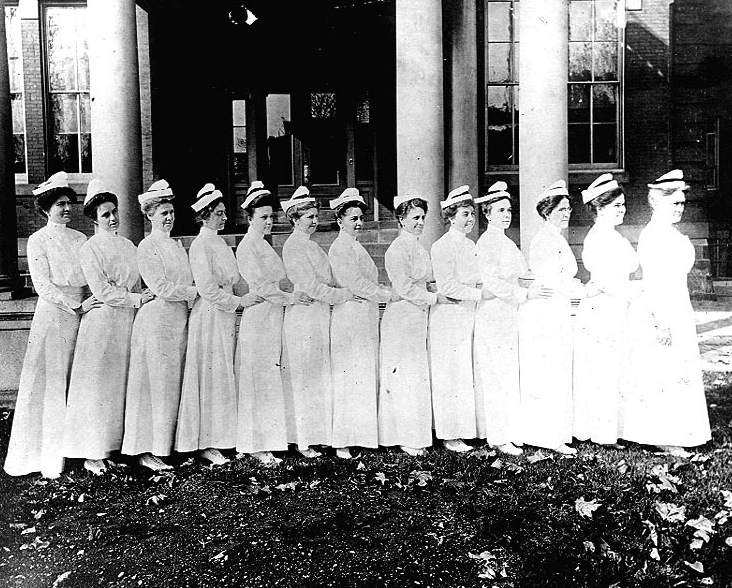
The group of nurses gradually grew from the “sacred 20,” the first group making up the Navy Nurse Corps. By the end of 1909, 37 nurses where in the Navy, scattered at stations across the continental United States.

Demand increased, and the Corps grew. By 1913, there were approximately 160 Navy Nurse Corp members. They were assigned to U.S. hospitals, but also to locations in Pearl Harbor (then a U.S. territory), the Philippine Islands, Guam, Samoa, Japan, Cuba and the Virgin Islands. For a brief time in 1913, Navy nurses served aboard ships: the USS Mayflower and the USS Dolphin.

This photograph at the U.S. Naval Hospital in Philadelphia, circa 1914, comes from the collection of the Naval History and Heritage Command.

The First Navy Nurses

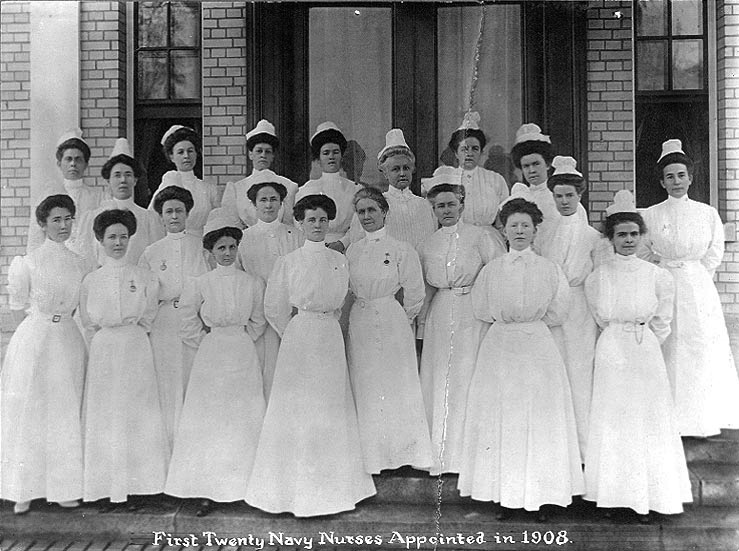
It wasn’t until 1908 that Congress allowed women to serve in the Navy – as nurses. On May 13th of that year, the Navy Nurse Corps was established.

Women had to have at least two years formal training as “graduate nurses” and also have relevant clinical experience to qualify.

Nineteen women were part of the first nurse contingent,. A 20th, Esther Vorhees Hasson, was a former Army nurse who was tapped to lead the women in the Navy Nurse Corps.

This photograph of the “sacred 20” comes from the collection of the Naval History and Heritage Command.

Spanish-American War

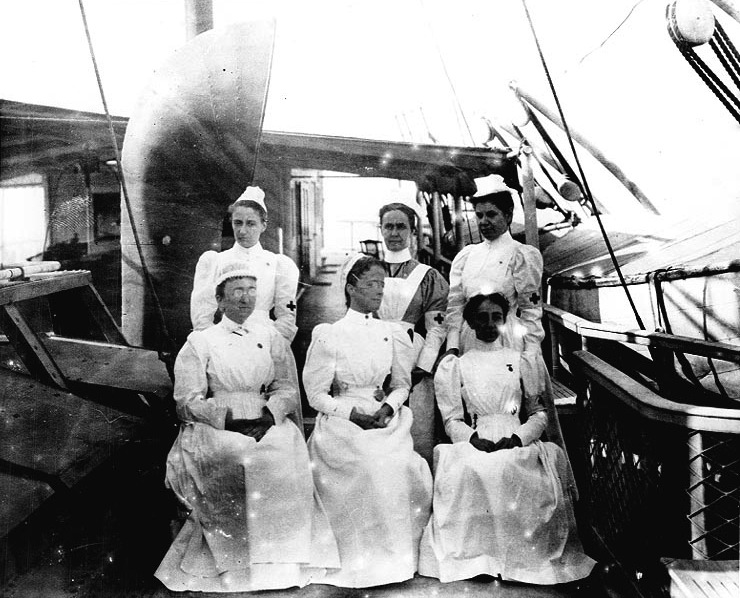
The Spanish American War would mark the first time non-religious female contract nurses would be hired by the Navy to serve ashore.The Army, meanwhile, hired women nurses to serve aboard ship on the Relief.

The use of women as nurses during wartime, both the Civil War and Spanish-America War, would lead to the establishment of nursing as a real profession requiring formal training — a profession both open to and dominated by women. It would also lead to the establishment of a formal female nursing corps within the military.

This image is of contract nurses serving in Cuban waters aboard the Army ship Relief. It comes from the collection of the Naval History and Heritage Command.
Albert D. J. Cashier

On August 3, 1862, a nineteen-year-old Irish immigrant named Albert D. J. Cashier, enlisted in the 95th Illinois Infantry. Cashier fought in about forty battles and served until August of 1865.

It wasn’t until 1913 that Cashier, then living in the Quincy, Illinois, Soldiers’ Home, was discovered to actually be a woman. A 1915 deposition from a fellow soldier held by the National Archives found that the deception was extensive, aside from being the shortest person in the company, there was no other indication that Cashier was female.

Cashier died the following year in an insane asylum.

This image comes from the Illinois State Historical Library and the National Archives.