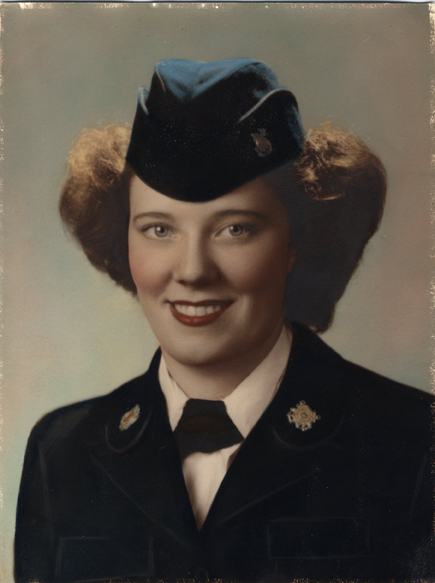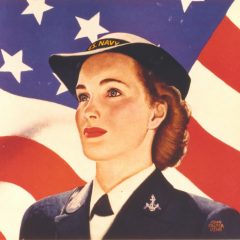
The Pharmacist’s Mate

Jean Byrd Stewart went to boot camp at Hunter College. Just 3 of her class of 1000 women were African American.

After training, Jean was assigned to become a Pharmacist’s Mate, just like half of her class. But she had hoped to do radio work.

I said, “I don’t see any singal, any insignia of radio.”  I said, “I’m going ask can I change.” So when I went to ask, who did they send me to but Harriet Pickens. She said, “Well, you know the hospital corps is the area where the Navy women are needed.” She said, “It’s a good field and what you want to do is nice and you do have a background for it.  But I think if maybe you had a higher mark, you might have made it, but because of the need for hospital corps.”  I don’t know whether I asked her or not, but do you know I had a three-point-nine — now how much higher can you get?  But I didn’t say anything, because I knew we were needed and I just left it. And thanked her, and went and that was it.

Jean worked with patients on the hospital ward. Some of the men’s injuries were devastating. She treated men with jaundice. One young man had TB of the spine. Another man had a brain injury and needed to stay quiet because his skull hadn’t healed yet.

He had a friend next door to where he was stationed and he knew it and wanted to see him.  At least he was happy he had come this far and wanted to say hello to his friend.  And they say, “No, we won’t let you go.”  They had to be careful of whoever took him. So while I was duty, I learned about him and him wanting.  I couldn’t give him an answer because I wasn’t in the position. But one day he wasn’t there. And what had he done?  He had gone next door to visit his friend.  He was so happy he knew what to do.  When he finished he came back.  He knew where he was, where he had come from and where he had to go.  And he came back and he was happy and contented.  And what could you do?  You didn’t want to smile and yet you were happy for him because — that was something.  That was something.

Jean left the Navy in May of 1946.

This is a copy of Jean’s graduation from the Hospital Corps school in Chicago, Illinois. It comes from the collection of Jean Byrd Stewart.

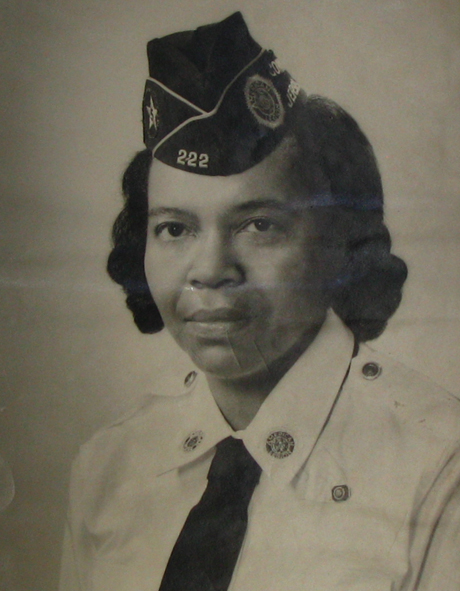
“You’re Not an Individual”

Though there was resistance to allowing African American women to serve in the Navy, Jean Byrd Stewart says she didn’t encounter any racism once she was in the military. She ended up being stationed in the Chicago area, but remembers one time traveling to St. Louis. St. Louis was a segregated community, and while she could find a restroom for white women, she couldn’t find one for African American women.

I said to the gentleman in charge, “I am going back upstairs where I saw ladies rooms. And I’m going to use that.  If you hear any commotion, you know I’m in trouble.  Send a Shore Patrol because I might need help.” Because there is no ladies room here. And I did.  I went in and you know, you have to wait until there’s an open on.  And I did, I went into the ladies room, came out, when I came out, I sat down.  I took off my hat.  I fixed my hair, checked my make-up, stood up to leave, and of course they were around talking and saying.  And you say, “Goodbye.”  Or “I’ll see you later.”  And you get up and you leave.  Nothing happened.  It shouldn’t have, but you never know.

You know what they told us when we went in?  “You’re not an individual. Remember your home training and all the things you’re supposed to do and how you’re supposed to act.  You belong to a group.  You’re not an individual.  You belong to a group and remember your manners.”  And that was it.

This photograph comes from the collection of Jean Byrd Stewart.
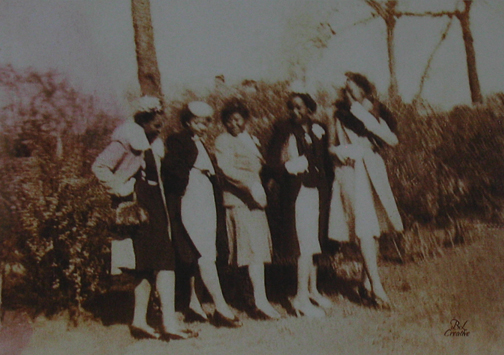
Deciding to Enlist

Jean Byrd was working as the war broke out. But she wanted to join the military service. Initially, only the Army was accepting African American women, and only into segregated units in the Women’s Army Corps. That didn’t interest Jean.

A lot of the women were going into the Army. I said, I want to be different, I want to be something nice.

One day in late 1944, her family was visited by a family friend, Dean William Pickens of Morgan College in Baltimore, Jean’s father’s alma mater. Dean Pickens had a daughter who was a little bit older than Jean.

His daughter Harriet, when she came out of school, they were asking for women to go into the Navy. And I saw it in the paper, where she went up to Smith to train for officer’s training school. And I said, “So the Navy is for me.”

Truman said, “We would like for the ladies to volunteer their services to relieve a man and I think it would help us win the war sooner.”  I said, “I’ll go!”  I’m sitting there working for a defense company making apparatus to go into airplanes.

Jean enlisted in the WAVES and was sent to boot camp in May of 1945.

This photograph comes from the collection of Jean Byrd Stewart.
Dreams

Even though Jean Byrd grew up during the Depression, she still dreamed big.

 You know how you wish for things?  My mother had a gentleman who would take her, my aunt and another lady, he would take them shopping because he had a car. They would go and shop, and they would pay him and I thought that was so nice. So one Saturday, I said, “You know, I would like to buy some property.” Well, I was working then and I had a few dollars.  I said, “I don’t have much, but I’d like find out how much land costs, how much you need” and this and that and the other thing.  I had a nice black dress and black pocketbook and this that and the other.  I said, “I’m going to get dressed and ask Mr.” I forget his name now “to take me out to this place so I can find out something about land.”  Didn’t have a dime.  A few dollars.  I think my first account I put two dollars in. Well, that’s what I got paid.  Two dollars a week. That was way back.  ’40 — I forget the year. ’30, ’38 I came out of high school. Anyway, this is what I was going to do.  I was going to act like I had some money and I was a lady who had some prestige.

This photo comes from the Jean Byrd Stewart collection.

The Importance of Education

Education was important to Jean Byrd’s family, especially as African Americans living in the Northeast.

You had to if you wanted to move in life and be something. Even the girls were going to school, learning a trade.  Something to do.  Because the men didn’t make the kind of money that the white men made, or the family.  Maybe the husband made enough money that the wife didn’t have to work. And she could do community work or belong to the women’s club. Because my aunt worked for a lady like that.  Her husband was the head of a bank.  And she was active in the community, head of the woman’s club. So I said, “That was an angle I can go.” You watched the different ones. Up the street lived lawyers, there was a councilman and there was so much to draw on that you could easily pick what you think you would like to do.

Jean dreamed about going to Brown College after high school, but it was a men’s school at the time. Instead, she went to Patterson State College. Part of the reason was economic: the school was nearby her home, so she could carpool with a friend who lived around the corner.

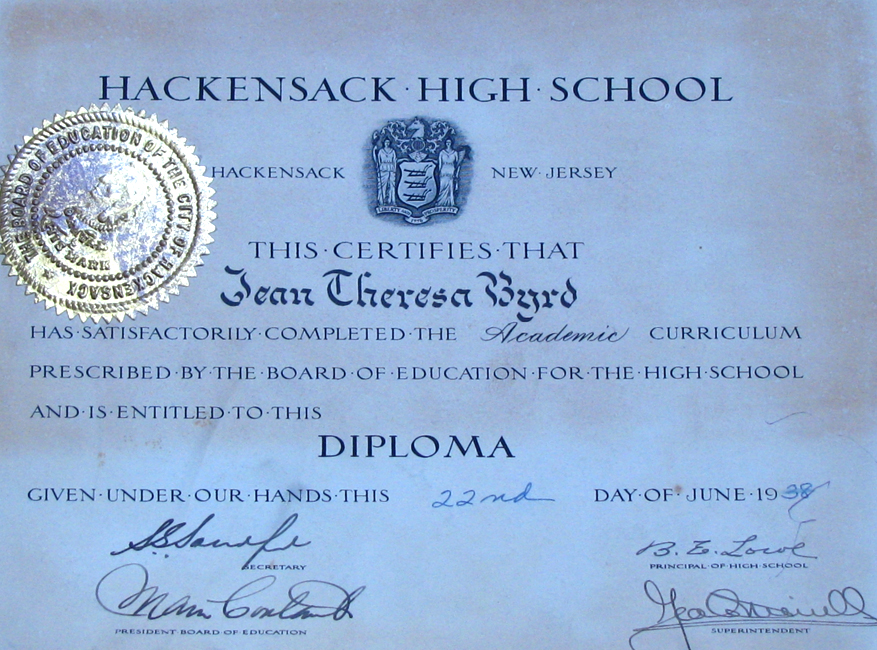
This is a copy of Jean Byrd’s high school diploma. It comes from the collection of Jean Byrd Stewart.

Meet Jean Byrd Stewart

Jean Byrd grew up in Hackensack, New Jersey, right across the George Washington Bridge from New York City. She would become one of the first African American WAVES during World War II.

Jean’s father had his degree in chemistry, and worked for a chemical company in nearby Maywood. During the Depression, things were tough for everyone, but Jean remembers things being doubly difficult for African American families. Her father was paid less than the white workers at the chemical company. Still, she said, the family did well enough – her father had a job and most of the time was working full time.

Aside from the lack of parity on on-the-job, Jean doesn’t remember any overt prejudice in her neighborhood.

I never paid any attention because where we lived was a mixed area.  I mean, mixed. So you were a person there who had to qualify and be as up as you could so that you would blend with others and would show that you had intelligence and keep up with people.  My mother and father went to school and they passed along a lot of things. So as one lady said later on in life, her parents didn’t raise any dummies.  I was surprised to hear her say it. She was a white girl, but that was the way she expressed it. So you live up to what you know, and have learned and picked up watching by seeing others. You just kept on moving.

This photograph comes from the collection of Jean Byrd Stewart.

“Send for Your Ice Skates”

Pat Pierpont met her husband-to-be, Dick Graves, while serving in the Navy. She was a WAVE and he was a sailor. They were both stationed in Jacksonville, Florida.

My sister was very much into boyfriends and things but I didn’t have any.  So I went down there (to Jacksonville) and just knew a lot of guys but didn’t go out hardly at all.  And then I met someone one day. He was in the hangar. And I just happened to meet him and he asked me once to go out.  The first time we ever went out was New Year’s Eve. We went to a movie. That was it.  Had dinner and went back to the base and then saw each other off and on, but we didn’t get married until we were both out of the Navy because that was the way it was.  We hadn’t known each other that long, you see,  He was from California and I was from Connecticut.

Their marriage was in February 1946. In Connecticut. Pat told them to prepare for the worst.

I said, “Send for your skates, your ice skates” because we always had ice everywhere. And virgin ice, clear beautiful.  On the lakes, everywhere. Well, of course, this was the year when they wasn’t any ice when they were there. Except the night we left from church.  Then it was raining and freezing. Dick learned to put on chains right away.

This photograph comes from the collection of Pat Pierpont Graves.

“We Had a System”

As World War II was winding down in late 1945, people in the military started thinking about life after the war. Jane Fisher was in the Coast Guard boot camp to serve in the SPARs (from the Coast Guard Motto Semper Paratas, Always Ready) when the word came down that the war had ended. She ended up relieving other women who had been enlisted longer.

Jane was sent to Seattle and assigned to work in the Post Office. For her, military service was about patriotism – and flirting.

I worked in the post office.  Oh that was good deal.  I had a friend who worked in personnel.  If we saw a cute guy, (laughs) just to show you how women worked in that day and age, if we saw a cute guy, she looked up his personnel records.  If it didn’t show that he was married, then I’d check the letters to see if he got a letter from the same person all the time.  (laughs).  Oh, we had a system.

Jane met her husband-to-be while she was heading back to work after leave to visit her family in Nebraska. She noticed him when he got on the train in Idado.

 I remember peeking out.  His voice. It just sounded good.  But I was playing it pretty cool as we were going up the river.  And we had had a wreck in the middle of the night which made our train late.  And we got to the Dalles (in Oregon) and everybody was getting off the train, you know, to go to the ladies who were serving cookies and stuff.  I thought, “Well, I’m not going to get off and have him give me a bad time.”  Because he kept walking back and forth and I knew he was getting up nerve enough. So I waited and I got off.  He had got off to check uniforms.  He waited and he jumped off the train behind me.  And he informed me that SP stood for “SPAR Patrol.”  Or “SPAR Protector.”  And then he sat on down beside me and he asked me if I knew anything about fish ladders.  Now that was the craziest line I had ever heard in my life.  And I didn’t know what a fish ladder one. I had never heard of one.  He said, “Well we’re coming to this Bonneville Dam and they have a fish ladder and I’m going to point it out to you.  Because someday, I’m going to design and build fish ladders.”  He was the only guy I ever met who really knew what he wanted to do with his life.  It really impressed me.

By the time the train reached Portland, Oregon, Jane was smitten. But she was supposed to transfer to a nearby train head back up to base in Seattle.

 He said to me, “If you purposely miss that train I’ll sign your papers that we had a wreck.”  So I did.  And we spent the whole day in Portland. I went on the train that night that he was on Shore Patrol to Seattle. And he took a cab and took me to where we were staying and got it all squared away that I really wasn’t late.  Signed the all papers and stuff. And we were married three months later.

It was a whirlwind courtship – spurred along by an over-anxious mother:

We were going to get married, but we were going to get discharged and go home.  But my mother kept planning my wedding.  And one night we were in a movie and I was so upset with her and I said, “Gee you know for two cents I’d just get married right here in Seattle.”  And he reached over and gave me two pennies.  So we got married in Seattle.  We were married 28 years.

The photograph comes from the Betty Jane Fisher Collection.

Keeping Romance Alive

Ruth Kinman used the power of letters to keep romance alive while serving as a WAVE during the war.

My sister, who is 13 months older than I, she decided she was going to go into the WAVES. And I hadn’t thought anything about it. But she decided and she joined. And then this young man I was going with, he was drafted into the Marine Corps. So I thought, “I’m not going to stay here by myself.  I’m going to go into the WAVES too.” So that’s why I enlisted.

Ruth stayed in touch with her young Marine, Carl Gaerig, throughout the war. But it wasn’t until the war was nearly over that they began talking seriously about marriage.

He had been discharged because he had been wounded, had been in the hospital and recovered.  Then he came to Washington, where I was stationed and so we decided to get married. When we decided to get married I had to get permission from my superior to wear a wedding gown and veil and all that. And my mother came to the wedding and Carl’s mother came tot he wedding from Duquoin, Illinois. It was quite a spectacular occasion for us.

This was in September of 1945, after V-J Day. Shortly after the wedding, Ruth was discharged. She can Carl moved back to Illinois, where they both went to college. We met them aboard the WAVES National Convention Cruise in 2006.

We’ve been married 61 years now,  I don’t know where the years have gone.

This photograph was taken of Ruth in 2006 aboard the WAVES National Convention Cruise. It comes courtesy of Mel Kangleon.

“I Can Make You Love Me”

Doris Cain had been married before she joined the WAVES in 1944. The marriage ended badly and she decided to enlist so she wouldn’t see her husband in the small farming community where they lived (he was deferred from military service because of the farm).

One day, she was at the USO for a dance and met a man who had been a pharmacist’s mate on Guadacanal. Doris was gunshy – she didn’t want to get into another bad romantic situation. And something the pharmacist’s mate did raised her suspicions:

He was wearing a Marine uniform when I met him. He made a date with me to pick me up for dinner or something, and he picked me up in a sailor uniform. I was really amazed because I didn’t know you could interchange uniforms like that. I almost quit going with him. We were working in a tight secure environment. I didn’t want to have anything to do with somebody who was messing around, do you know what I mean?  Well, you don’t know if they’re spies or if they’re crazy or what. So I went out with him for dinner but I wouldn’t make another date or anything. He kept bugging me. “Why? Why?”  And I told him.  I said, “Because you wear a Marine uniform one time and a sailor uniform.”  That’s when he told me that the Marines don’t have a medical department and the Navy supplies medical for them. He was stationed at Camp LeJeune, North Carolina.  That’s the reason he could go in either uniform. He wears a Navy patch in the Marine uniform that shows he’s a pharmacist. But outside of that you can’t tell.

Doris’ pharmacist’s mate was persistent. They began going out, and he began asking her to marry him.

He proposed to me, but I wasn’t sure that I wanted to get married again. I told him, I says, “I don’t love you.” And he said, “But I can make you love me.”  So I married him.

By this point it was late 1945 and the war was over. Doris left the service and she and her pharmacist’s mate got married shortly after. Once he was out of the military, they moved to California and had two children.

This photograph, “She Loves Me, She Loves Me Not,” shows WAVES and sailors on liberty in New Orleans, LA, c. 1944. It comes from the Naval History and Heritage Command.