First Officer on Ship

WAVES would continue to serve in the military through 1950s. And while enlisted WAVES were assigned to ships in 1953, it wouldn’t be until 1961 that the Navy would assign a WAVE officer to shipboard duty.

Lieutenant Charlene T. Suneson, received that honor. She reported for duty aboard the USS General W.A. Mann (AP-112).

This photograph comes from the Naval History and Heritage Command.

First Women on Ship

WAVES were allowed to go onboard ships in 1953. The women were all hospital corpsmen, meaning they were assigned to medical ward duties.

The women were (left to right): Hospital Corpsman Second Class Eileen Paluzzi, USN;  Hospital Corpsman Third Class Marie A. Myers, USN; and Hospital Corpsman Third Class Mavia Cain, USN. Louise “Billye” Wilde, the WAVES commander at the time, and Rear Admiral Clarence J. Brown, MC, USN, Deputy Surgeon General, are looking on while Vice Admiral Holloway, Jr. signs the orders.

This photograph comes from the Naval History and Heritage Command.

The Third Commander

Joy Bright Hancock, the former yeomanette, would become the third commander of the WAVES, succeeding Jean Palmer. She was appointed to her position in February of 1946, and would lead the WAVES through contractions of servicewomen in the 1940s and expansion in the 1950s.

Hancock was the WAVES leader when the women became a part of the regular Navy. She retired in 1953.

This photograph comes from the Naval History and Heritage Command.

Permanent Status

The Women’s Armed Services Integration Act of 1948 gave women a permanent role in the military. The WAVES went from being a wartime reserve to an actual branch of the Navy.

The Women in Military Service for America Memorial describes the limitations of the Act:

The act placed a two percent ceiling on the number of women in each of the services, restricted promotions to one full colonel or Navy captain as Chief of the Nurse Corps and/or Service Director, and limited the number of female officers who could serve as lieutenant colonels or Navy commanders. The law also granted the service Secretaries authority to discharge women without specified cause and restricted women from flying aircraft engaged in combat and from being assigned to ships engaged in combat.

Nonetheless, it was a start. Some of the World War II WAVES converted to the new permanent division.

This photograph shows the first six women being sworn into the regular U.S. Navy. It comes from the Naval History and Heritage Command.

Dorothy Stratton

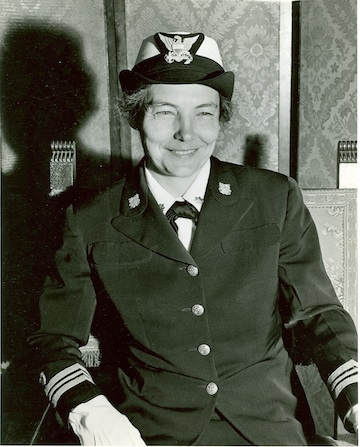
Dorothy Stratton, who had been dean of women at Purdue University before the war, was a member of the first WAVE officer class in August of 1942. A few months later she was asked to head another new women’s military group: the Coast Guard SPARs (from the Coast Guard Motto Semper Paratus, Always Ready).

She said of her appointment to lead the Coast Guard:

I knew nothing about the Coast Guard, nothing. I had never seen a Coast Guard officer. I didn’t know anything. I think I felt if that was the place where I could work, that was fine with me. In other words, I only cared about being where I could feel I was doing something useful, and I thought this was something useful.

About 12,000 women served in the SPARs during World War II. They were decommissioned at war’s end, and women weren’t allowed to join the Coast Guard again until 1949.

This photograph comes from the National Archives.
Jean Palmer

Though Women’s History Month has ended, we’re going to continue our feature on women’s Navy firsts for the next few days.

Jean Palmer enlisted in the Navy in 1942. She would become the second woman to command the WAVES, taking over the position after Mildred McAfee stepped down in 1945.

She said of her service:

You had to be able to adapt. There were many interesting jobs, and I felt that at the end of the four year perdio the people who had the brains and the background found their way into those jobs…One of the advantages of being a woman in a service that never had women before, you never quite knew whether they would treat you like a lady or like an officer..

Palmer left the Navy in 1946. She became director of admissions at Barnard College. Palmer died in 1992.

This photograph comes from the National Archives. Palmer is third from the left.

Margaret Chase Smith

A mention of the WAVES wouldn’t be complete with a mention of Margaret Chase Smith. Smith was a Congresswoman during World War II (she would later become a Senator) and has been called by some “the mother of the WAVES.”

It’s a title she disavowed, but she was a strong supporter of women in military service, and was a part of the Congressional committee which expanded duties for WAVES, eventually allowing them to serve overseas. She said later:

I can only say to you that while I knew there was great reluctance and criticism, my feeling has always been that if women were to serve as men, they must accept the responsibilities as well as the privileges.  If they needed these women in spots other than those designated by the first law, then there must be very serious consideration given to the legislation for it. I think the women had a great deal to do. They had a great responsibility to uphold the dignity of women.

This photograph comes the National Archives.

The Creative Spirit

Elizabeth Reynard initially struggled in the Navy. It wasn’t that she wasn’t qualified – it was more that her creative impulses clashed often with the regimentation of military life. She was also unhappy living away from her family and friends in New York.

When the Navy decided to open a training school for women in New York in late 1942, Reynard was appointed to help develop the education program. By all accounts, her work was a huge success. She came up with the idea of bringing models of ships, sample guns and Link trainers and other equipment the women might encounter on the job for their boot camp training at Hunter College.

This newspaper clipping comes from the Schlesinger Library, Radcliffe Institute for Advanced Studies. It is about a commendation Reynard received for her service with the Navy.

W.A.V.E.S

Elizabeth Reynard is credited for being the woman who came up with the name for the WAVES. According to Virginia Gildersleeve, in her book Many a Good Crusade, the Navy wanted something that was “nautical, suitable, fool-proof, and attractive.” Reynard took up the challenge, as she wrote to Gildersleeve:

I played with those two letters [w and v] and the idea of the sea and finally came up with ‘Women Accepted for Volunteer Emergency Service’ — W.A.V.E.S. I figure the word ‘Emergency’ will comfort the older admirals, because it implies that we’re only a temporary crisis and won’t be around for keeps.

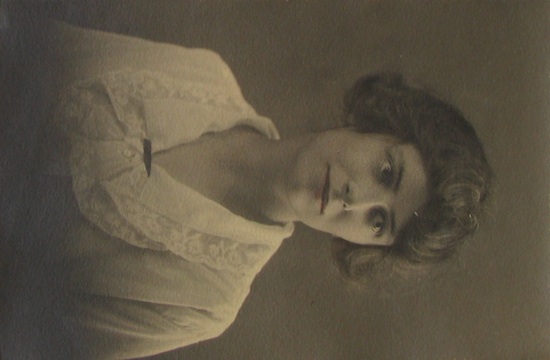
This photograph of Reynard comes from the Schlesinger Library, Radcliffe Institute for Advanced Studies.

Elizabeth Reynard

Virginia Gildersleeve, Dean of Barnard College in New York, also asked one of her close personal friends to go to Washington and help work within the Navy develop a woman’s program. That woman was Elizabeth Reynard.

Reynard was a an English professor and graduate of Barnard College. She was a strange choice to lobby for a woman’s service because Reynard was by all accounts highly artistic and an unconventional thinker – not perhaps the best civilian woman to lobby for women’s military service. She moved to Washington in early 1942 and would eventually become one of the first women to join the WAVES.

This photograph comes from the Schlesinger Library, Radcliffe Institute for Advanced Studies.