Getting the Uniform

The second image in the photo essay of Maria Ramona Espinosa at boot camp at Hunter College followed as she was fitted for her Navy uniform.

The caption reads:

Apprentice Seaman Esponosa, her hair done up in regulation style, has her first uniform fitted.

The photograph comes from the National Archives. It dates from September 1943.

A Girl Joins the Navy

Part of the WAVES recruitment efforts were to show the experiences of women in the Navy, and boot camp was no exception. This photo essay followed one woman, Maria Ramona Espinosa, through boot camp at Hunter College.

In this photo, she arrives at the gate of the Navy facility, dressed in her civilian clothes. The caption reads:

Maria Ramona Espinosa goes thru some of the steps necessary to become a WAVE at Hunter College, Bronx, N.Y. Arriving at school she gets her first directions from a Shore Patrolman at the gate.

The photograph comes from the National Archives. It dates from September 1943.

The Map

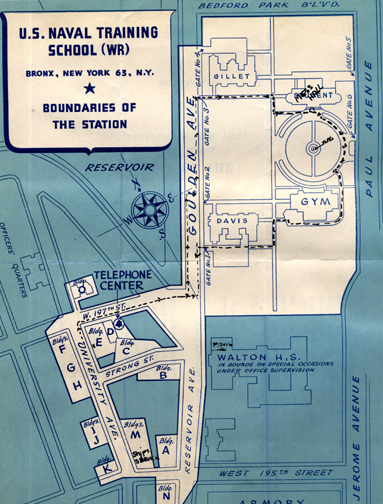
When women were stationed at the Hunter College boot camp, they received a map as part of their orientation packet. The map showed where the key buildings were, and included the surrounding apartment buildings.

This copy of the map comes from the collection of WAVE Margaret Anderson Thorngate. It shows the path she would take from the building where her quarters were located (Building D, a former apartment complex) to the Mess Hall, where meals were served.

Hunter College: Living Quarters

Hunter College was primarily a commuter college; there weren’t any dorms on the campus grounds. The Navy needed housing for 8,000-10,000 women at a time (plus instructors), so it turned to the Bronx neighborhood for help. Apartments surrounding the campus were commandeered by the Navy for the duration of the war.

An article in the New York Times talked about this development:

While … merchants on Kingsbridge Road, the nearest shopping center, all claimed their businesses would suffer, none complained.  Businessman Max Steubens, who ran a self-serve market, depended on the 13 apartments for most of his business, but when interviewed said, “I’m more than willing to do my share toward the war effort” (1.13.43) A few days after this, complaints arose because nearby apartments were raising rent for the occasion. The situation was investigated and The New York Times made sure to note that, “The complaints they received were logical and natural and not at all unpatriotic” (1.14.43)

This photograph comes from a postcard booklet designed for WAVES recruits to send it home to their parents, families and friends. It shows the converted apartments, where women lived 8-10 to a one bedroom unit.  It is from the Betty H. Carter Women Veterans Historical Project at the University of North Carolina Greensboro.

Hunter College: History

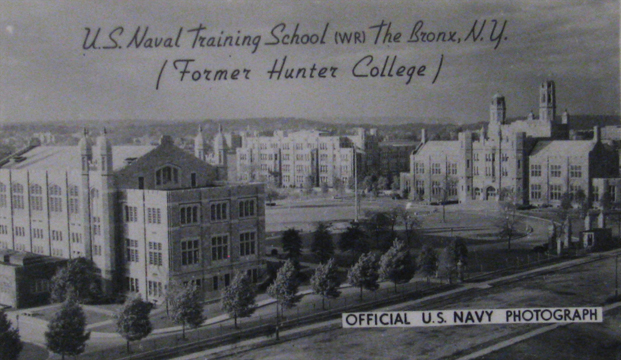
Hunter College was established in 1870 as part of New York City’s public university system. It was located on the Upper East Side of New York City. The Bronx campus (now known as Lehman College) first opened in the 1930s; by this time Hunter had locations in Brooklyn, Queens and Staten Island as well.

The Bronx campus remained under Navy jurisdiction until 1945. Then it briefly housed the United Nations, before being returned to the Hunter College system in 1946.

Hunter was the women’s college of the system through the 1950s. The Bronx campus was one of the first to go co-educational, and the entire system allowed women by 1964, The Bronx campus was renamed Lehman College in 1968.

This photograph comes from a postcard booklet designed for WAVES recruits to send it home to their parents, families and friends. It shows the Hunter College training station.  It is from the Betty H. Carter Women Veterans Historical Project at the University of North Carolina Greensboro.

Hunter College: Boot Camp

In early February, 1943, the Navy opened its new WAVES boot camp at Hunter College. The Bronx, New York campus (now known as Lehman College) was commandeered by the Navy for the duration of the war.

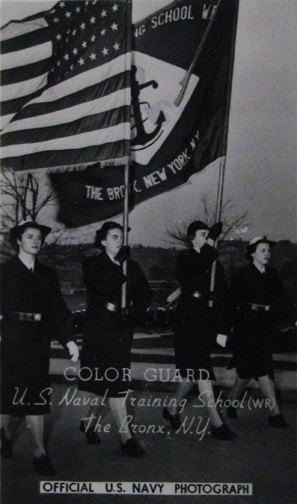
Boot classes of two thousand women would begin every two weeks or so. They would spend six weeks at Hunter learning military basics before being moved along to specialty training.

This photograph comes from a postcard booklet designed for WAVES recruits to send it home to their parents, families and friends. It shows the flag of for the Hunter College training station.  It is from the Betty H. Carter Women Veterans Historical Project at the University of North Carolina Greensboro.

Honorable Discharge

V-J Day happened August 9, 1945. Jean Clark’s husband, Lou, returned to Seattle from his assignment soon after and was to be immediately discharged. Jean’s commander decided to help her out as well.

He said, “I’ll put you down for 30 days leave. You come back and your discharge will be complete.”  So I went home with my husband and we — then we came back in a month. That was in August, I think. By the time we got back the discharge was complete. We went back to Lebannon where my parents were living. We didn’t have a house or anything. While we were there, we decided, I guess maybe we ought to find a job. We did. We went to the school district and both of us were hired. Because then teachers were in short supply and we both had our degrees and our certificate.

This is a photograph of Jean’s honorable discharge from the Navy, dated September 6th, 1945. It comes from the collection of Jean Clark.

Telegram

Jean Clark’s husband was in the Army, stationed overseas. But that didn’t mean he didn’t stay in touch.

This telegram was sent to Jean while she was stationed at Lake Washington Naval Air Station. It shows her husband’s sense of humor, even as he’s sending her a “love” letter:

Fondest love darling. You are more than ever in my thoughts at this time. Please send me one hundred dollars. Lewis E. Clark.

Maybe telegraphs were the text messages of their day? Minus the emoticons, of course.

The telegraph comes from the collection of Jean Clark.

Growing Up

Jean Clark was stationed at NAS Lake Washington for two and a half years. She said her experience in the Navy changed her outlook on life:

Well, I think it helped me to grow up a little bit. You know. I said, you know, I was 19 when we were married and well, ’45 I was 24. And during that time, I think was pretty green, I was, you know, about the rest of the world and after that,  we sort of took advantage of some things and got to go a little farther then we might’ve before.

This is a photograph taken at NAS Lake Washington of WAVES and a sailor relaxing between assignments. It comes from the collection of Jean Clark.

Flight Pay

WAVES typically didn’t get flight pay, or extra money for serving aboard an aircraft. But Jean Clark did receive some extra training so that she could get the flight pay, as seen in this copy of her certification.

The officer at Lake Washington NAS thought that Jean deserved the extra money. But that meant that she had to fly sometimes. One flight was particularly memorable:

One time he said, “We’re going out. You might want to go.” I said, “OK.”  We’re going to deliver a captain to a flatop. That means we’re taking the captain back to the aircraft carrier.  He says, “They’re out there off the coast,” he said, but he says, “It’s top secret. So you have to keep still about it.”  So we took the captain out to the carrier.  Off the coast of Seattle. It was a rough rough sea. The waves were coming in like crazy.  You might think that landing on water is a soft landing?  It’s like landing on a pile of rocks if you hit water. And it’s bumpy. So we hit down and they put down a small boat from the aircraft carrier to come out and get the captain. They captain came out on the pontoon of the little widgen waiting to get picked off as they came by. They made several swipes. The commander says to me, “You know, they better get him pretty soon. Those waves  are getting pretty high. We may not get out of here.”  I thought “Oop, well, this is it.”  It did look pretty dangerous. Pretty soon, they did grab him and get him off and take him back. The commander says, “Hold on!” And here was this big wave coming towards us.  I mean, big. So he, I could see us heading right into that wave, and we went right into it and right through it and on and we’re airborne.  He says, “Well!  We made it!”  (laughs)  That was the most exciting thing that happened to me when I was in the Navy.

The certification comes from the collection of Jean Clark.