WAVES could, of course, get leaves to spend time with family and friends. But holiday leave – that was another thing. It was highly desirable and tough to get. And the Navy, unlike civilian businesses, didn’t take a day off because it was Christmas.
Betty Bruns Lord in Uniform
It wasn’t until 1945 that Betty Bruns Lord would be allowed home – to Mason City, Iowa – for the holidays.
You didn’t get a lot of leave and sometimes you couldn’t get off because you were so busy. Just couldn’t take it when you wanted to. And I know when the boys started coming home — the last year, in ’45, I did get home for Christmas which was something you didn’t get at that time. A lot of the boys said, “Well, uh, uh?” He said, “These girls haven’t been home for Christmas since they joined.” “Oh.” And so Commander Fair, we did get our leaves. We thought for sure we were going to get cancelled. But no no no no. He said, “No, you girls are going home. You haven’t had yours.”
On the airstrip with Betty Bruns Lord
Betty was stationed at Mustin Air Field in Philadelphia working on planes. She was one of the WAVES who not only worked on planes, but knew how to fly them. Her uncle had trained her as a pilot before the war.
Virginia Gilmore was married when she joined the WAVES in 1943. Her husband was a handsome Marine. But in their first Christmas as a married couple they were thousands of miles apart. He was just back from a two-and-a-half year stint in the Pacific, stationed at the Puget Sound Navy Yard in Bremerton, Washington. Virginia was at the other end of the country at WAVE boot camp in Hunter College.
We were there on Christmas Eve. And huge Navy trucks pulled up and they unloaded a filled stocking for every recruit and hung them — they came in and hung them on the corner of our bunks.
WAVE Wraps Presents, U.S. Navy Photograph
We had candy and gum and cookies and little presents. Can you imagine all the thousands — I don’t know what the Navy word is for Navy warehouse, but Navy stores where you could find all those things but we had them.
Joyce Fish Sherwood joined the WAVES in 1942. Like Helen Edgar Gilbert, she was part of the first class of WAVES, who skipped the Hunter College boot camp experience. After enlistment, Joyce was sent to Indiana University in Bloomington for orientation and storekeeper training.
Joyce was stuck in training and Christmas was approaching. So since she couldn’t get home to her family, her family brought Christmas to her.
US Navy Photograph
The three of them came down and stayed in Bloomington and came onto what we called the ship (laughs) to visit and they were allowed to do that. I really don’t have much of a recollection of gift giving or anything like that. Because we had our uniforms by then. We had sent all out civilian clothes home. So there wasn’t much they could give me except stationary (laughs) or things like shampoo and stuff that you would always need.
US Navy Photograph
They were proud. They were proud. I think that had something to do with this patriotism blast we were on, too. All the civilians were, “Oh! You’re in the military!” You know, they were glad to see us and they were appreciative of what we were trying to do.
We’ve been humming Bing Crosby’s White Christmas a lot lately – likely because there’s no risk of not having Christmas snow this year in Colorado. The song first premiered on an NBC radio show in 1941 and was initially released on an album for the film Holiday Inn, about a pair of song and dance men who create a country inn that featured holiday-themed performances.
By October of 1942, White Christmas was released as a single and it quickly shot to the top of the “Your Hit Parade” radio charts. The song perfectly captured the mood of the time. In it, the singer pines for the perfect Christmas:
I’m dreaming of a white Christmas, just like the ones I used to know
Where tree tops glisten, and children listen to hear sleigh bells in the snow…
Those first classes of WAVES were in training during the Christmas of 1942. Helen Gilbert was training to be a radio coder at the University of Wisconsin in Madison:
I remember Bing Crosby’s White Christmas. Every time it went on we were just sobbing. It was crazy…The first Christmas in Wisconsin, it was very sad. We were all homesick. We were just a bunch of young girls who wanted to go home.
White Christmas would later be the inspiration for the film of the same name – featuring former Army buddies (and Broadway stars) who head up to Vermont in the years after the war to help their beloved General’s struggling Vermont inn.
White Christmas is the biggest selling single of all time.
Three thousand miles of widely varied terrain – from mountains to deserts, swamps to farmland. Another three thousand miles or so across the Pacific Ocean. That’s the distance that separates Pearl Harbor from Washington, DC.
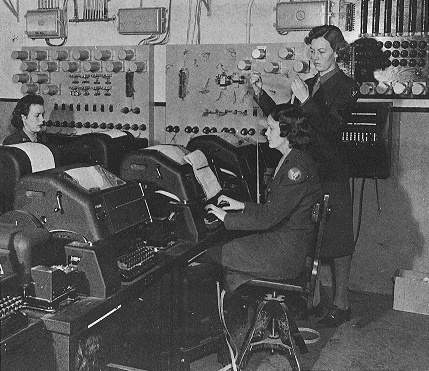
WACs operate a teletype machine during World War II.
While today communication across the world is nearly instantaneous, in 1941 there were some challenges. Starting with the time difference. When the attack began in Pearl Harbor at 8am local time, it was 1pm on the east coast – it ended close to 3pm. And forget the immediacy of the internet: news was spread by telephone, morse code or telegraph machines, which transmitted news stories via a cable. In this case, a cable stretched for miles underneath the Pacific Ocean.
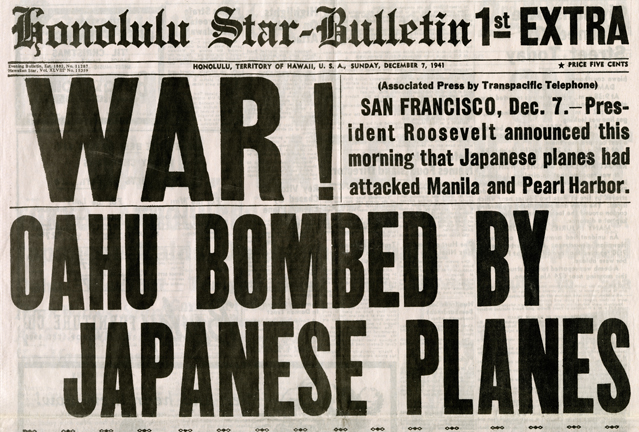
The initial reports about the attack spread on December 7th, through breaking news updates on local radio stations (remember these were the days before television). And the next day, December 8th, President Franklin Roosevelt announced that the United States was at war.
It was in the just-past-dawn hours of a quiet Sunday morning at an exotic base for U.S. military personnel. The ships were anchored in the port, lined up like sailors at attention waiting for an inspection. A routine day.
And just after 6am, the first wave of Japanese planes launched from Japanese carriers in the Pacific. Two hours later, the planes reached their targets. Pearl Harbor.
More than 90 ships were docked in the harbor, including eight battleships. The USS Pennsylvania was in dry dock on one side of the harbor. The rest sat in battleship row: the USS Oklahoma, the USS West Virginia, the USS California, the USS Maryland, the USS Tennessee, the USS Nevada and the USS Arizona. Five of the ships received some damage in the raid. The USS Oklahoma flipped upside down (“turned turtle” in Navy parlance) and sank. The West Virginiaalso sank. But a sinking ship can be a slow-moving process and for the most part men were able to escape those ships.
That wasn’t the case for the crew of the USS Arizona. At just after 8am, the ship was hit by an armorpiercing bomb that ignited some of the ammunition aboard the ship. It exploded. And 1,177 men were killed – the largest number of men lost on any ship that day and about half of the total casualties of the attack.
And then came the second wave of Japanese fighters.
By 10am, the attack was over. Two-thousand and three Americans were dead. Twenty-one ships were sunk or damaged. One-hundred and eighty-eight aircraft were destroyed and another 159 damaged. Most planes were hit on the tarmac.
The news would gradually trickle back to the mainland that Sunday afternoon. And the world would forever change.
We know the holiday season can be busy. But its also a time when people think about things outside of themselves. Dirty little secret about the Homefront Heroines production crew: Producer David Staton and Director Kathleen Ryan are addicted to made-for-tv holiday movies. Last night’s entry was Dear Santa, where a young well-to-do woman finds a letter a little girl sent to Santa and as a result begins volunteering at a local soup kitchen. She falls in love with the girl’s father, who runs the soup kitchen, and learns to be a better person from the homeless people they serve.
The promotional photo for the Lifetime movie "Dear Santa"
Yes, it’s silly and not particularly sophisticated, but the movie (and others of its ilk) tap into our spirit of generosity over the holidays.
That spirit has taken a hit in recent years. The Chicago Sun-Times reports that charity giving is down from its pre-recession levels (off by about six percent nationally). Meanwhile, federal and state dollars are also down because of cuts in budgets, meaning that charities (and the people and projects they serve) are even more reliant on those independent donors. That’s one of the reasons our multimedia project turned to Kickstarter for a fundraising campaign and why we have a donor wall where people can back the project, pre-ordering the film, sponsoring web exhibits or even becoming an executive producer on the project (complete with an IMDB credit).
Paige the Fundraising Penguin from the International Women's Air and Space Museum
We’ve adopted a family through the ACC House of Denver, buying Christmas presents for three kids who otherwise might not get anything under the tree this holiday season.
Newspaper article about WAVE Margaret Anderson's blood drive efforts.
So what does this have to do with WAVES? The military has a long history of charitable good works (Toys for Tots is a U.S. Marines program). The women who served in the Navy during World War II also gave of their time to help others, through blood drives, war bond sales or other efforts.
When searching for an article to link to on our Facebook page, a story from the St. Petersburg Times popped up. It was about WAVES National Unit 27, which shut down on November 12th of this month. The ladies had met every month or so for the last 25 years, sharing stories and camaraderie. Sixteen women were members of the unit and paid their annual dues, but only five attended the meetings and were active in keeping going. So this year, they made the hard decision to shut the doors. Said Unit Vice President Lee Lund, a WWII WAVE:
The unit has disbanded because of the decline of membership due to death, health issues, lack of younger members to take office and not enough members to assume officer responsibilities.
Unit 27 is facing challenges familiar to all the WAVES National units. When this project began, members were scattered in states across the country. Oregon, where the Homefront Heroines producer and director were living at the time, had the second largest number of units on the West Coast (only California had more); Florida, with its scores of retirees, was traditionally only of the states with a high number of units. The WAVES National Convention, held aboard a cruise ship in 2006, drew nearly 300 women, veterans of WWII, the Korean War, and Vietnam. However, only a handful came from more recent conflicts.
WAVES National Convention 2006, courtesy Mel Kangleon
It’s not just an issue in Florida. Oregon, which had that plethora of active units when we began the project, now had just one listed on the WAVES National website. Other states are seeing similar declines. Barbara McCarthy, herself a Korean vet, was the most recent president of Unit 27. She saw the problem as twofold:
Only three of us are under (age) 80. Three girls are in assisted living facilities. One is homebound. Younger women are working, raising children
But Harvard Professor Robert D. Putnam offers some startling research that indicates this lack of community involvement from the younger generation may be something beyond just working and raising a family. Instead, it has something to do with a shift in traditional social capital:
The very fabric of our connections with each other, has plummeted, impoverishing our lives and communities. We sign fewer petitions, belong to fewer organizations that meet, know our neighbors less, meet with friends less frequently, and even socialize with our families less often.
He dubs this trend “bowling alone,” because while Americans are bowling, they’re not doing it in leagues or other formalized organizations, but rather, alone.
Putnam doesn’t see this as a terminal condition; in fact he offers a list of 150 things you can do to build social capital. And we are seeing an uptick in some organizational groups, such as the politically based Tea Party and Coffee Party movements. Facebook can also offer a way to feel a part of a virtual community, and there are a plethora of veterans groups there (check our our Facebook page “likes” for links to some).
On another note, today (November 26) is Small Business Saturday, a movement to support local and independent businesses during the holiday season. It’s a great cause – and a great way to build social capital through supporting your own community.
From Mary M. Ryan. She is somewhere in the sea of women at Hunter College.
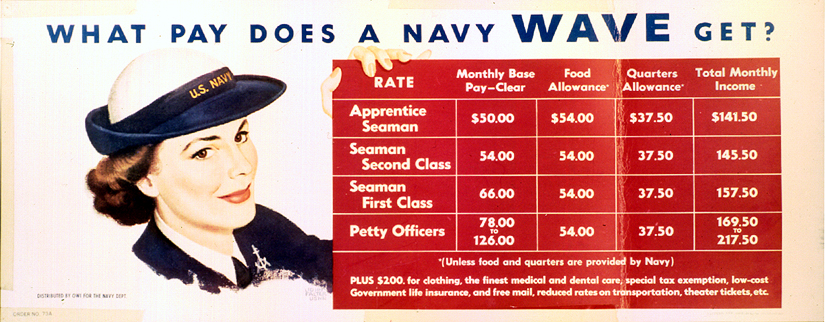
As you know, my mother was a WAVE during World War II – and it was her story which inspired this project. And the WAVES were truly trailblazers during the war. This blog is called “Hinges of History” to recognize that contribution. The WAVES were the first women admitted into the service at the same rank and pay as men. And it wasn’t just the service – women during that era generally were paid less than men, under the rationale that they didn’t need the money as much because men were supporting families and women were “only” supporting themselves. So for the Navy to pay women the same amount for the same work was pretty groundbreaking.
WAVE Pay Scale Recruitment Poster, U.S. Navy
But the WAVES weren’t the only ones forging new territory during the war. Inside of the military, the Army WAACs (Women’s Army Auxiliary Corps, later Women’s Army Corps) were the first women other than nurses to travel overseas in troops with men.
WACs in Formation, U.S. Army
The WASP (Women’s Air Service Pilots) were the first women to regularly fly planes, mostly ferrying planes in the continental United States from one side of the country to another. They weren’t “in” the service, but had the same risks as male pilots: 38 WASPs died while flying for their country.
WASPs on a Plane's Wing, International Women's Air and Space Museum
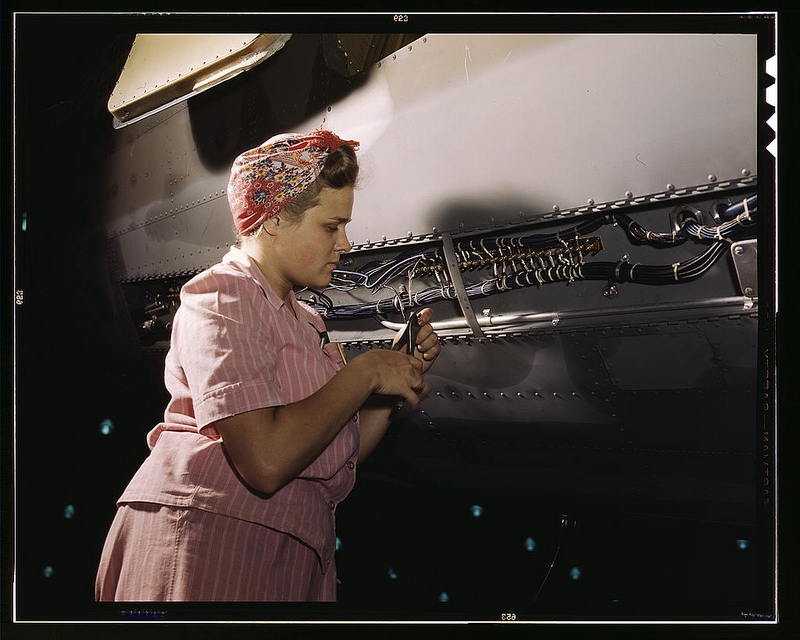
Of course, there were also the Women Marines (about 20,000 during World War II) and the SPARs (Coast Guard women, about 12,000 served; their name comes from the Coast Guard motto “Semper Paratus, Always Ready). And we can’t ignore the contributions of the “Rosie the Riveters,” millions of women who entered the workforce during the war to take jobs on assembly lines and in other formerly-male jobs. Before World War II about 12 million women were in the workforce. By the end of the war, that number had swelled to 18 million, a full third of the workforce, and three million of those were “Rosies.”
A "Rosie" working as a Electrician, National Archives.
While historians are divided about the lasting contributions of these women, those who served in both civilian and military jobs believed their work mattered. They were the “hinge”: without their contributions the world wouldn’t have changed in the same way. Without them, our world would be a different place.
First post-WWII WAVES take the oath of office, U.S. Navy.
Our friends at the National Women’s History Museum seem to be on the same wavelength this week. They put together a fabulous video series about women who blazed a trail for those who followed – and those who are dedicated to keeping those histories alive. Part One is embedded below (see Part Two and Part Three on their YouTube channel).
Thank you, this Thanksgiving eve, to the National Women’s History Museum and everyone else who is honoring the trailblazers in women’s history! And, of course, thank you to the trailblazers!


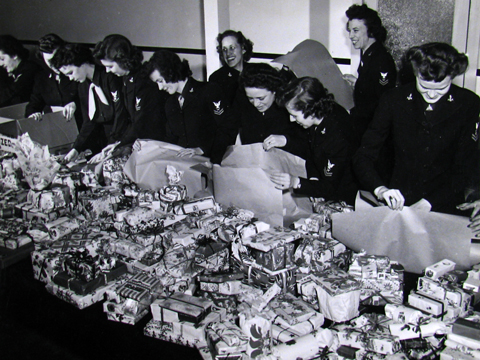 WAVES in Bethesda, MD, wrap holiday gifts in December of 1944.














 Hinges of History