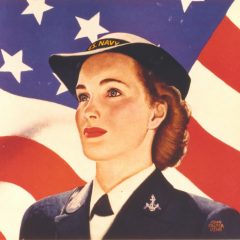
The Leader Resigns

Mildred McAfee would lead the WAVES until August of 1945. During that time, she amassed some pretty impressive military firsts:

  • First female line officer in the Navy (1942)
  • First WAVES Director (1942-1945)
  • First female Navy Captain (1944)
  • Recipient of the Distinguished Service Medal

After she resigned as Director of the WAVES, McAfee would remain active duty until February of 1946.

McAfee met and married the Reverend Dr. Douglas Horton while in the Navy and changed her name to Mildred McAfee Horton. After she left the WAVES, she would first return to the Presidency of Wellesley College, where she would remain until 1948. After she left Wellesely, she became involved with the General Council of Congregational Christian Churches. McAfee also served as a UNESCO delegate, was on the board of directors of the New York Life Insurance Company, the National Broadcasting Company, Radio Corporation of America, and the Ford Foundation’s Fund for the Advancement of Education. She later co-chaired the National Women’s Conference on Civil Rights.

This photograph comes from the Naval Historical Center.

Mildred McAfee

Mildred McAfee attended Vassar College in New York, where she studied economics, sociology and English. She was also active in team sports (hockey and basketball), the Christian association, and student government. She earned an M.A. in sociology from the University of Chicago.

McAfee spent 14 years working in various collegiate administration positions (including Dean of College Women at Oberlin College) before being selected as President of Wellesley College in 1936. She beat out 100 other candidates for the job. She was just 36 years old.

She told Wellesley students:

I envision the function of this college, or any college, to prepare an oncoming generation of students to disseminate truth. It is my conviction that truth is more easily given a hearing if it’s presented by a healthy, well-adjusted, effective human being who see truth in the light of a word philosophy that gives it meaning.

McAfee wasn’t the first female president of Wellesley (that would be Ada Howard, who was also the first president of the school.)

This photograph shows Mildred McAfee (left) with Rear Admiral A. E. Watson and Margaret Disert in August of 1942. It comes from the Naval Historical Center.

Women’s History Month!

March is Women’s History Month, and we decided that our blog a day will feature firsts or other accomplishments by the WAVES.  Please let us know if there’s something you’d like to know more about, or would like to see featured this month.

We begin with Mildred McAfee. She’s a pretty special woman to the WAVES we’ve talked with on this project. She was the leader of the WAVES for most of World War II.

McAfee was the daughter of a pastor and the President of Wellesley College before being asked to lead the WAVES. She said at the time that the Navy brass told her:

The Navy is going to admit women into the regular positions in the Navy. There’s not going to be any separateness about this. You’re going to be really in the Navy. That sounded very good to me and I used it all the rest of the way through the war.

McAfee was the first Navy female line officer in 1942 and was appointed a Navy Captain in late 1943 – the only WAVE Captain at the time.

We salute Ms. Mac!

This photograph comes from the Naval Historical Center.

A Strange Sight

One of the first things Frances Wills Thorpe did as an officer was to visit a Navy ship docked in Brooklyn. There she became acutely aware of her status as something unusual, as she recalled in her memoirs:

I became aware of a brown face, staring, wide-eyed from the galley opening.  I tried to appear casual as I smiled lightly in his direction.  The face disappeared and another brown one took its place immediately, equally wide-eyed.  Seconds later, it seemed, the soup was brought to the table.  The steward who had seen us first, came to me.  Nellie smiled at me, obviously trying to hold onto her dignity because she recognized that I was beginning to be embarrassed.  I thought that any moment she would fall into giggle but both she and Anna watched and waited demurely until the steward crossed to their side, as this were the expected way to be served. Only after I passed the third serving plate did I realize how I had almost missed a reaction which I would soon become accustomed to see in various places, with different people. It was the first time that these stewards (the only job available for many years for Afro-Americans in the Navy) had seen a person of color in officer’s uniform.  It may well have been the first time they had seen WAVES of any color since they had just returned from duty.

When asked, near the end of our training, to state a preferred location for assignment, I had written ‘East or West Coast.’ After I had completed my entire Navy duty no more than forty-five minutes from where I lived and had signed on, except for three days temporary duty in the distant ports of Philadelphia and Washington, I often wondered if my Navy experience might have been altogether different had I written ‘West Coast’ first.

Frances was assigned to the Hunter College boot camp for the duration of the war. This photograph comes from the National Archives.

“I Can Make You Love Me”

Doris Cain had been married before she joined the WAVES in 1944. The marriage ended badly and she decided to enlist so she wouldn’t see her husband in the small farming community where they lived (he was deferred from military service because of the farm).

One day, she was at the USO for a dance and met a man who had been a pharmacist’s mate on Guadacanal. Doris was gunshy – she didn’t want to get into another bad romantic situation. And something the pharmacist’s mate did raised her suspicions:

He was wearing a Marine uniform when I met him. He made a date with me to pick me up for dinner or something, and he picked me up in a sailor uniform. I was really amazed because I didn’t know you could interchange uniforms like that. I almost quit going with him. We were working in a tight secure environment. I didn’t want to have anything to do with somebody who was messing around, do you know what I mean?  Well, you don’t know if they’re spies or if they’re crazy or what. So I went out with him for dinner but I wouldn’t make another date or anything. He kept bugging me. “Why? Why?”  And I told him.  I said, “Because you wear a Marine uniform one time and a sailor uniform.”  That’s when he told me that the Marines don’t have a medical department and the Navy supplies medical for them. He was stationed at Camp LeJeune, North Carolina.  That’s the reason he could go in either uniform. He wears a Navy patch in the Marine uniform that shows he’s a pharmacist. But outside of that you can’t tell.

Doris’ pharmacist’s mate was persistent. They began going out, and he began asking her to marry him.

He proposed to me, but I wasn’t sure that I wanted to get married again. I told him, I says, “I don’t love you.” And he said, “But I can make you love me.”  So I married him.

By this point it was late 1945 and the war was over. Doris left the service and she and her pharmacist’s mate got married shortly after. Once he was out of the military, they moved to California and had two children.

This photograph, “She Loves Me, She Loves Me Not,” shows WAVES and sailors on liberty in New Orleans, LA, c. 1944. It comes from the Naval History and Heritage Command.

Hunter College: Living Quarters

Hunter College was primarily a commuter college; there weren’t any dorms on the campus grounds. The Navy needed housing for 8,000-10,000 women at a time (plus instructors), so it turned to the Bronx neighborhood for help. Apartments surrounding the campus were commandeered by the Navy for the duration of the war.

An article in the New York Times talked about this development:

While … merchants on Kingsbridge Road, the nearest shopping center, all claimed their businesses would suffer, none complained.  Businessman Max Steubens, who ran a self-serve market, depended on the 13 apartments for most of his business, but when interviewed said, “I’m more than willing to do my share toward the war effort” (1.13.43) A few days after this, complaints arose because nearby apartments were raising rent for the occasion. The situation was investigated and The New York Times made sure to note that, “The complaints they received were logical and natural and not at all unpatriotic” (1.14.43)

This photograph comes from a postcard booklet designed for WAVES recruits to send it home to their parents, families and friends. It shows the converted apartments, where women lived 8-10 to a one bedroom unit.  It is from the Betty H. Carter Women Veterans Historical Project at the University of North Carolina Greensboro.

Honorable Discharge

V-J Day happened August 9, 1945. Jean Clark’s husband, Lou, returned to Seattle from his assignment soon after and was to be immediately discharged. Jean’s commander decided to help her out as well.

He said, “I’ll put you down for 30 days leave. You come back and your discharge will be complete.”  So I went home with my husband and we — then we came back in a month. That was in August, I think. By the time we got back the discharge was complete. We went back to Lebannon where my parents were living. We didn’t have a house or anything. While we were there, we decided, I guess maybe we ought to find a job. We did. We went to the school district and both of us were hired. Because then teachers were in short supply and we both had our degrees and our certificate.

This is a photograph of Jean’s honorable discharge from the Navy, dated September 6th, 1945. It comes from the collection of Jean Clark.

Telegram

Jean Clark’s husband was in the Army, stationed overseas. But that didn’t mean he didn’t stay in touch.

This telegram was sent to Jean while she was stationed at Lake Washington Naval Air Station. It shows her husband’s sense of humor, even as he’s sending her a “love” letter:

Fondest love darling. You are more than ever in my thoughts at this time. Please send me one hundred dollars. Lewis E. Clark.

Maybe telegraphs were the text messages of their day? Minus the emoticons, of course.

The telegraph comes from the collection of Jean Clark.

Growing Up

Jean Clark was stationed at NAS Lake Washington for two and a half years. She said her experience in the Navy changed her outlook on life:

Well, I think it helped me to grow up a little bit. You know. I said, you know, I was 19 when we were married and well, ’45 I was 24. And during that time, I think was pretty green, I was, you know, about the rest of the world and after that,  we sort of took advantage of some things and got to go a little farther then we might’ve before.

This is a photograph taken at NAS Lake Washington of WAVES and a sailor relaxing between assignments. It comes from the collection of Jean Clark.

Learning the Ropes

Jean Clark was sent to Atlanta in order to learn how to give proper instruction to potential pilots via the Link Trainer. But it wasn’t enough to simply learn how to give instruction. They had to learn everything about the trainer from top to bottom.

We also had to check the trainer. While we were at the air base, not only did we learn how to operate the trainer, we also learned how to repair it if anything went wrong.  There was an engine just outside of the building, the main, that had to be dismantled and cleaned every now and again so it was operating efficiently.  That was part of our duty.

At the end of the training session, the women received a certificate saying that they were qualified in their ranking.

This certificate comes from the Jean Clark collection.