Post-War WAVES?

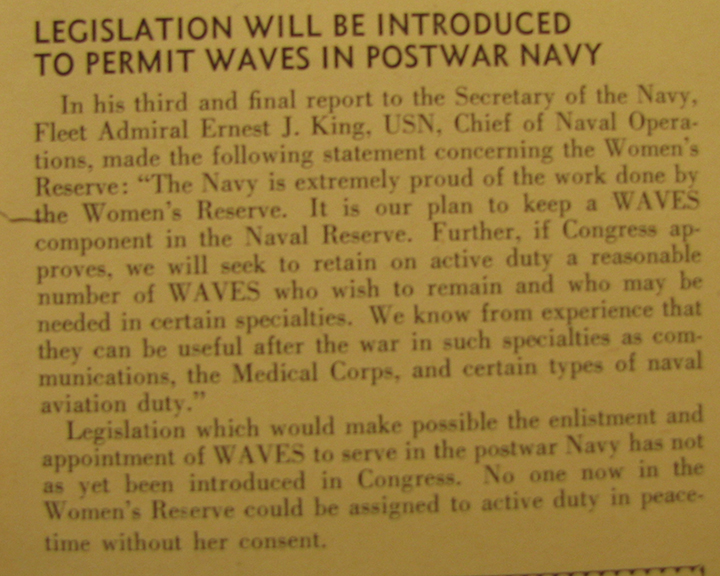
The reality is that a group of women hoped to remain with the Navy after the war – while others were looking forward to returning home. So in the articles discussing the possibility for a post-war Women’s Reserve, the Navy had to strike a careful balance, as illustrated by this article. While the article discusses how women might be able to continue to serve, it also reassures them that “no one now in the Women’s Reserve could be assigned to active duty in peacetime without her consent.”

It comes from the Schlesinger Library at Radcliffe College.
Cake and Candles!

Today we’re celebrating the birthday of the sister of the Homefront Heroines director (and daughter of a WAVE). Happy birthday, Sharon!  And happy birthday cousins Karen and Melanie, also born on the same day.

In this photo from the National Archives, WAVES pose behind their 2nd anniversary birthday cake in New Orleans.

A Company of Two

Only two Navy WAVES were qualified to wear victory medal of World War I.  Joy Bright Hancock (left) and Eunice Whyte (right) both served as Yeomanettes during World War I. About 25,000 Yeomanettes (from Yeomen-F, or Yeoman-Female) were part of the regular Navy because of loophole – the military act at the time didn’t specify that only men could serve. The loophole was closed after the war, and women wouldn’t become an official part of the Navy, other than nurses, until 1942.

This image come from the National Archives.


First the Hat


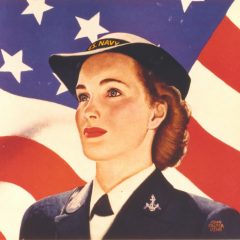
Before WAVES recruits would get their uniforms at boot camp (which needed to be personally fitted), they would receive the WAVES hat.

This image comes from Marjorie Sue Green’s booklet From Recruit to Salty WAVE! The Ordeal of Seaman Green held by The Betty H. Carter Women Veterans Historical Project at the University of North Carolina Greensboro.

Seaman Green

The next step after signing the paperwork? Becoming a recruit, or seaman.

Marjorie Sue Green’s booklet From Recruit to Salty WAVE! The Ordeal of Seaman Green illustrates Green’s transformation from civilian to military.

It comes from The Betty H. Carter Women Veterans Historical Project at the University of North Carolina Greensboro.

Extra Pay

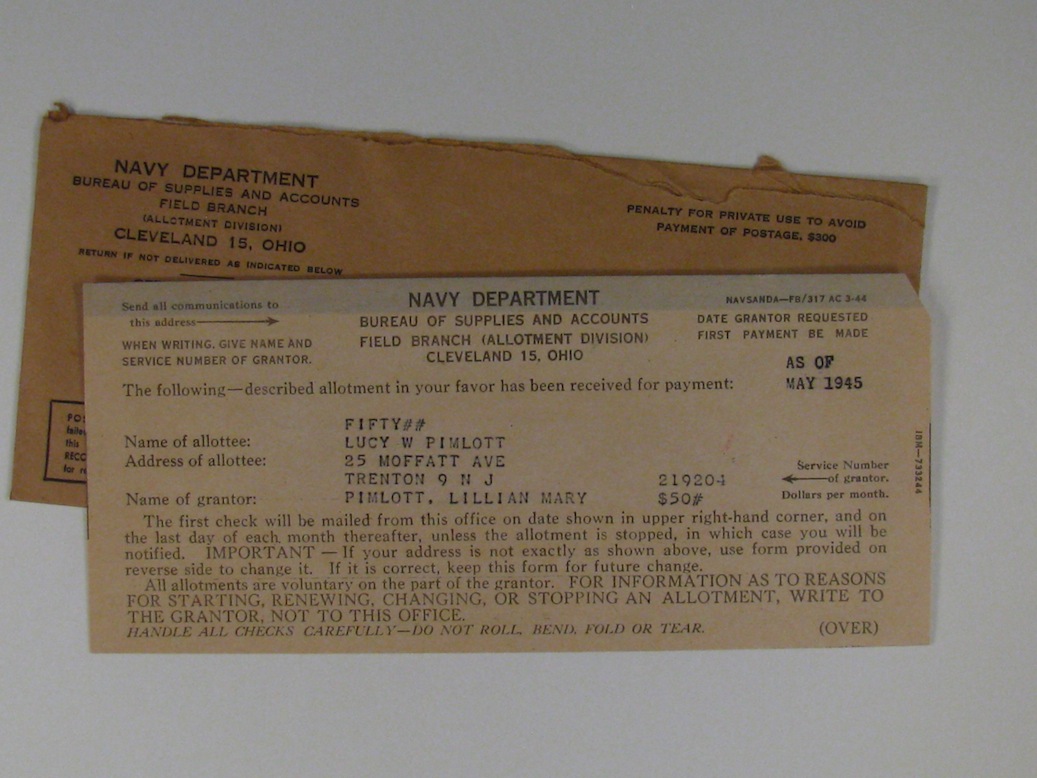
This is a really fascinating document found in the Betty H. Carter Women Veterans Historical Project at the University of North Carolina Greensboro. It is a receipt for extra pay ($50) disbursed to Lucy W. Pimlott, on behalf of WAVES Lillian Pimlott. WAVES received the same pay as men, and like men often received extra money to pay for uniforms and uniform updates. It’s likely this is for a uniform or other supplement, as the $50 amount is much lower than all but one of the Navy pay rates (only an Apprentice Seaman, the lowest rank in the Navy,  made $50 a month).

At this time of this disbursement, WAVE Lillian Pimlott was stationed in Hawaii working in the District Personnel office. She had been in the WAVES since 1943 and would later become a part of the post-World War II Navy.

This disbursement was likely a portion of Pimlott’s monthly base pay, sent home to help support her family.