Here’s the exciting news: the rough edit of the film is done (!!!) and our fabulous composer Andy Forsberg should have our music composed by mid-February.
So what’s up in the New Year for the Homefront Heroines crew?
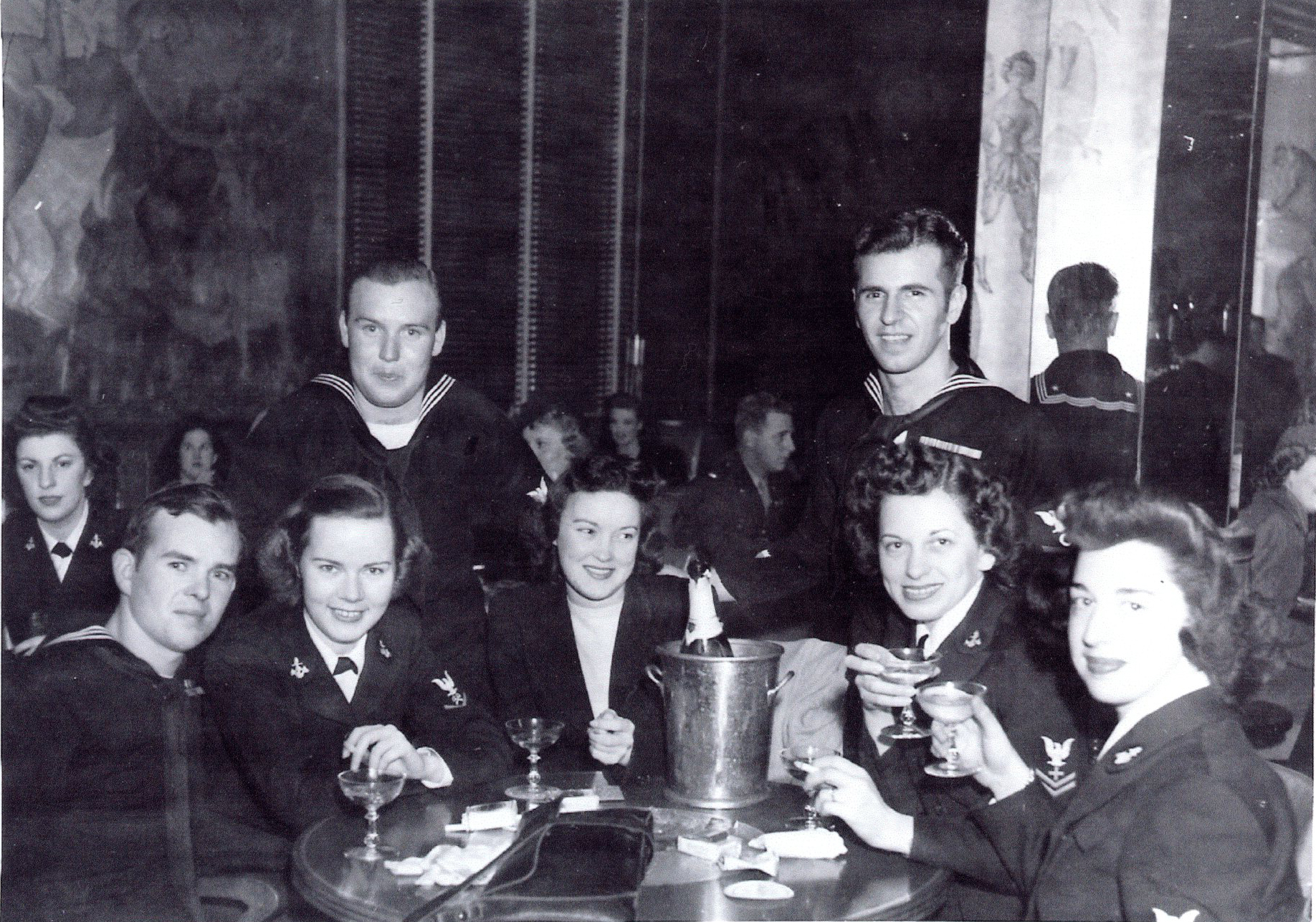
Champagn and celebration with Navy WAVES at San Francisco's Fairmont Hotel.
We have some resolutions in place.
Blog a WAVES picture a day for 2012
Submit the film for ITVS and American Documentary Film Fund financing in January. Then, on to American Experience, who we’re hoping will agree that the story of the WAVES is worth a place on PBS. The funding will help us with our other resolutions.
License film footage and archival music
Find a firm to do color correction
And, find a narrator. We love the idea of :
Zooey Deschanel – because of her work with Hello Giggles advocating strong storytelling by women
Geena Davis – she’s a huge advocate for strong female role models, was a part of the film Women, War and Peace and was a speaker last year at the Joint Women’s Leadership Symposium, where we’ll be talking about the film in March
Mila Kunis – The Black Swan and Friends with Benefits star made news this year for going to the Marine Corps Ball after being asked out on Twitter. How about supporting the accomplishments of military women?
What do you think?
Here’s to a fabulous 2012 and the debut of Homefront Heroines both for the WAVES at the WAVES National Annual Conference and (ideally) at a film festival or on a television screen near you!
WAVES could, of course, get leaves to spend time with family and friends. But holiday leave – that was another thing. It was highly desirable and tough to get. And the Navy, unlike civilian businesses, didn’t take a day off because it was Christmas.
Betty Bruns Lord in Uniform
It wasn’t until 1945 that Betty Bruns Lord would be allowed home – to Mason City, Iowa – for the holidays.
You didn’t get a lot of leave and sometimes you couldn’t get off because you were so busy. Just couldn’t take it when you wanted to. And I know when the boys started coming home — the last year, in ’45, I did get home for Christmas which was something you didn’t get at that time. A lot of the boys said, “Well, uh, uh?” He said, “These girls haven’t been home for Christmas since they joined.” “Oh.” And so Commander Fair, we did get our leaves. We thought for sure we were going to get cancelled. But no no no no. He said, “No, you girls are going home. You haven’t had yours.”
On the airstrip with Betty Bruns Lord
Betty was stationed at Mustin Air Field in Philadelphia working on planes. She was one of the WAVES who not only worked on planes, but knew how to fly them. Her uncle had trained her as a pilot before the war.
Virginia Gilmore was married when she joined the WAVES in 1943. Her husband was a handsome Marine. But in their first Christmas as a married couple they were thousands of miles apart. He was just back from a two-and-a-half year stint in the Pacific, stationed at the Puget Sound Navy Yard in Bremerton, Washington. Virginia was at the other end of the country at WAVE boot camp in Hunter College.
We were there on Christmas Eve. And huge Navy trucks pulled up and they unloaded a filled stocking for every recruit and hung them — they came in and hung them on the corner of our bunks.
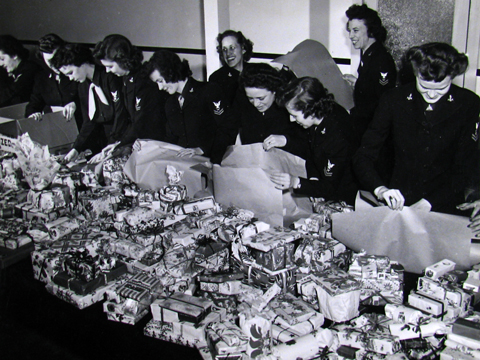
WAVE Wraps Presents, U.S. Navy Photograph
We had candy and gum and cookies and little presents. Can you imagine all the thousands — I don’t know what the Navy word is for Navy warehouse, but Navy stores where you could find all those things but we had them.
Joyce Fish Sherwood joined the WAVES in 1942. Like Helen Edgar Gilbert, she was part of the first class of WAVES, who skipped the Hunter College boot camp experience. After enlistment, Joyce was sent to Indiana University in Bloomington for orientation and storekeeper training.
Joyce was stuck in training and Christmas was approaching. So since she couldn’t get home to her family, her family brought Christmas to her.
US Navy Photograph
The three of them came down and stayed in Bloomington and came onto what we called the ship (laughs) to visit and they were allowed to do that. I really don’t have much of a recollection of gift giving or anything like that. Because we had our uniforms by then. We had sent all out civilian clothes home. So there wasn’t much they could give me except stationary (laughs) or things like shampoo and stuff that you would always need.
US Navy Photograph
They were proud. They were proud. I think that had something to do with this patriotism blast we were on, too. All the civilians were, “Oh! You’re in the military!” You know, they were glad to see us and they were appreciative of what we were trying to do.
We’ve been humming Bing Crosby’s White Christmas a lot lately – likely because there’s no risk of not having Christmas snow this year in Colorado. The song first premiered on an NBC radio show in 1941 and was initially released on an album for the film Holiday Inn, about a pair of song and dance men who create a country inn that featured holiday-themed performances.
By October of 1942, White Christmas was released as a single and it quickly shot to the top of the “Your Hit Parade” radio charts. The song perfectly captured the mood of the time. In it, the singer pines for the perfect Christmas:
I’m dreaming of a white Christmas, just like the ones I used to know
Where tree tops glisten, and children listen to hear sleigh bells in the snow…
Those first classes of WAVES were in training during the Christmas of 1942. Helen Gilbert was training to be a radio coder at the University of Wisconsin in Madison:
I remember Bing Crosby’s White Christmas. Every time it went on we were just sobbing. It was crazy…The first Christmas in Wisconsin, it was very sad. We were all homesick. We were just a bunch of young girls who wanted to go home.
White Christmas would later be the inspiration for the film of the same name – featuring former Army buddies (and Broadway stars) who head up to Vermont in the years after the war to help their beloved General’s struggling Vermont inn.
White Christmas is the biggest selling single of all time.
When searching for an article to link to on our Facebook page, a story from the St. Petersburg Times popped up. It was about WAVES National Unit 27, which shut down on November 12th of this month. The ladies had met every month or so for the last 25 years, sharing stories and camaraderie. Sixteen women were members of the unit and paid their annual dues, but only five attended the meetings and were active in keeping going. So this year, they made the hard decision to shut the doors. Said Unit Vice President Lee Lund, a WWII WAVE:
The unit has disbanded because of the decline of membership due to death, health issues, lack of younger members to take office and not enough members to assume officer responsibilities.
Unit 27 is facing challenges familiar to all the WAVES National units. When this project began, members were scattered in states across the country. Oregon, where the Homefront Heroines producer and director were living at the time, had the second largest number of units on the West Coast (only California had more); Florida, with its scores of retirees, was traditionally only of the states with a high number of units. The WAVES National Convention, held aboard a cruise ship in 2006, drew nearly 300 women, veterans of WWII, the Korean War, and Vietnam. However, only a handful came from more recent conflicts.
WAVES National Convention 2006, courtesy Mel Kangleon
It’s not just an issue in Florida. Oregon, which had that plethora of active units when we began the project, now had just one listed on the WAVES National website. Other states are seeing similar declines. Barbara McCarthy, herself a Korean vet, was the most recent president of Unit 27. She saw the problem as twofold:
Only three of us are under (age) 80. Three girls are in assisted living facilities. One is homebound. Younger women are working, raising children
But Harvard Professor Robert D. Putnam offers some startling research that indicates this lack of community involvement from the younger generation may be something beyond just working and raising a family. Instead, it has something to do with a shift in traditional social capital:
The very fabric of our connections with each other, has plummeted, impoverishing our lives and communities. We sign fewer petitions, belong to fewer organizations that meet, know our neighbors less, meet with friends less frequently, and even socialize with our families less often.
He dubs this trend “bowling alone,” because while Americans are bowling, they’re not doing it in leagues or other formalized organizations, but rather, alone.
Putnam doesn’t see this as a terminal condition; in fact he offers a list of 150 things you can do to build social capital. And we are seeing an uptick in some organizational groups, such as the politically based Tea Party and Coffee Party movements. Facebook can also offer a way to feel a part of a virtual community, and there are a plethora of veterans groups there (check our our Facebook page “likes” for links to some).
On another note, today (November 26) is Small Business Saturday, a movement to support local and independent businesses during the holiday season. It’s a great cause – and a great way to build social capital through supporting your own community.
From Mary M. Ryan. She is somewhere in the sea of women at Hunter College.
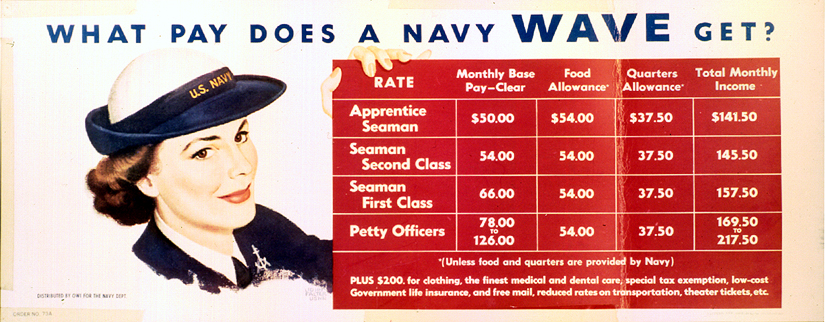
As you know, my mother was a WAVE during World War II – and it was her story which inspired this project. And the WAVES were truly trailblazers during the war. This blog is called “Hinges of History” to recognize that contribution. The WAVES were the first women admitted into the service at the same rank and pay as men. And it wasn’t just the service – women during that era generally were paid less than men, under the rationale that they didn’t need the money as much because men were supporting families and women were “only” supporting themselves. So for the Navy to pay women the same amount for the same work was pretty groundbreaking.
WAVE Pay Scale Recruitment Poster, U.S. Navy
But the WAVES weren’t the only ones forging new territory during the war. Inside of the military, the Army WAACs (Women’s Army Auxiliary Corps, later Women’s Army Corps) were the first women other than nurses to travel overseas in troops with men.
WACs in Formation, U.S. Army
The WASP (Women’s Air Service Pilots) were the first women to regularly fly planes, mostly ferrying planes in the continental United States from one side of the country to another. They weren’t “in” the service, but had the same risks as male pilots: 38 WASPs died while flying for their country.
WASPs on a Plane's Wing, International Women's Air and Space Museum
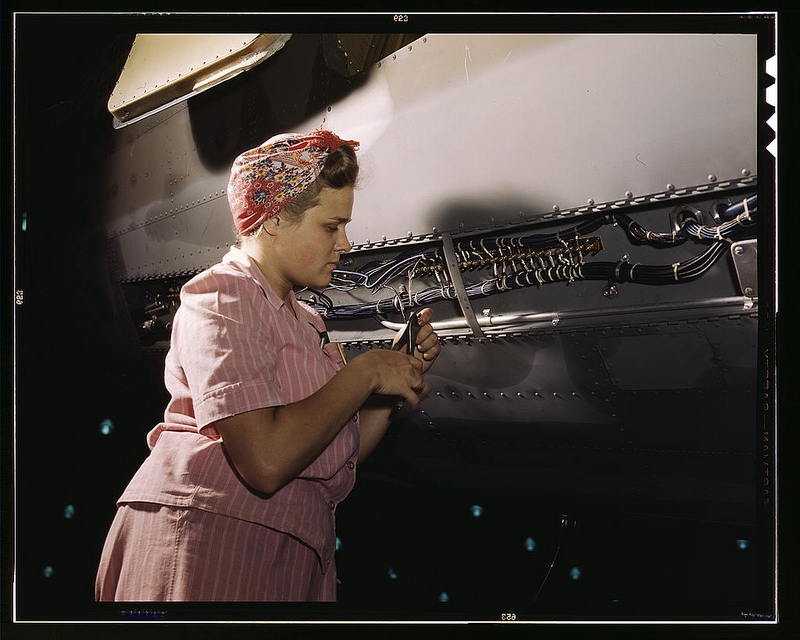
Of course, there were also the Women Marines (about 20,000 during World War II) and the SPARs (Coast Guard women, about 12,000 served; their name comes from the Coast Guard motto “Semper Paratus, Always Ready). And we can’t ignore the contributions of the “Rosie the Riveters,” millions of women who entered the workforce during the war to take jobs on assembly lines and in other formerly-male jobs. Before World War II about 12 million women were in the workforce. By the end of the war, that number had swelled to 18 million, a full third of the workforce, and three million of those were “Rosies.”
A "Rosie" working as a Electrician, National Archives.
While historians are divided about the lasting contributions of these women, those who served in both civilian and military jobs believed their work mattered. They were the “hinge”: without their contributions the world wouldn’t have changed in the same way. Without them, our world would be a different place.
First post-WWII WAVES take the oath of office, U.S. Navy.
Our friends at the National Women’s History Museum seem to be on the same wavelength this week. They put together a fabulous video series about women who blazed a trail for those who followed – and those who are dedicated to keeping those histories alive. Part One is embedded below (see Part Two and Part Three on their YouTube channel).
Thank you, this Thanksgiving eve, to the National Women’s History Museum and everyone else who is honoring the trailblazers in women’s history! And, of course, thank you to the trailblazers!
In January of 1941, months before the United States would become officially involved in World War II, President Franklin Roosevelt gave one of his radio addresses.
Roosevelt was an innovator in using mass media to help bring his message to the public. His speech about the banking crises in 1933 was the first time a President had used the power of the radio to speak directly to the American public (in this case to attempt to stop the bank runs which nearly destroyed the nation’s economic system in 1933). That speech would lay the groundwork for the Fireside Chats, 31 radio addresses on a variety of topics, ranging from the New Deal to the War in Europe.
The Four Freedoms speech wasn’t one of those Fireside Chats. It was the official State of the Union Address for 1941. But it nonetheless illustrates Roosevelt’s skill at using the public airwaves to speak to the American public:
In the future days, which we seek to make secure, we look forward to a world founded upon four essential human freedoms…That is no vision of a distant millennium. It is a definite basis for a kind of world attainable in our own time and generation. That kind of world is the very antithesis of the so-called new order of tyranny which the dictators seek to create with the crash of a bomb. To that new order we oppose the greater conception—the moral order. A good society is able to face schemes of world domination and foreign revolutions alike without fear.
Roosevelt included two Constitutionally-mandated freedoms (Freedom of Speech and Freedom of Worship) in his speech, and then added two freedoms which he said should be a part of the social contract we have with our fellow Americans. Freedom from Want means that Americans shouldn’t go hungry or be without basic human needs (food, shelter, etc.) – and that a modern society had a responsibility to provide for those in need. Freedom from Fear means that we should live in a country where we don’t have to worry about our safety. Roosevelt went on to say that these weren’t just American values, but should be values available to everyone in the world.
The Four Freedoms wasn’t a Thanksgiving speech, but nonetheless we’re thankful this time of year for Roosevelt and his identification of the Four Freedoms.
Seventy years ago today, America wasn’t officially involved in World War II. In less than a month, the country would be. The Japanese attack on Pearl Harbor would thrust the United States into the war and transform the country.
This is a photograph of my (Homefront Heroines Director Kathleen Ryan) mother, Mary Marovich Ryan. It was taken after she enlisted in the WAVES. She came from a large family and grew up on the south side of Chicago. They didn’t have much – it was the Depression and there were a lot of mouths to feed.
But as the war enlisted all of her brothers – except for her younger brother who was too young to join up – enlisted in the military. They joined the Army and the Coast Guard. Two of her brothers joined together. By the time my mother enlisted, every member of her family was in the service, except for that younger brother and a sister who was married with a young child (her younger brother would serve during the Korean War). I love her quote in the article below about wanting a six star pin so she can honor her brothers.
Those of you who have been following the Homefront Heroines project know that my mother didn’t talk much about her military service. I knew that enlisted in mid-1943. She went to New York for boot camp, and then traveled across country on a train to head to her specialty training at a Naval Hospital in California as a pharmacist’s mate. A pharmacist’s mate helped out in various medical capacities; my mother actually worked in the pharmacy. She was stationed at Treasure Island in San Francisco where she met my father, a pilot in the Army Air Forces. She was decommissioned shortly after V-J Day, and she and my father eventually settled about an hour north of New York City in a town along the Hudson River.
But she kept things. Like these photographs (including the one above of a celebration at the Fairmont Hotel in San Francisco with a group of friends) and the articles about her service. Or a book discussing the properties of various prescription drugs. Or gloves. Dozens of pairs of white cotton gloves, which were part of the formal WAVES uniform. And before she died, she asked that she be buried with military honors, commemorated by a headstone listing her dates of service.
On this Veteran’s Day, we salute all of those who offered their service to our country, including those Homefront Heroines who blazed a trail for women in the future – in the military, of course, but also in the civilian workplace.













 Hinges of History