“Yes They Are”

Virginia Gildersleeve, Dean of the all-women’s Barnard College in New York, believed that it was a duty for women to participate in helping the war effort. After the Pearl Harbor attack, she spoke to students at Barnard College about the opportunities women might have:

Are they really going to use women for ‘trained personnel’?  Yes, they are.  They have begun to realize that the ‘man power’ of the country includes also the woman power, and that the government and industry will be forced to use women for nearly every kind of work except the front-line military and naval fighting.
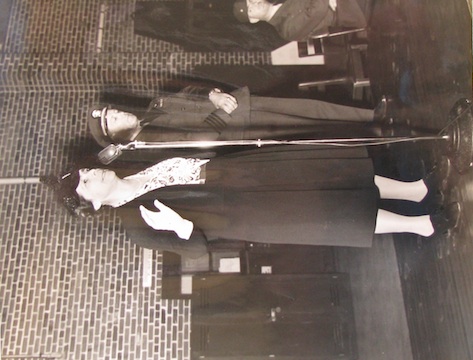
This photograph comes from the Schlesinger Library, Radcliffe Institute for Advanced Studies.

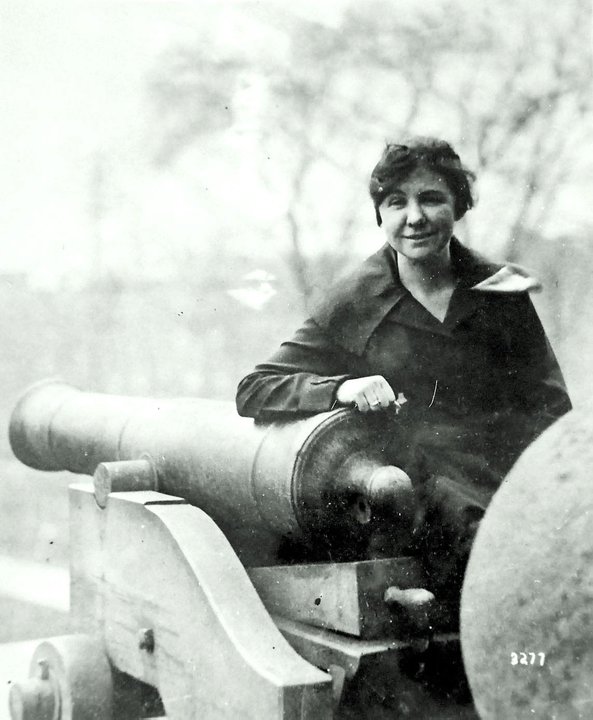
Virginia Gildersleeve

As the rumblings of World War II began in Europe, women in the U.S. began laying the groundwork for women to serve in the military here. Joy Bright Hancock began doing some of that work within the Navy, in her role as a civilian for the Naval Bureau of Aeronautics.

But other women also lobbied for for women’s military service. Virginia Gildersleeve was the Dean of Barnard College in New York. She wrote at the time:

It seemed as if Hitler were about to plunge Europe into war and I, having just returned from abroad, was profoundly distressed.  I felt that we ought to do something about it.  I was intensely interested in this problem … and the enormous contribution that women might make.

This photograph comes from the Schlesinger Library, Radcliffe Institute for Advanced Studies.
The Telegraph

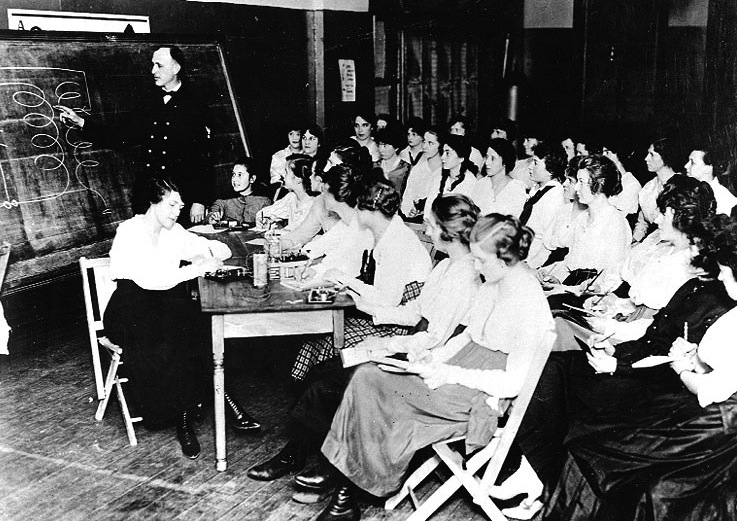
The Yeomenettes greatly expanded the opportunities for women in the Navy.  One job the women learned was telegraphy, using a telegraph to send messages via wires over long distances using Morse Code. The Morse telegraph was invented in the United States in 1936, and by 1861, telegraph cables stretched not only across the United States but also under the Atlantic Ocean to Europe.

In this photograph, new enlistees receive training in telegraphy from a Chief Petty Officer, at the Naval Training Center, Great Lakes, Illinois, in 1917. Some of these women are in uniform while others are still wearing civilian attire.

It comes courtesy of the Naval History Heritage and Command.

The First Yeoman (F)

When looking at the history of the WAVES, and Navy women’s firsts during Women’s History Month, one can’t ignore the contributions of the World War I Yeomen (F). The Yeomenettes (as they were known) were the first women to serve in the Navy in a position other than nursing. They did a wide variety of work in the Navy, from clerical jobs to translations to fingerprinting and ship camouflage design.They were allowed in because of a loophole in the Naval Act, which never indicated that Naval service was limited to men.

Loretta Perfectus Walsh was the very first Yeomanette. She enlisted on March 17, 1917 at age 18. She became the first woman Navy Petty Officer on March 21st of the same year.

About 13,000 women were WWI Yeomanettes.

This photograph comes from the Library of Congress.

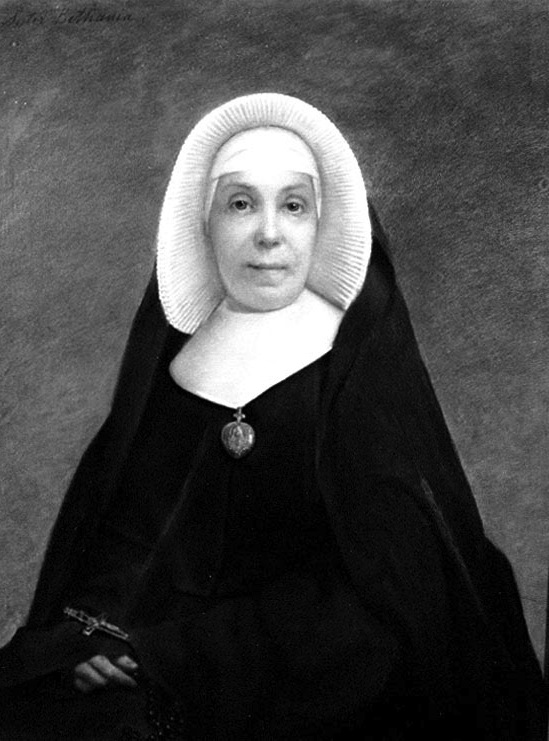
Mother Angela

Eighty Sisters of the Holy Cross served the Navy as nurses aboard the USS Red Rover during the Civil War. The Red Rover was a hospital ship based in the Mississippi River.

They were supervised by Mother Angela Gillespie, founder of the Sisters of the Holy Cross.

This engraving of Mother Angela comes from the U.S. Naval History and Heritage Command.

Aboard the Red Rover

During the Civil War, the the USS Red Rover. a hospital ship based in the Mississippi River, became the first Navy vessel to have women on board. The Catholic Sisters of the Holy Cross served as nurses aboard the ship.

This engraving from Harper’s Bazaar shows  a sister nurse attending a patient bedside in one of the wards. It comes from the U.S. Naval History and Heritage Command.

The First Shipboard Women

By the Civil War, the U.S. Navy realized that it would need help from women. And since nursing was an accepted profession for women, the Navy decided that women could serve aboard ships as an experiment.

But not just any women. Nuns. Specifically the Catholic Sisters of the Holy Cross, who served in aboard the pioneer Naval hospital ship the USS Red Rover.  The ship was based in the Mississippi River.

This engraving from Harper’s Bazaar shows at left a sister nurse attending a patient bedside. It comes from the U.S. Naval History and Heritage Command.

Growing Up

Jean Clark was stationed at NAS Lake Washington for two and a half years. She said her experience in the Navy changed her outlook on life:

Well, I think it helped me to grow up a little bit. You know. I said, you know, I was 19 when we were married and well, ’45 I was 24. And during that time, I think was pretty green, I was, you know, about the rest of the world and after that,  we sort of took advantage of some things and got to go a little farther then we might’ve before.

This is a photograph taken at NAS Lake Washington of WAVES and a sailor relaxing between assignments. It comes from the collection of Jean Clark.

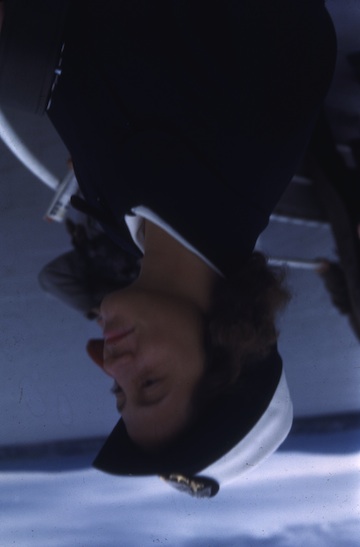
Franny Prindle Taft

Meet Franny Prindle Taft. She was a WAVE during World War II and spent her entire Navy career at Smith College in Northampton, training future officers. Taft was in the first full officer class at Smith College in the fall of 1942.

This photo was taken sometime in 1943 while she was on her honeymoon with her husband Seth Taft (the grandson of President William Howard Taft). They traveled up the Hudson River to Canada; both were officers in the Navy and had met while at college (she at Vassar, he at Yale).

 I did work in cancer research at Yale right after I got out.  That’s where I went immediately after graduation … I was making really almost no money, and I heard about the WAVES.   I didn’t want to go into anything that was kind of just an auxiliary with people jumping around in uniforms and not really doing very much.  And (the secretary to the Dean at Vassar College) assured me it was going to much more than that.

Frannie lives in the Cleveland area, where she teaches at the Cleveland Institute of Art.

This photograph is courtesy of Franny Prindle Taft.

Why Women Choose the Military

Today approximately 20 percent of all new military recruits are female and 11 percent of the U.S. forces deployed to Iraq and Afghanistan have been women. (Iraq and Afghanistan Veterans of America)

Why do women choose military service?  Here’s what Army First Lieutenant Jessica Scott, contributor to the PBS “Regarding War” blog,  says:

” There are a number of things that the military offers that makes joining and staying in the military attractive for women and men alike. According to the Defense Department Advisory Committee on Women in the Services’s Annual Report for 2008, the number one reason women stayed in the military was their sense of job satisfaction and job performance. Other reasons for women to stay in the military included access to health care, education opportunities, a sense of purpose and being part of a team. “

To read her full article click here.

Joining the service in the ’40s was a different story.  Taking the same jobs in the Navy as men had never happened before, the WAVES were breaking out of traditional roles and looking for a way to get involved in the war effort.

Pearl Harbor was a milestone for many WAVES in their decision to join.  Read more about women’s roles in society and the military before WWII on the Homefront Heroines site exhibit “Before the Waves.”