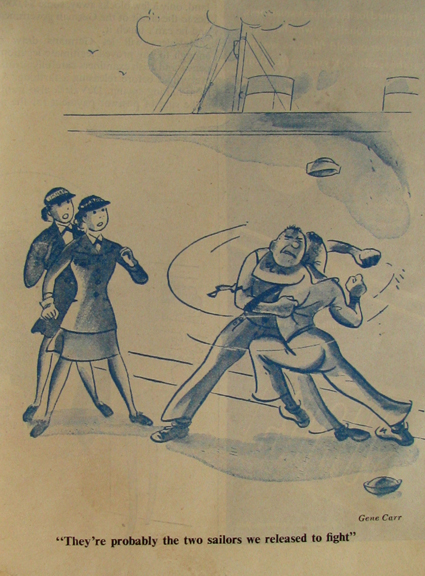
This likely isn’t what the military was thinking about when they released the film Why We Fight or when they came up with the slogan “Free a Man to Fight.”
The comic from an unknown magazine comes from the collection of Liane Rose Galvin.
A Blog About Women Who Were Homefront Heroines: the WAVES of World War II
This likely isn’t what the military was thinking about when they released the film Why We Fight or when they came up with the slogan “Free a Man to Fight.”
The comic from an unknown magazine comes from the collection of Liane Rose Galvin.
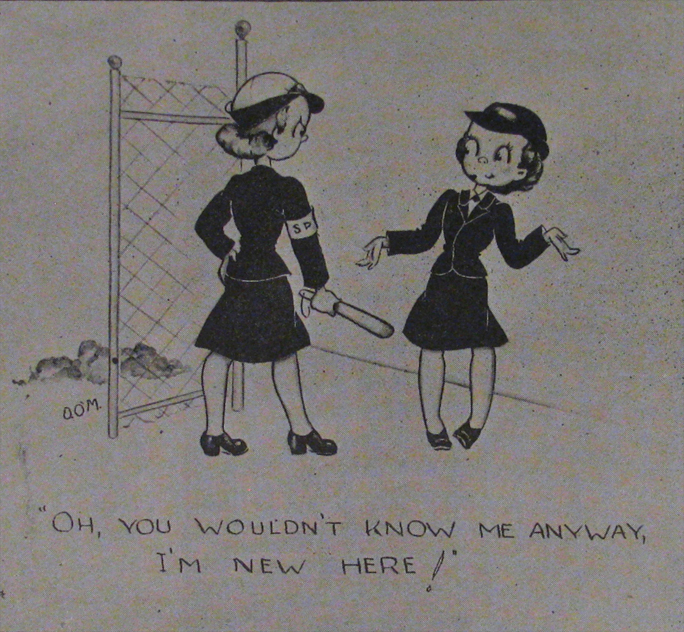
This comic (using a modified version of the “little girl” look seen on WAVES’ greeting cards) pokes fun at the disorientation women felt when entering boot camp. It also offered a pretty clever way of getting out of trouble – the “I’m new” approach.
This cartoon comes from the The Betty H. Carter Women Veterans Historical Project at the University of North Carolina Greensboro.

Comics about the WAVES’ experiences appeared in the dozens of military training center and base newspapers/newsletters across the country. But mass market newspapers and magazines also offered cartoons and other drawn interpretations of the WAVES’ experience. Some, like this one, offered an inspirational message, showing the women as part of a larger military team which included military men, WACs, Women Marines and even a Red Cross “donut Dolly” woman.
And note the dates of the War Bond Drive.
This comes from the archives at the University of Northern Iowa.

The illustrations of WAVES spilled over into greeting cards, which were made for a variety of occasions, including just to say “hello.” But there were also cards to congratulate a woman on her enlistment, to bid a farewell when she was heading to boot camp, to celebrate a birthday or a holiday, etc.
What’s interesting is how many of the cards portray the WAVES. Rather than the young women seen in other illustrations, greeting cards inevitably show the WAVE as a child, with pudgy legs and cheeks and few womanly curves in her figure.
This card comes from the collection of Liane Rose Galvin.

This WAVE greeting card comes from the collection of Liane Rose Galvin. May you have a safe and happy Fourth of July!

WAVES newsletters and booklets also explained to women what would happen as they left the military. This image comes from the Women’s Reserve Information: Separation Pamphlet. The pamphlet outlined the transition process from WAVE to civilian at war’s end.
The first group of WAVES left shortly after V-J Day in fall of 1945. The separations would continue through the next couple of years until the passage of the Women’s Armed Services Integration Act in June of 1948. At that point, WAVES were qualified to become a part of the peacetime Navy.
Lots of Navy photographs show the WAVES marching or standing in formation. And many of the women we’ve talked with shared these pictures, telling us that they were there.

The trick, as Marjorie Sue Green so humorously illustrates in this image from her booklet From Recruit to Salty WAVE! The Ordeal of Seaman Green, is to find the individual woman in the sea of WAVES. Some women actually circled themselves. For others, we weren’t so lucky.
Green’s book is held by The Betty H. Carter Women Veterans Historical Project at the University of North Carolina Greensboro.
This image holds a special spot in the hearts of the Homefront Heroines crew because both the director and producer are alum of the University of Oregon, aka the Ducks.
It comes from Marjorie Sue Green’s booklet From Recruit to Salty WAVE! The Ordeal of Seaman Green held by The Betty H. Carter Women Veterans Historical Project at the University of North Carolina Greensboro.

The Navy gave each boot a battery of shots (all the women we’ve talked with remember them). That experience is featured in both photographs and comics like this image.
It comes from Marjorie Sue Green’s booklet From Recruit to Salty WAVE! The Ordeal of Seaman Green held by The Betty H. Carter Women Veterans Historical Project at the University of North Carolina Greensboro.

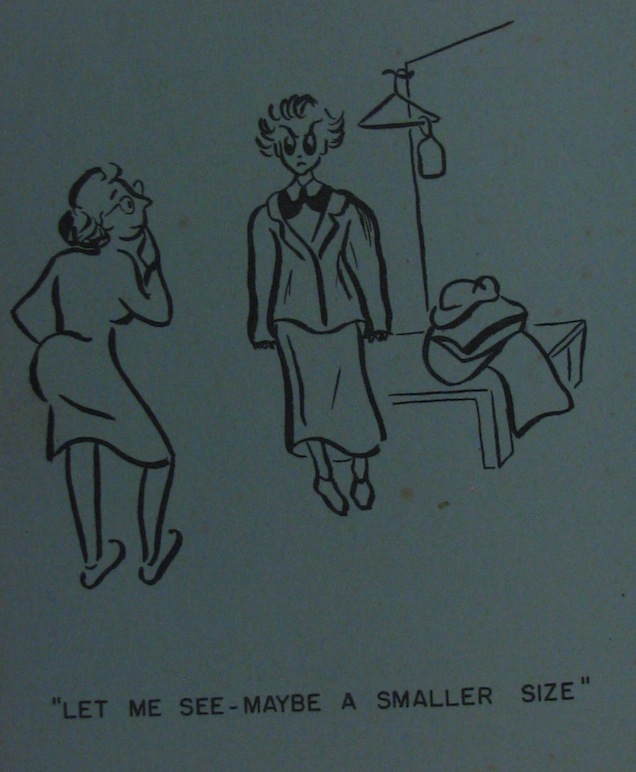
WAVES fitters estimated the uniform size for women, and then the WAVES were expected to get their uniforms custom-tailored for a perfect fit. Tailoring was included in the stipend women received to purchase a uniform.
This image comes from Marjorie Sue Green’s booklet From Recruit to Salty WAVE! The Ordeal of Seaman Green held by The Betty H. Carter Women Veterans Historical Project at the University of North Carolina Greensboro.
 Hinges of History