Arrival!

Hawaii was a Pacific territory during World War II. But it wasn’t the manicured beaches and tourism mecca that we know today.

It was a territory, and it was laid back, you have to understand, very very primitive.  Primitive.  Kamaiamaia Highway was a dirt road and everything.

– Patricia Farrington Siegner, WAVE

This photo shows WAVES disembarking from their transport ship in January of 1945. It comes from the National Archives.

In Quarantine

The trip to Hawaii didn’t always go smoothly.

We ported and we were all going on the same ship. This was really under tight orders because they were very careful about  us.  On the ship, which often happens when people are crowded together, it happens. A case of spinal meningitis broke out and we were quarantined for six weeks in Hawaii.

– Patricia Farrington Siegner, WAVE

This photo shows WAVES crowding an open hatch door even before their transport ship docks in Hawaii. It comes from the National Archives.
Heading to Hawaii

The first group of WAVES headed to Hawaii in January 1945. Doris Mansfield Leichliter was in the third group of WAVES to go overseas. They were the first to be based at Barber’s Point.

I wanted to see as much of the world as I could since I had never gone anyplace growing up anyplace because my dad would never go anyplace.  Once I got to New York and saw how much fun it was to travel, I just wanted to do all the traveling I could.  So I had decided that based on my parents, by the time I was — I didn’t want to get married and I figured I didn’t want to until I was past 30, because up to 30 I would see all the world I wanted to see.  That was my logic.  (laughs)

This photo shows WAVES embarking on the ship to head to Hawaii in January 1945. It comes from the National Archives.

Overseas

WAVES (and also the Coast Guard women, the SPARs) were able to be based not only to Hawaii, but also to Alaska and selected Caribbean locations.

They opened it up for women to go overseas, which was Hawaii and Alaska. And I didn’t want to go to Hawaii. I grew up on the ocean (in Oregon).  I didn’t want to go see the ocean. So I elected to go to Ketchecan (Alaska).  I was in Ketchecan for, I don’t know, six weeks. I was there long enough to turn around and come back to Seattle.

– Vicki Burdick Leach, World War II SPAR

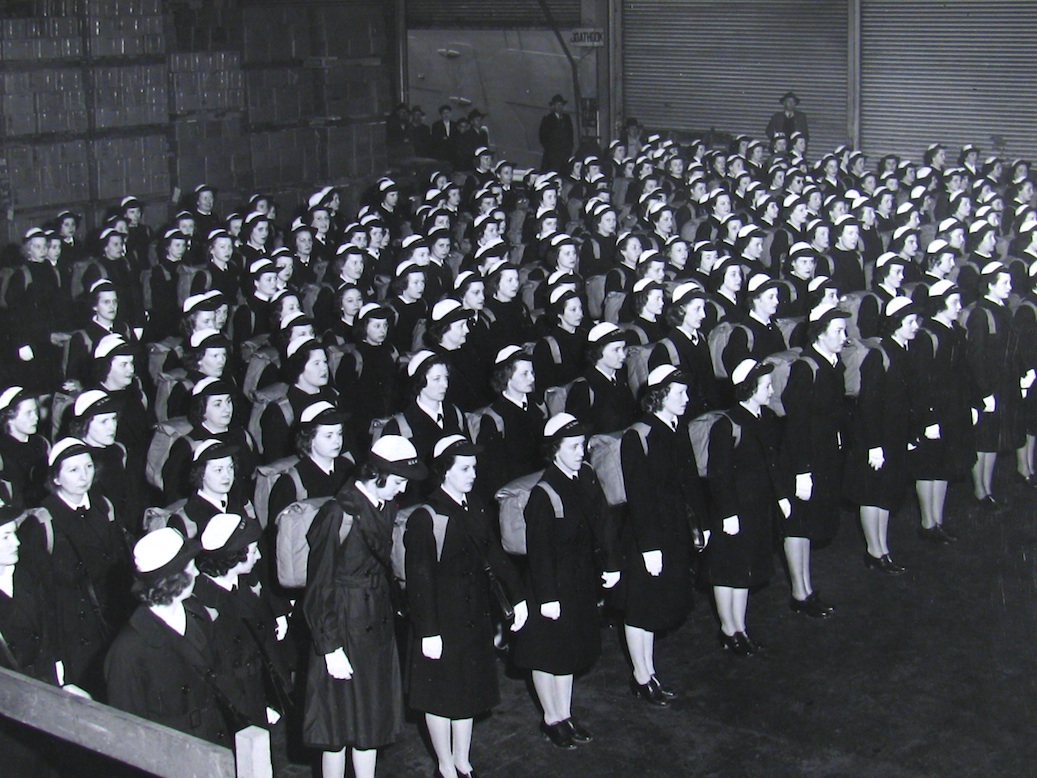
This image shows the first contingent of WAVES packed and ready to go ship to Hawaii in January of 1945. It comes from the National Archives.

Tropical Whites

WAVES heading to Hawaii would need uniforms fit for a more tropical environment. That meant the seersucker uniforms for work and tropical white uniforms for dress, instead of the every blues most women wore.

Here, WAVES are learning the protocol for wearing the white uniform, which most hadn’t had or needed before heading to Hawaii.  It dates from January 8, 1945, just before the women were scheduled to depart.

It comes from the National Archives.

Getting Picked

The post to Hawaii was very desirable for some. And not everyone was selected for overseas duty.

After I was in the service for six months, I could sign up for overseas.  My officer was Lt. Jerry Clays and he said, “Dottie, I know you have the time in, but I want a letter from your folks saying it’s OK to go overseas.”  He said, “I want a letter from your folks giving permission for you to go overseas.”  Well, by the time I got the letter back, and so forth, the war was over and so I never got to go overseas.

– Dorothy “Dottie” Anderson McDowll, WWII WAVE

This photograph shows WAVES leaving on their last stateside liberty before heading to Hawaii in January of 1945. It comes from the National Archives.

WAVES to Hawaii

Continuing our theme of Asian-Pacific Heritage month, we’re going to begin a series looking at the WAVES’ experience in Hawaii.

Initially, the WAVES were only allowed to serve stateside, but by late 1944 discussions began to expand their duties to overseas. And that included the then-US territory of Hawaii.

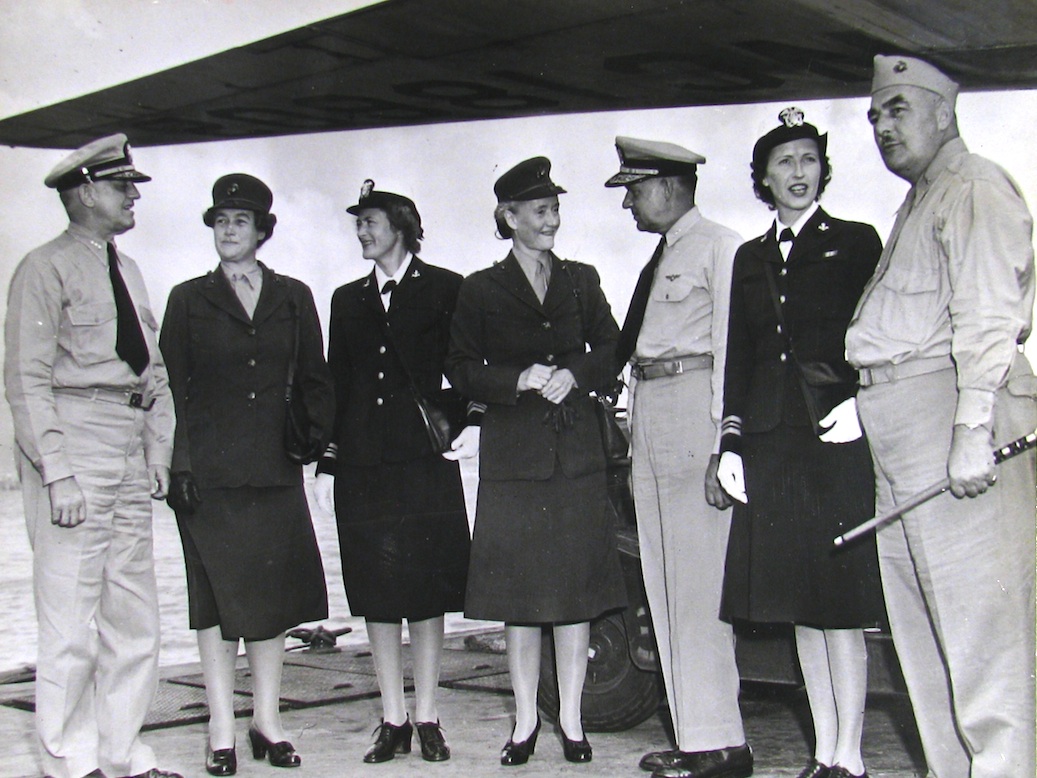
This image shows the first members of the Women’s Reserve of the Navy and Marine Corps doing a preliminary survey of the area in October of 1944 before sending female personnel.

The people shown are (from left): Vice Admiral Robert L. Ghermlevy, Colonel Ruth Street, Lieutenant Commander Jean T. Palmer, Major Marian B. Drydenyof, Vice Admiral John H. Towers, Lieutenant Commander Joy Bright Hancock, and Brigadier General L.W.T. Weller Jr.  It comes from the National Archives.