Honorable Discharge

V-J Day happened August 9, 1945. Jean Clark’s husband, Lou, returned to Seattle from his assignment soon after and was to be immediately discharged. Jean’s commander decided to help her out as well.

He said, “I’ll put you down for 30 days leave. You come back and your discharge will be complete.”  So I went home with my husband and we — then we came back in a month. That was in August, I think. By the time we got back the discharge was complete. We went back to Lebannon where my parents were living. We didn’t have a house or anything. While we were there, we decided, I guess maybe we ought to find a job. We did. We went to the school district and both of us were hired. Because then teachers were in short supply and we both had our degrees and our certificate.

This is a photograph of Jean’s honorable discharge from the Navy, dated September 6th, 1945. It comes from the collection of Jean Clark.

Telegram

Jean Clark’s husband was in the Army, stationed overseas. But that didn’t mean he didn’t stay in touch.

This telegram was sent to Jean while she was stationed at Lake Washington Naval Air Station. It shows her husband’s sense of humor, even as he’s sending her a “love” letter:

Fondest love darling. You are more than ever in my thoughts at this time. Please send me one hundred dollars. Lewis E. Clark.

Maybe telegraphs were the text messages of their day? Minus the emoticons, of course.

The telegraph comes from the collection of Jean Clark.

Growing Up

Jean Clark was stationed at NAS Lake Washington for two and a half years. She said her experience in the Navy changed her outlook on life:

Well, I think it helped me to grow up a little bit. You know. I said, you know, I was 19 when we were married and well, ’45 I was 24. And during that time, I think was pretty green, I was, you know, about the rest of the world and after that,  we sort of took advantage of some things and got to go a little farther then we might’ve before.

This is a photograph taken at NAS Lake Washington of WAVES and a sailor relaxing between assignments. It comes from the collection of Jean Clark.

Flight Pay

WAVES typically didn’t get flight pay, or extra money for serving aboard an aircraft. But Jean Clark did receive some extra training so that she could get the flight pay, as seen in this copy of her certification.

The officer at Lake Washington NAS thought that Jean deserved the extra money. But that meant that she had to fly sometimes. One flight was particularly memorable:

One time he said, “We’re going out. You might want to go.” I said, “OK.”  We’re going to deliver a captain to a flatop. That means we’re taking the captain back to the aircraft carrier.  He says, “They’re out there off the coast,” he said, but he says, “It’s top secret. So you have to keep still about it.”  So we took the captain out to the carrier.  Off the coast of Seattle. It was a rough rough sea. The waves were coming in like crazy.  You might think that landing on water is a soft landing?  It’s like landing on a pile of rocks if you hit water. And it’s bumpy. So we hit down and they put down a small boat from the aircraft carrier to come out and get the captain. They captain came out on the pontoon of the little widgen waiting to get picked off as they came by. They made several swipes. The commander says to me, “You know, they better get him pretty soon. Those waves  are getting pretty high. We may not get out of here.”  I thought “Oop, well, this is it.”  It did look pretty dangerous. Pretty soon, they did grab him and get him off and take him back. The commander says, “Hold on!” And here was this big wave coming towards us.  I mean, big. So he, I could see us heading right into that wave, and we went right into it and right through it and on and we’re airborne.  He says, “Well!  We made it!”  (laughs)  That was the most exciting thing that happened to me when I was in the Navy.

The certification comes from the collection of Jean Clark.
NAS Lake Washington

Jean Clark was stationed at NAS Lake Washington for the duration of the war. The facility is no longer a Naval Air Station, but is a public park. It’s located in Seattle, along the shores of the lake near the University of Washington’s Seattle campus.

Jean was in charge of the Link Trainer Instructors.

I think probably because I was one of the first ones there.  I had a little more training than, I guess, well I had been retained for instructor, too, there. So the commander decided I was going to be in charge of the whole group. We didn’t have that many at first, only four. But then we increased to nine. We had a full complement of all we could use. By that time, when we had nine, we were pretty loaded with personnel.

We were all good friends. All nine of us, still, went out to Seattle when we had liberty and we also after we were discharged, I was the first one to be discharged, we were writing letter. I think we wrote letters for 35 years probably. They came maybe twice a year. We called them a round robin letter. They were sent to the next person you know and we had a mailing list that you followed. It’s interesting. I used to keep all these letters, but I don’t have them any more.

The photograph comes from the collection of Jean Clark.

Link Job Description

Link Trainer Instructors also got a “ratings description” booklet which told them of the details of the job.  Jean Clark’s booklet has her name typed on the front cover.

One of the things they trained pilots was in a skill known as a “square search”:

The go up in the air, some of these 90 day wonders (officers trained in 90 days), they’re flying around on a flight, wherever they’re going and they come back. They can see the field and make a landing. OK. Another day they go out and they go out and it fogged in.  They can’t see the field.  And they can really get into trouble. So we had to teach them what they call the square search. Where they were to fly in a direction for one minute and make a turn and fly, a left turn and fly in another direction until they could finally spot the field.  If they were lost in the fog and didn’t know where they were and were coming down and didn’t see it. That was mainly extra protection to keep them from flying into a mountain.

This booklet comes from the collection of Jean Clark.

Learning the Ropes

Jean Clark was sent to Atlanta in order to learn how to give proper instruction to potential pilots via the Link Trainer. But it wasn’t enough to simply learn how to give instruction. They had to learn everything about the trainer from top to bottom.

We also had to check the trainer. While we were at the air base, not only did we learn how to operate the trainer, we also learned how to repair it if anything went wrong.  There was an engine just outside of the building, the main, that had to be dismantled and cleaned every now and again so it was operating efficiently.  That was part of our duty.

At the end of the training session, the women received a certificate saying that they were qualified in their ranking.

This certificate comes from the Jean Clark collection.

Coveted Assignment

WAVES worked in a wide variety of jobs, but many of the women with teaching experience like Jean Clark ended up in instructional positions. Jean wanted to become a Link Trainer, which used an early form of flight simulation to train men in piloting skills.

We had to take aptitude tests.  Now, I’m going to brag a little bit. Partly, I think, because I’d been a teacher. All of the girls who were chosen to go to Link School had been in education. I think they felt, “They’ve already learned how to teach.  After that, we can teach them the subject matter and they can teach it.” That was their theory I’m sure. They said it was the top thing and if it was the top thing, that’s what I want (laughs).  So, everybody was envious if we got it. There were only 50 of us I think that got it. So not too many.

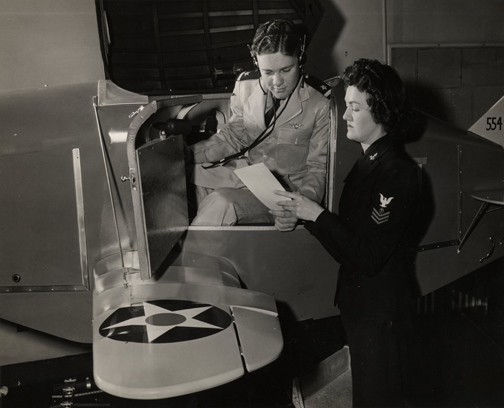
This is a photo of Jean training a man in the Link flight simulator. It comes from the collection of Jean Clark.

Indoctrinization

Jean Clark was in the first class of recruits to be trained at Hunter College in the Bronx. The women were bunked in what were formerly civilian apartments surrounding the campus. There were 12 in her room, all sharing a single shower.

We had to take turns taking showers. One day it was my turn to take my shower and they called — while I was in the shower, hey called from the downstairs “Inspection!”  We had been there a little while and we were supposed to have the room shipshape. Everything neat and clean and dusted and at attention in full dress.  Here I am in the nude in the shower and here it is five floors down. My bunkmates all start handing me clothes (laughs). I thought, “I’ll make it” and I did, except I didn’t’ get my shoes tied.  And I was standing there at attention with my shoelaces dangling.  The WAVE officer didn’t notice (laughs).

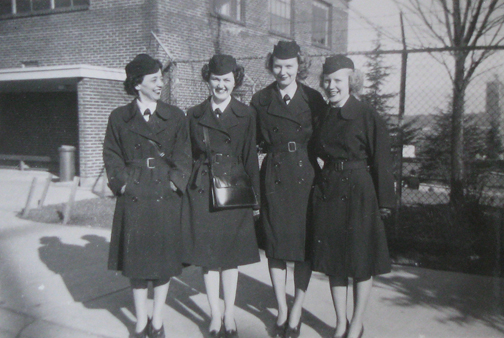
This photograph shows the WAVES-in-training standing outside of the Bronx apartment building where they were stationed. It comes from the collection of Jean Clark.

Enlisting in the WAVES

Jean Clark enlisted in the WAVES in December of 1942 at a recruiting station in Portland, OR, after her husband was sent overseas for the war. She heard about the WAVES through an article in her local newspaper.

And I just thought, “That’s what I’m going to do.” My husband said,  “Please don’t join the WAAC (Women’s Army Auxiliary Corps), because that’s what was going on around right then. He says they’ll probably send you overseas and you’ll be overseas when I get home!

Clark told the recruiter that she was teaching in Sweet Home, a small town in central Oregon. She asked the recruiter to let her finish out the school year, which would end in May.

He grinned and said, “Don’t worry about that.”  (laughs).  Well, then in January, I think it was, I got my first letter. It told me what things to expect. In February I got one, “Report.”

This photograph comes courtesy of Jean Clark.