As World War II was winding down in late 1945, people in the military started thinking about life after the war. Jane Fisher was in the Coast Guard boot camp to serve in the SPARs (from the Coast Guard Motto Semper Paratas, Always Ready) when the word came down that the war had ended. She ended up relieving other women who had been enlisted longer.
Jane was sent to Seattle and assigned to work in the Post Office. For her, military service was about patriotism – and flirting.
I worked in the post office. Oh that was good deal. I had a friend who worked in personnel. If we saw a cute guy, (laughs) just to show you how women worked in that day and age, if we saw a cute guy, she looked up his personnel records. If it didn’t show that he was married, then I’d check the letters to see if he got a letter from the same person all the time. (laughs). Oh, we had a system.
Jane met her husband-to-be while she was heading back to work after leave to visit her family in Nebraska. She noticed him when he got on the train in Idado.
I remember peeking out. His voice. It just sounded good. But I was playing it pretty cool as we were going up the river. And we had had a wreck in the middle of the night which made our train late. And we got to the Dalles (in Oregon) and everybody was getting off the train, you know, to go to the ladies who were serving cookies and stuff. I thought, “Well, I’m not going to get off and have him give me a bad time.” Because he kept walking back and forth and I knew he was getting up nerve enough. So I waited and I got off. He had got off to check uniforms. He waited and he jumped off the train behind me. And he informed me that SP stood for “SPAR Patrol.” Or “SPAR Protector.” And then he sat on down beside me and he asked me if I knew anything about fish ladders. Now that was the craziest line I had ever heard in my life. And I didn’t know what a fish ladder one. I had never heard of one. He said, “Well we’re coming to this Bonneville Dam and they have a fish ladder and I’m going to point it out to you. Because someday, I’m going to design and build fish ladders.” He was the only guy I ever met who really knew what he wanted to do with his life. It really impressed me.
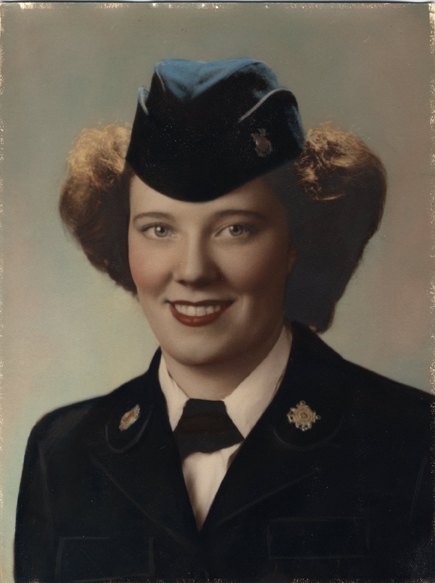
By the time the train reached Portland, Oregon, Jane was smitten. But she was supposed to transfer to a nearby train head back up to base in Seattle.
He said to me, “If you purposely miss that train I’ll sign your papers that we had a wreck.” So I did. And we spent the whole day in Portland. I went on the train that night that he was on Shore Patrol to Seattle. And he took a cab and took me to where we were staying and got it all squared away that I really wasn’t late. Signed the all papers and stuff. And we were married three months later.
It was a whirlwind courtship – spurred along by an over-anxious mother:
We were going to get married, but we were going to get discharged and go home. But my mother kept planning my wedding. And one night we were in a movie and I was so upset with her and I said, “Gee you know for two cents I’d just get married right here in Seattle.” And he reached over and gave me two pennies. So we got married in Seattle. We were married 28 years.
The photograph comes from the Betty Jane Fisher Collection.



 Hinges of History