Special Edition

This is a photo of a commemorative stamp honoring the U.S. Coast Guard. It was released after World War II had ended, on November 10, 1945. The Coast Guard itself was originally founded on August 4th, 1790.

The stamp comes from the Better H. Carter Women Veterans Historical Project at the University of North Carolina Greensboro.
Top Secret Assignment

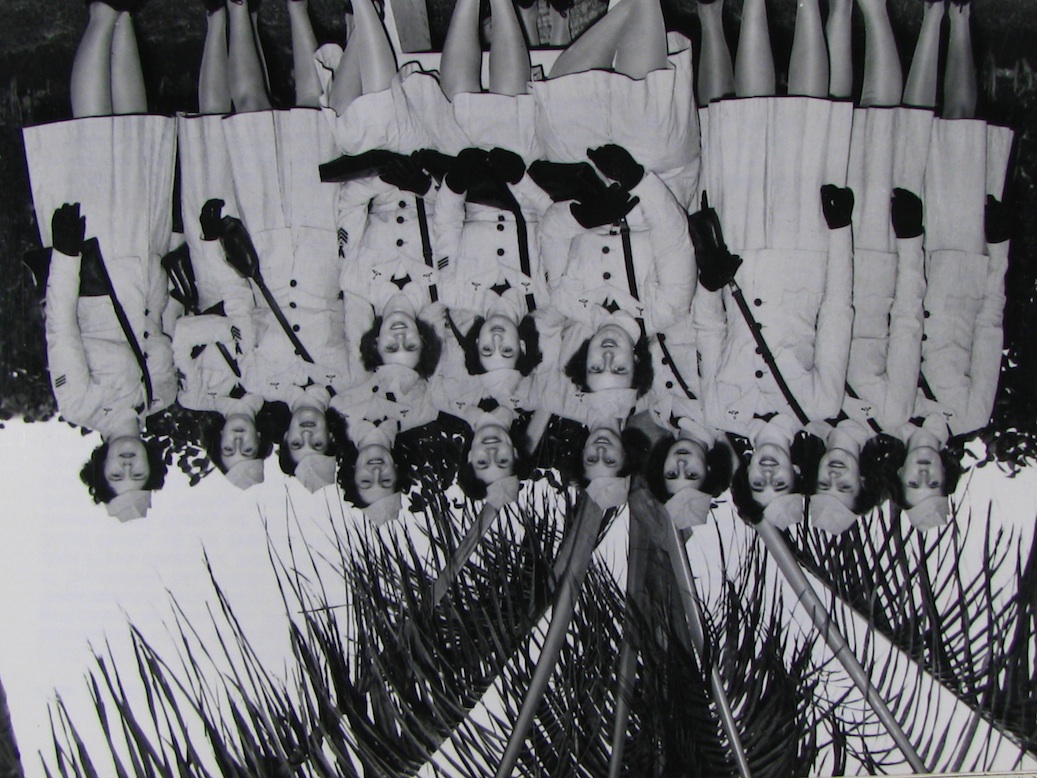
WAVE Patricia Farrington Siegner worked in an underground bunker when she was stationed in Hawaii, coding and decoding military messages:

I couldn’t tell my mother where I was.  I have, I have in these letters, I’ve got cut outs, paper dolls where the censor took stuff out.  And of course it went over once it looked like we were going to sign armistice they didn’t have so much censorship.  But I couldn’t tell her where I was. So I said, she wanted to know. And of course it would have been cut out. So I told her, “Think about your favorite fruit.” She loved pineapple (laughs). And she got it right away.  You see, it was a territory then. It was not a state, so it was different, entirely different.  Entirely different.  We were in the center of the Pacific Theater War.

This photograph of WAVES in Hawaii comes from the National Archives.

In Quarantine

The trip to Hawaii didn’t always go smoothly.

We ported and we were all going on the same ship. This was really under tight orders because they were very careful about  us.  On the ship, which often happens when people are crowded together, it happens. A case of spinal meningitis broke out and we were quarantined for six weeks in Hawaii.

– Patricia Farrington Siegner, WAVE

This photo shows WAVES crowding an open hatch door even before their transport ship docks in Hawaii. It comes from the National Archives.

Getting Picked

The post to Hawaii was very desirable for some. And not everyone was selected for overseas duty.

After I was in the service for six months, I could sign up for overseas.  My officer was Lt. Jerry Clays and he said, “Dottie, I know you have the time in, but I want a letter from your folks saying it’s OK to go overseas.”  He said, “I want a letter from your folks giving permission for you to go overseas.”  Well, by the time I got the letter back, and so forth, the war was over and so I never got to go overseas.

– Dorothy “Dottie” Anderson McDowll, WWII WAVE

This photograph shows WAVES leaving on their last stateside liberty before heading to Hawaii in January of 1945. It comes from the National Archives.

Getting the Chiefs on Your Side

Dorothy Turnbull used her southern charm to win over even the most recalcitrant Navy man. She knew that the key to her success was making sure that those in command supported her.

Keeping these people on your team was the main reason for success.  If the old chiefs were with you, you had your foot in the door and you could get people that would maybe just casually call or see him someplace and ask them a question about Navy women or something. He would then be your salesperson, so to speak, even if he was just an old gruff fellow with no polish. He could still support the Navy and the women.

This photograph of Dorothy with two regional Navy commanders comes from the collection of Dorothy Turnbull Stewart.


On the Job

Dorothy Turnbull first was stationed in New Orleans, but later transferred to southern Texas to work as a recruiter.

We never had to sell the Navy openly. To me, when I’d go to a radio station and talk about what the Navy women were doing and so forth, talking about their lives before they went in service — see, you had to show their families were behind them. That they were still young ladies, even though they had this uniform on. They weren’t going to be different from their sisters were.  This kind of thing.

This photograph shows Dorothy on stage at a recruitment event in Texas. It comes from the collection of Dorothy Turnbull Stewart.


First Officer on Ship

WAVES would continue to serve in the military through 1950s. And while enlisted WAVES were assigned to ships in 1953, it wouldn’t be until 1961 that the Navy would assign a WAVE officer to shipboard duty.

Lieutenant Charlene T. Suneson, received that honor. She reported for duty aboard the USS General W.A. Mann (AP-112).

This photograph comes from the Naval History and Heritage Command.

First Women on Ship

WAVES were allowed to go onboard ships in 1953. The women were all hospital corpsmen, meaning they were assigned to medical ward duties.

The women were (left to right): Hospital Corpsman Second Class Eileen Paluzzi, USN;  Hospital Corpsman Third Class Marie A. Myers, USN; and Hospital Corpsman Third Class Mavia Cain, USN. Louise “Billye” Wilde, the WAVES commander at the time, and Rear Admiral Clarence J. Brown, MC, USN, Deputy Surgeon General, are looking on while Vice Admiral Holloway, Jr. signs the orders.

This photograph comes from the Naval History and Heritage Command.