Link Job Description

Link Trainer Instructors also got a “ratings description” booklet which told them of the details of the job.  Jean Clark’s booklet has her name typed on the front cover.

One of the things they trained pilots was in a skill known as a “square search”:

The go up in the air, some of these 90 day wonders (officers trained in 90 days), they’re flying around on a flight, wherever they’re going and they come back. They can see the field and make a landing. OK. Another day they go out and they go out and it fogged in.  They can’t see the field.  And they can really get into trouble. So we had to teach them what they call the square search. Where they were to fly in a direction for one minute and make a turn and fly, a left turn and fly in another direction until they could finally spot the field.  If they were lost in the fog and didn’t know where they were and were coming down and didn’t see it. That was mainly extra protection to keep them from flying into a mountain.

This booklet comes from the collection of Jean Clark.

Learning the Ropes

Jean Clark was sent to Atlanta in order to learn how to give proper instruction to potential pilots via the Link Trainer. But it wasn’t enough to simply learn how to give instruction. They had to learn everything about the trainer from top to bottom.

We also had to check the trainer. While we were at the air base, not only did we learn how to operate the trainer, we also learned how to repair it if anything went wrong.  There was an engine just outside of the building, the main, that had to be dismantled and cleaned every now and again so it was operating efficiently.  That was part of our duty.

At the end of the training session, the women received a certificate saying that they were qualified in their ranking.

This certificate comes from the Jean Clark collection.

Coveted Assignment

WAVES worked in a wide variety of jobs, but many of the women with teaching experience like Jean Clark ended up in instructional positions. Jean wanted to become a Link Trainer, which used an early form of flight simulation to train men in piloting skills.

We had to take aptitude tests.  Now, I’m going to brag a little bit. Partly, I think, because I’d been a teacher. All of the girls who were chosen to go to Link School had been in education. I think they felt, “They’ve already learned how to teach.  After that, we can teach them the subject matter and they can teach it.” That was their theory I’m sure. They said it was the top thing and if it was the top thing, that’s what I want (laughs).  So, everybody was envious if we got it. There were only 50 of us I think that got it. So not too many.

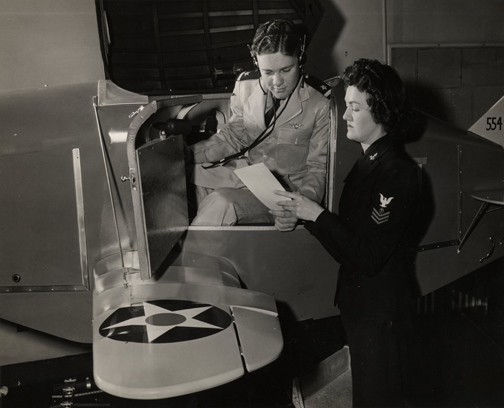
This is a photo of Jean training a man in the Link flight simulator. It comes from the collection of Jean Clark.
Indoctrinization

Jean Clark was in the first class of recruits to be trained at Hunter College in the Bronx. The women were bunked in what were formerly civilian apartments surrounding the campus. There were 12 in her room, all sharing a single shower.

We had to take turns taking showers. One day it was my turn to take my shower and they called — while I was in the shower, hey called from the downstairs “Inspection!”  We had been there a little while and we were supposed to have the room shipshape. Everything neat and clean and dusted and at attention in full dress.  Here I am in the nude in the shower and here it is five floors down. My bunkmates all start handing me clothes (laughs). I thought, “I’ll make it” and I did, except I didn’t’ get my shoes tied.  And I was standing there at attention with my shoelaces dangling.  The WAVE officer didn’t notice (laughs).

This photograph shows the WAVES-in-training standing outside of the Bronx apartment building where they were stationed. It comes from the collection of Jean Clark.

Enlisting in the WAVES

Jean Clark enlisted in the WAVES in December of 1942 at a recruiting station in Portland, OR, after her husband was sent overseas for the war. She heard about the WAVES through an article in her local newspaper.

And I just thought, “That’s what I’m going to do.” My husband said,  “Please don’t join the WAAC (Women’s Army Auxiliary Corps), because that’s what was going on around right then. He says they’ll probably send you overseas and you’ll be overseas when I get home!

Clark told the recruiter that she was teaching in Sweet Home, a small town in central Oregon. She asked the recruiter to let her finish out the school year, which would end in May.

He grinned and said, “Don’t worry about that.”  (laughs).  Well, then in January, I think it was, I got my first letter. It told me what things to expect. In February I got one, “Report.”

This photograph comes courtesy of Jean Clark.

Edna Jean Clark

Meet Edna Jean Clark, who goes by Jean. Jean was born and grew up in Stayton, Oregon, which she called “a family town.”

My great-great grandfather came there in the early 1800s and founded the town.  The town is named for him. Stayton, Oregon.  My family all grew up there.  My brother and I and my cousins.

Jean’s mother was a Murphy and her father a Richardson. related to that original Stayton who founded the town. They got married 1911.

Stayton was a logging community, and Jean’s family all worked in the industry. That meant the family often moved around the area as her father got new jobs.

He was always a logger or a farmer depending on which was the best. We did a lot of moving from one log camp to another. I grew up, my first grade class was in a logging camp where there were just eight children in the first grade and only one in the second grade and then several along scattered through. It was a one-room school. Pot bellied stove on the floor.  We played on the the sawed off logs as a playground.

The certificate of marriage comes from the collection of Jean Clark.

Why No Team Sports?

Janette Shaffer Alpaugh helped to organize sports teams for WAVES in the south. But she also helped to start alternatives to traditional exercises at the training centers as well.

We were at Smith, with a nice gymnasium. I kept thinking, “Why don’t we have some sports?”  Because we took classes and we’d go down for marching and some calisthenics. But that was that.  So I kept thing, “Well, you’ve got all these other young people. Why can’t we be trying basketball or something?”  So I went to the lady, head officer, “Isn’t there some time we could schedule some basketball?  Anybody who shows up could just play.”  And she said, “Oh, that’s a good idea.  I don’t know why we don’t do it.” So they fixed something up for Sundays when you had free time.

I think because I did that (laughs) — I didn’t think that was anything unusual. I did that because I wanted to play.

The photo comes from a Navy post card set produced about the Hunter College boot camp. It’s from the Betty H. Carter Women Veterans Historical Project at the University of North Carolina Greensboro.

Dance, Dance, Dance

Physical education took many different forms. These WAVES are square dancing their way to fitness.

The photograph dates from April of 1943. It was taken at the U.S. Naval Training School for Radio Operators at the University of Wisconsin in Madison. It’s held in the collection of the National Archives.

WAVES also participated in sports teams which traveled to other bases and competed with women in various sports, like volleyball or basketball. Janette Shaffer Alpaugh helped organize those teams in the south. Read more about her work in physical activities for WAVES here.

Calisthentics

Depending upon the weather, WAVES could do their exercises either indoors or out. These WAVES are at the Naval Training School for Advanced Machinist’s Mates in Norman, Oklahoma. They’re working on a field outdoors (note the jumpsuits they’re wearing for their exercise).

But a cold winter day could drive the WAVES indoors. Jeanette Shaffer Alpaugh remembers being at training camp in Cedar Falls working one day inside in the gymnasium.

We were four abreast, one bunch of four after the other. The officer is charge was, somebody came to the door and called her over. She didn’t say “halt.” So we were marching ahead and this person kept talking to her. Now, we didn’t really know this. Anyway, I was in the second group of four,  We come to the end of the gymnasium and she hadn’t said, “halt” or “squad left” or right or anything.  And so there were stall bars at the end of the gymnasium.  I don’t know how this first group of four — I don’t think I would have thought of it, but they started climbing the stall bars (climbing bars on the walls of old gyms).  So here’s four people going up stall bars. We’re the second group of four, we started going up stall bars. She turned around and there were about four groups  (laughs) up on stall bars. I think that — you know, then she says. “Halt!”  It was really funny.

The photograph comes from the National Archives.

WAVES Do Swim!

One of the rumors swirling about the military women was the various qualifications they’d need in order to join the different branches. Since the WAVES’ name evoked water, and the WAVES were part of the Navy, one rumor about the WAVES was that a woman had to know how to swim in order to join. Some members of the Women’s Army Corps even now say they didn’t join the WAVES in World War II because they couldn’t swim!

The rumor was false; a woman didn’t have to be a swimmer to join the WAVES.  But swimming was one of the activities women could do to keep in shape.

These WAVES are swimming in the pool at Yeoman Training School at the University of Northern Iowa in Cedar Falls, circa March 1943. The photograph can be found in the National Archives.