“Buying Fasion”

Always remember that simplicity is the keynote of dressing smartly. Avoid choosing fashions that were “in” when you went into the Navy; chances are they’re “out” now. Here’s where your study of fashion magazines comes in.

Try to get clothes that are coming into fashion. You will be happier with them longer.

Avoid the fashion you meet on every third woman. When you see the same dress in every shop window, you may be sure it has reached its peak of popularity, and is not going to last as long, fashion-wise, as something which is in far less quantity.

Avoid the pitfall of exaggerated fashions; the too-wide shoulder, the too-nipped-in waist. The too-deep armhole. When in doubt, always take the middle of the road.

From the booklet “Back to Civvies,”  held by the The Betty H. Carter Women Veterans Historical Project at the University of North Carolina Greensboro.

Pretty, Smart or Crisp?

The Navy gave women three options for their personal “look” after getting out of the military: pretty, smart or crisp:

If the answer is:

  • “Pretty”–then choose a feminine hat, soft dresses,
  • “Smart”–the a few very smooth clothes for you,
  • “Crisp”–then stick to tailored clothes.

From the booklet “Back to Civvies,”  held by the The Betty H. Carter Women Veterans Historical Project at the University of North Carolina Greensboro.

Back to Civvies

The Navy’s help for women heading back to civilian life extended beyond just the practical information needed to muster out of service.  Remember, the WAVES were consider the most fashionable and best dressed branch of the service, with couture uniforms designed by Mainbocher.

So it should come as no surprise that the Navy offered women suggestions for how the former WAVES could remain fashionable after they returned home.

This booklet is held by the The Betty H. Carter Women Veterans Historical Project at the University of North Carolina Greensboro.
Arriving Home

The Navy also offered advice to help women keep track of their military records after returning to civilian life:

Have the Recorder of County Clerk record your discharge certificate. You can then obtain a certified copy any time in the future if the original is lost or destroyed.

This image comes from the Women’s Reserve Information Separation Pamphlet. It is held by the The Betty H. Carter Women Veterans Historical Project at the University of North Carolina Greensboro.
Post-War WAVES?

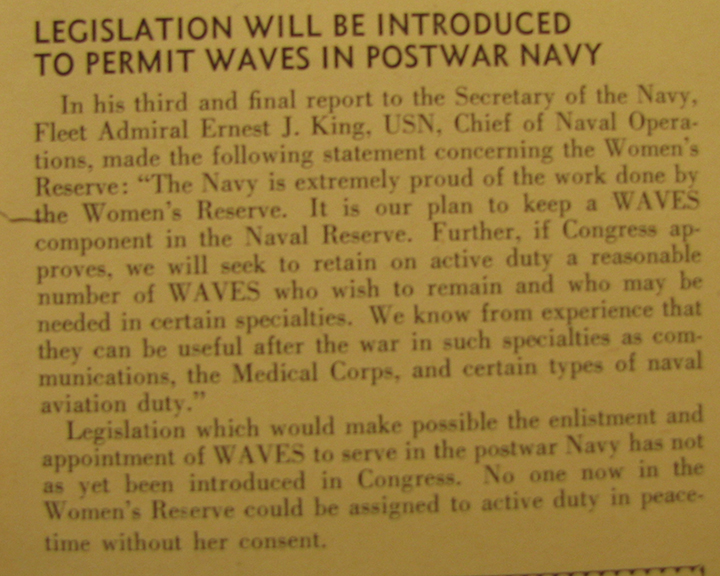
The reality is that a group of women hoped to remain with the Navy after the war – while others were looking forward to returning home. So in the articles discussing the possibility for a post-war Women’s Reserve, the Navy had to strike a careful balance, as illustrated by this article. While the article discusses how women might be able to continue to serve, it also reassures them that “no one now in the Women’s Reserve could be assigned to active duty in peacetime without her consent.”

It comes from the Schlesinger Library at Radcliffe College.

Special Message

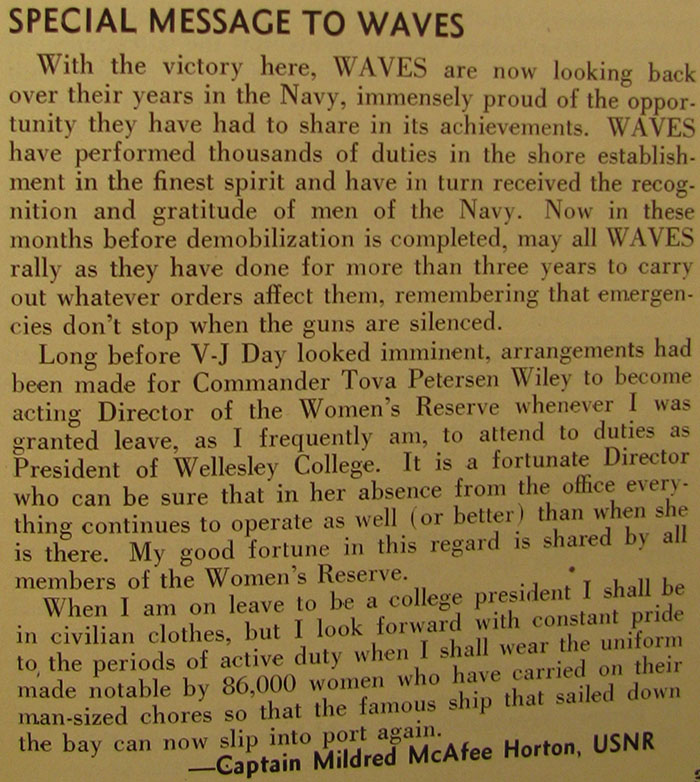
As the war was ending, WAVE leader Mildred McAfee offered this missive to WAVES in mid-1945. It was then that she took a leave of absence to get married (and return to her post at Wellesley College; she would officially resign from the WAVES in 1946.
This clipping comes from Schlesinger Library at Radcliffe College.


Writing on the Wall

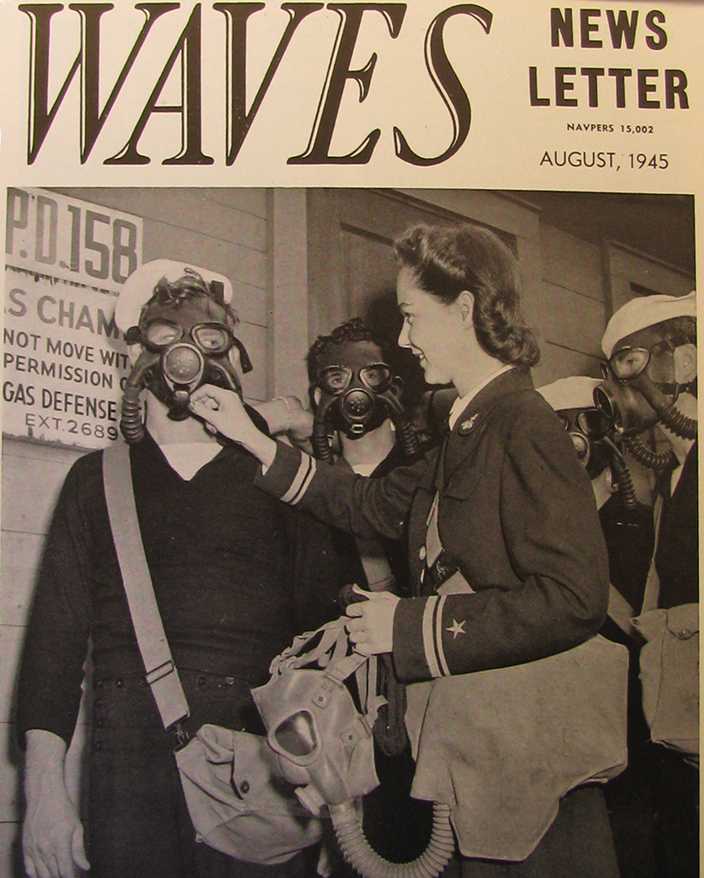
While the war wasn’t over by the time the WAVES newsletter was released in August of 1945, the signs were there that peach would soon be at hand. The Allied troops had had a number of stunning victories in Europe throughout the summer, and by July 11th the Postdam Agreement had been signed, outlining terms for peace. Japan would agree to peace until a month later, after the nuclear attacks on Hiroshima and Nagasaki.

What’s interesting is this cover of the WAVES’ newsletter makes no reference to the peace agreements in Europe – but inside the newsletter demonstrates that the Navy was thinking about the post-war world – and the WAVES’ role in it.

In comes from Schlesinger Library at Radcliffe.

Open Wide!

The open houses held in connection with the WAVES’ anniversary were designed to show people the extent of the work the women were doing. In this image, a WAVE shows her visitors the dental equipment. WAVES worked in Naval dental offices during the war. The photo of the second anniversary celebration at NAS New Orleans comes from the National Archives.