
Secretary of Navy, Frank Knox, and Lt. Comdr. Mildred H. McAfee, with a group of enlisted WAVES following the WAVES’ first anniversary ceremony at Washington, D.C. July 30, 1943. From the National Archives.
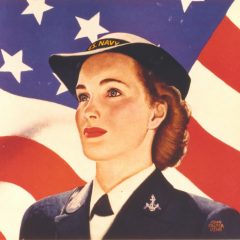
A Blog About Women Who Were Homefront Heroines: the WAVES of World War II
Secretary of Navy, Frank Knox, and Lt. Comdr. Mildred H. McAfee, with a group of enlisted WAVES following the WAVES’ first anniversary ceremony at Washington, D.C. July 30, 1943. From the National Archives.

Even though the WAVES were established on July 30, 1942, it would take a few days after that formal declaration for Mildred McAfee to be sworn in as leader. The official enlist date of the former Wellesley President was August 3, 1943.
In this image, Adm. Ernest King expresses his approval of the job being done by members of the Women’s Reserve to Capt. Mildred McAfee on the secondd anniversary of the WAVES. More than 70,000 were on duty at the time – nearly three times the number from just a year before. It comes from the National Archives.
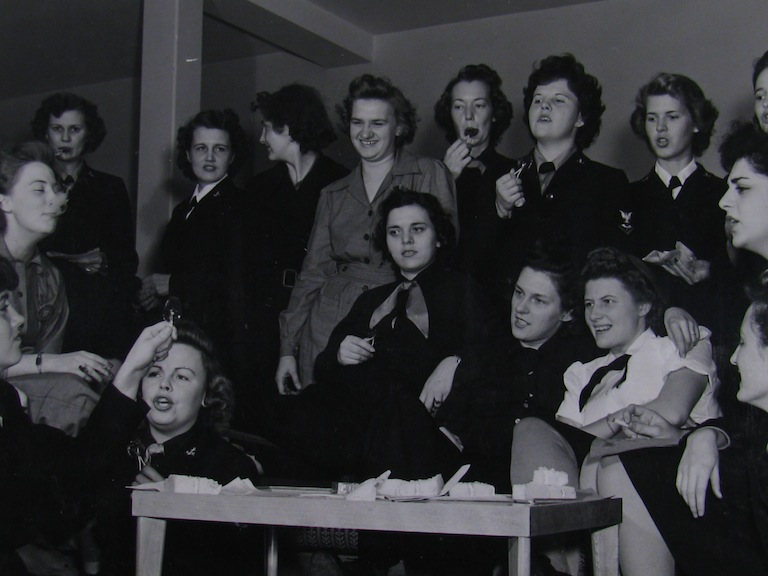
At the NAS in Seattle, 1943, WAVES celebrated the first anniversary of the WAVES with songs and lollipops. The photo comes from the National Archives.

On the first anniversary of the establishment of the WAVES, this comic was published staking out their history. Take a look at the last milestone: by July 30, 1943, there were 27,000 women in the service. By the end of the war, nearly 100,000 would have served as WAVES.
This comes from the Schelsinger Library at the Radcliffe Institute for Advanced Study, Harvard University.

This 1944 image is from a celebrating marking the second anniversary of the founding of the WAVES. In it, Captain Johnson (left) and Lt. Dyer cut the WAVES birthday cake at NAS Miami.
It comes from the National Archives.

Only two Navy WAVES were qualified to wear victory medal of World War I. Joy Bright Hancock (left) and Eunice Whyte (right) both served as Yeomanettes during World War I. About 25,000 Yeomanettes (from Yeomen-F, or Yeoman-Female) were part of the regular Navy because of loophole – the military act at the time didn’t specify that only men could serve. The loophole was closed after the war, and women wouldn’t become an official part of the Navy, other than nurses, until 1942.
This image come from the National Archives.
No female Naval Academy grads have ever made it to the U.S. Olympic Team, but dozens of men have, including gold medalists Carl Osborn (Rifle, 1920), Raymond Bass (Gymnastics, 1932), and David Robinson (Basketball, 1992). The 8-oared rowing teams, made up entirely of Navy men, also took home gold in 1920 and 1952.
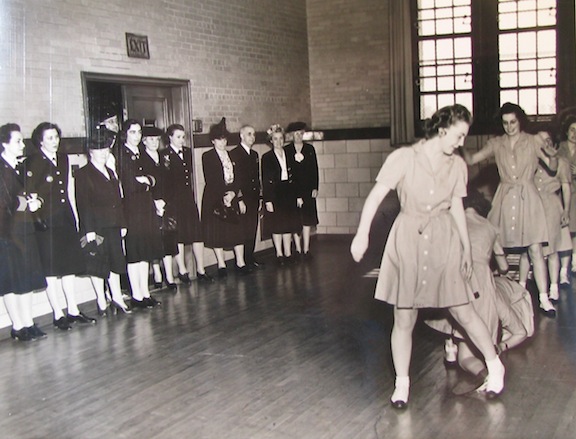
It’s not clear if any WAVES were Olympians either before or after their service, but Wimbledon and U.S. Open tennis champ Helen Hull Jacobs was a WAVE commander in Naval intelligence during the war (tennis wasn’t an Olympic sport during the years she competed). And WAVE certainly were in shape via their exercise programs, as indicated by this photo, which comes from Radcliffe’s Schlesinger Library.
Enjoy the games!

Did you know that three Navy women, the Naval Academy’s Laura Gorinski, Toni Paruso, and Rheanna Vaughn, qualified to swim in the recent U.S. Olympic trials? While they didn’t make the Olympic swim team, they deserve a salute as we head to the opening ceremony of the Olympics this week.
This photo shows WAVES celebrating the 2nd anniversary of the WAVES with a spash in the pool. It comes from the National Archives.
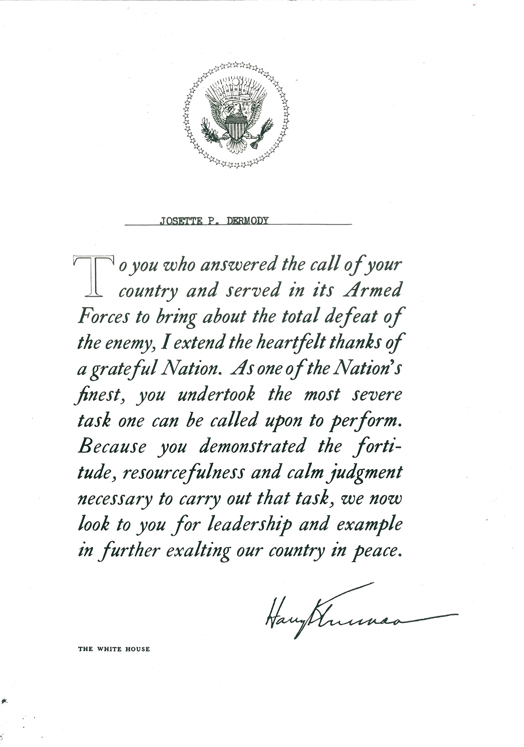 WAVES received this notice from President Harry Truman at the end of their military service.
I think the WAVES are kind of the hinges of history. They were there when the world changed. And they didn’t cause it particularly bu t it wouldn’t have happened in the same way if the women hadn’t have been there. The Navy was such a different world. Men and women learned to get along with each other in different ways. (laughs) As I say, we were the hinge. We grew up in this old world watching our mothers and our fathers and then our marriages were completely different.
– Josette Dermony, World War II Navy WAVE.
This comes from the collection of Josette Dermody Wingo.

They say there is always first love and married love and baby love and the one you never forget. That’s Blackie.
– Josette Dermody, World War II WAVE
This photo of Josette Dermody and the one she never forgot, Blackie, comes from the collection of Josette Dermody Wingo.
 Hinges of History