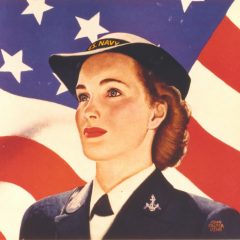
The Pharmacist’s Mate

Jean Byrd Stewart went to boot camp at Hunter College. Just 3 of her class of 1000 women were African American.

After training, Jean was assigned to become a Pharmacist’s Mate, just like half of her class. But she had hoped to do radio work.

I said, “I don’t see any singal, any insignia of radio.”  I said, “I’m going ask can I change.” So when I went to ask, who did they send me to but Harriet Pickens. She said, “Well, you know the hospital corps is the area where the Navy women are needed.” She said, “It’s a good field and what you want to do is nice and you do have a background for it.  But I think if maybe you had a higher mark, you might have made it, but because of the need for hospital corps.”  I don’t know whether I asked her or not, but do you know I had a three-point-nine — now how much higher can you get?  But I didn’t say anything, because I knew we were needed and I just left it. And thanked her, and went and that was it.

Jean worked with patients on the hospital ward. Some of the men’s injuries were devastating. She treated men with jaundice. One young man had TB of the spine. Another man had a brain injury and needed to stay quiet because his skull hadn’t healed yet.

He had a friend next door to where he was stationed and he knew it and wanted to see him.  At least he was happy he had come this far and wanted to say hello to his friend.  And they say, “No, we won’t let you go.”  They had to be careful of whoever took him. So while I was duty, I learned about him and him wanting.  I couldn’t give him an answer because I wasn’t in the position. But one day he wasn’t there. And what had he done?  He had gone next door to visit his friend.  He was so happy he knew what to do.  When he finished he came back.  He knew where he was, where he had come from and where he had to go.  And he came back and he was happy and contented.  And what could you do?  You didn’t want to smile and yet you were happy for him because — that was something.  That was something.

Jean left the Navy in May of 1946.

This is a copy of Jean’s graduation from the Hospital Corps school in Chicago, Illinois. It comes from the collection of Jean Byrd Stewart.

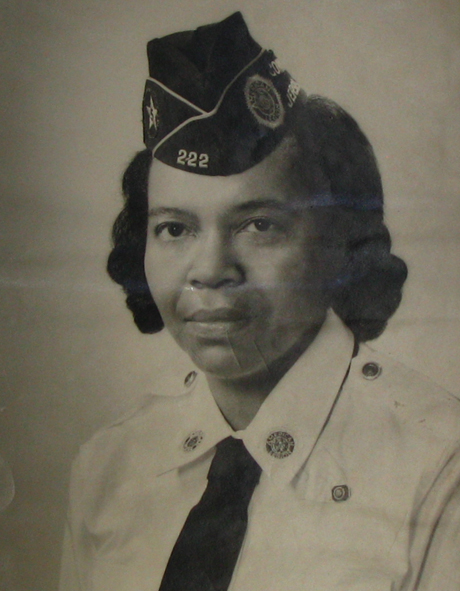
“You’re Not an Individual”

Though there was resistance to allowing African American women to serve in the Navy, Jean Byrd Stewart says she didn’t encounter any racism once she was in the military. She ended up being stationed in the Chicago area, but remembers one time traveling to St. Louis. St. Louis was a segregated community, and while she could find a restroom for white women, she couldn’t find one for African American women.

I said to the gentleman in charge, “I am going back upstairs where I saw ladies rooms. And I’m going to use that.  If you hear any commotion, you know I’m in trouble.  Send a Shore Patrol because I might need help.” Because there is no ladies room here. And I did.  I went in and you know, you have to wait until there’s an open on.  And I did, I went into the ladies room, came out, when I came out, I sat down.  I took off my hat.  I fixed my hair, checked my make-up, stood up to leave, and of course they were around talking and saying.  And you say, “Goodbye.”  Or “I’ll see you later.”  And you get up and you leave.  Nothing happened.  It shouldn’t have, but you never know.

You know what they told us when we went in?  “You’re not an individual. Remember your home training and all the things you’re supposed to do and how you’re supposed to act.  You belong to a group.  You’re not an individual.  You belong to a group and remember your manners.”  And that was it.

This photograph comes from the collection of Jean Byrd Stewart.
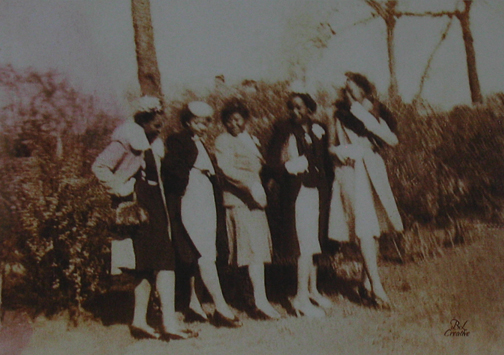
Deciding to Enlist

Jean Byrd was working as the war broke out. But she wanted to join the military service. Initially, only the Army was accepting African American women, and only into segregated units in the Women’s Army Corps. That didn’t interest Jean.

A lot of the women were going into the Army. I said, I want to be different, I want to be something nice.

One day in late 1944, her family was visited by a family friend, Dean William Pickens of Morgan College in Baltimore, Jean’s father’s alma mater. Dean Pickens had a daughter who was a little bit older than Jean.

His daughter Harriet, when she came out of school, they were asking for women to go into the Navy. And I saw it in the paper, where she went up to Smith to train for officer’s training school. And I said, “So the Navy is for me.”

Truman said, “We would like for the ladies to volunteer their services to relieve a man and I think it would help us win the war sooner.”  I said, “I’ll go!”  I’m sitting there working for a defense company making apparatus to go into airplanes.

Jean enlisted in the WAVES and was sent to boot camp in May of 1945.

This photograph comes from the collection of Jean Byrd Stewart.
Dreams

Even though Jean Byrd grew up during the Depression, she still dreamed big.

 You know how you wish for things?  My mother had a gentleman who would take her, my aunt and another lady, he would take them shopping because he had a car. They would go and shop, and they would pay him and I thought that was so nice. So one Saturday, I said, “You know, I would like to buy some property.” Well, I was working then and I had a few dollars.  I said, “I don’t have much, but I’d like find out how much land costs, how much you need” and this and that and the other thing.  I had a nice black dress and black pocketbook and this that and the other.  I said, “I’m going to get dressed and ask Mr.” I forget his name now “to take me out to this place so I can find out something about land.”  Didn’t have a dime.  A few dollars.  I think my first account I put two dollars in. Well, that’s what I got paid.  Two dollars a week. That was way back.  ’40 — I forget the year. ’30, ’38 I came out of high school. Anyway, this is what I was going to do.  I was going to act like I had some money and I was a lady who had some prestige.

This photo comes from the Jean Byrd Stewart collection.

The Importance of Education

Education was important to Jean Byrd’s family, especially as African Americans living in the Northeast.

You had to if you wanted to move in life and be something. Even the girls were going to school, learning a trade.  Something to do.  Because the men didn’t make the kind of money that the white men made, or the family.  Maybe the husband made enough money that the wife didn’t have to work. And she could do community work or belong to the women’s club. Because my aunt worked for a lady like that.  Her husband was the head of a bank.  And she was active in the community, head of the woman’s club. So I said, “That was an angle I can go.” You watched the different ones. Up the street lived lawyers, there was a councilman and there was so much to draw on that you could easily pick what you think you would like to do.

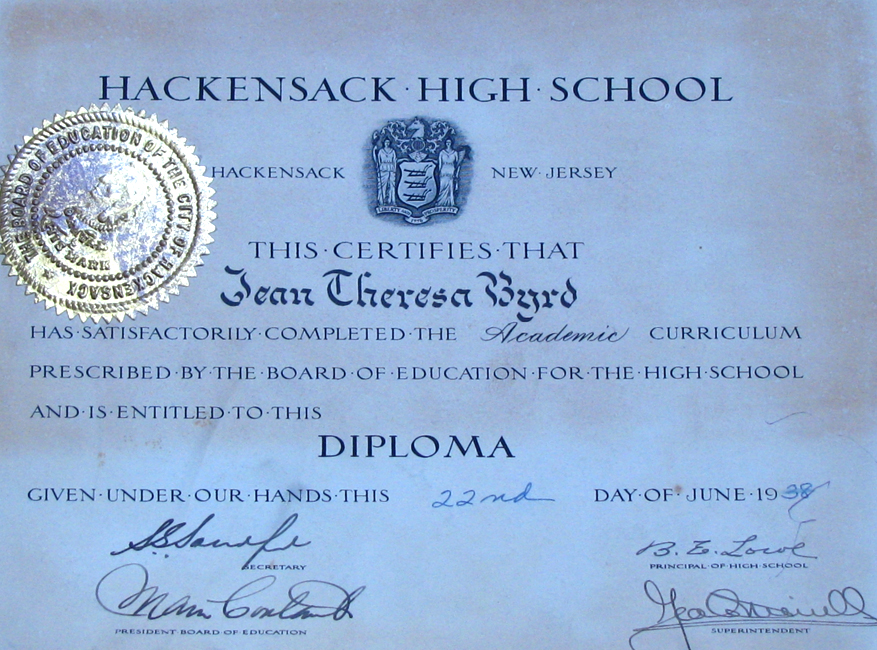
Jean dreamed about going to Brown College after high school, but it was a men’s school at the time. Instead, she went to Patterson State College. Part of the reason was economic: the school was nearby her home, so she could carpool with a friend who lived around the corner.

This is a copy of Jean Byrd’s high school diploma. It comes from the collection of Jean Byrd Stewart.

Meet Jean Byrd Stewart

Jean Byrd grew up in Hackensack, New Jersey, right across the George Washington Bridge from New York City. She would become one of the first African American WAVES during World War II.

Jean’s father had his degree in chemistry, and worked for a chemical company in nearby Maywood. During the Depression, things were tough for everyone, but Jean remembers things being doubly difficult for African American families. Her father was paid less than the white workers at the chemical company. Still, she said, the family did well enough – her father had a job and most of the time was working full time.

Aside from the lack of parity on on-the-job, Jean doesn’t remember any overt prejudice in her neighborhood.

I never paid any attention because where we lived was a mixed area.  I mean, mixed. So you were a person there who had to qualify and be as up as you could so that you would blend with others and would show that you had intelligence and keep up with people.  My mother and father went to school and they passed along a lot of things. So as one lady said later on in life, her parents didn’t raise any dummies.  I was surprised to hear her say it. She was a white girl, but that was the way she expressed it. So you live up to what you know, and have learned and picked up watching by seeing others. You just kept on moving.

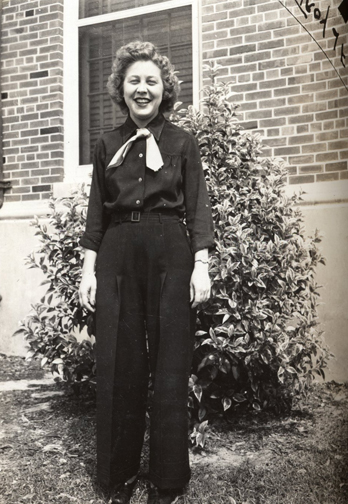
This photograph comes from the collection of Jean Byrd Stewart.
A Whirlwind Romance

Romance often moved quickly during World War II. Phyllis Jensen Ankeney grew up in the same neighborhood as her husband-to-be. She remembered admiring his Navy uniform after he enlisted in the service, but romance didn’t blossom until after she had joined the WAVES and they were home on leave together.

He got pretty upset when he found out I had gone in the service (laughs). He didn’t think a woman shouldn’t be there either at that point. But anyway, we came on home on leave together, not knowing it. He came from the South Pacific and I came from Florida.  We happened to come home at the same time. We went together for the few days we were  at home. Other than that, I had not dated him.  And he said that we’d get married — that I’d get a ring for my birthday in January. This was in September.  We were married the seventh of October.

We talked every night. And he wanted to get married. I said, “I don’t have any leave coming, If we’re going to get married you’re going to have to come here.” So he came right on down there. But we did have a church wedding in Pensacola.  A Lutheran church.  No family, no one around.  Just the ones from the base that came in. The minister had a youth class there on Sunday night and he asked if I would invite them to be at the wedding, so I did.

They ended up moving back to their home town after World War II and Phyllis got pregnant almost immediately after she was discharged. Her husband did get called up into the Navy again, during the Korean War.

The photograph comes from the collection of Phyllis Ankeney.

Romance Week!

With the approach of Valentine’s Day, we’re turning our focus to romance during World War II.

Margaret Anderson Thorngate, who we’ve featured before in these posts, met her husband Fred during the war:

 I was a member of the Fourth Interceptor Command. That’s when they had that — no radar in those days, so you looked for airplanes in the air, at sea, whatever. I belonged to that.  Another girl and I had the duties on Sunday afternoons, which we picked because they we could sun ourselves on the sand dune where the observation post was.  And so Fred was stationed in the beach club down the street, down the little ways. He came trotting up one day, when I was — one Sunday afternoon when I was sitting there in my black bathing suit watching for airplanes (laughs). With my glasses picked him up right away.

Margaret and Fred wrote back and forth to each other during the war,  while he was stationed overseas and she was in the WAVES in California. Eventually she agreed to marry him.  So in late summer 1945, he got a leave between assignments, so he returned to California.

He came back from overseas and we were going to get married. I met him at my aunt’s in Glendale. He rang the front doorbell and I ran out the back. I was scared to death (laughs). And she (Margaret’s aunt) made me — she made me answer the door and I couldn’t talk.  I couldn’t talk!   Absolutely, for 20 minutes I couldn’t say anything.  And he was just laughing. I thought, “This is the dumbest thing you’ve ever done in your life!  You’re going to marry somebody you haven’t even seen in two years and barely know!”

They were on their honeymoon when the war ended.

Something worked about their unconventional romance – Margaret and Fred are still married.

The photo comes from the collection of Margaret Anderson Thorngate.

The Boot Camp Experience

Part of the Hunter College boot camp experience for the young WAVES was learning what it mean to be in the Navy. And that meant restrictions, as WAVE Virginia Gillmore remembered:

The hard adjustment was the way they treated a few people.  One of the really hard things was the fact that if we kept our hair off our collar that was the requirement.  And that if you did your hair up, your long hair up and kept it off your collar you’d be ok.  But one cold morning they mustered us outside our apartment house outside in the street — that means they lined us all up — or we lined up.  And they went behind all the girls with long hair and they pulled their bobbie pins or whatever was holding their hair up out and let their hair fall down, and then took scissors and clipped their hair off.  And these girls had been told they wouldn’t have to have their hair cut.  There was almost mutiny that morning.  None of us thought it was fair. Because the regulation was just keep your hair up off your collar.  But we all kept quiet.  So it was a little fear that I didn’t think was entire necessary in our training.  But I suppose we all have to go through something.

All in all, boot camp was a good, positive experience.  We felt lots of support from the instructors, as a whole group.  But we did have to toe the line.

This photograph comes from the National Archives.

Telegram

Jean Clark’s husband was in the Army, stationed overseas. But that didn’t mean he didn’t stay in touch.

This telegram was sent to Jean while she was stationed at Lake Washington Naval Air Station. It shows her husband’s sense of humor, even as he’s sending her a “love” letter:

Fondest love darling. You are more than ever in my thoughts at this time. Please send me one hundred dollars. Lewis E. Clark.

Maybe telegraphs were the text messages of their day? Minus the emoticons, of course.

The telegraph comes from the collection of Jean Clark.