Medical Check-Up

As WAVES were leaving the service, one of the first things they would get was a medical check-up to make sure they were still in tip-top shape. Here, a pharmacist’s mate assists WAVE Helen Kiley in the final medical exam at the separation unit in New York City.

It comes from The Arthur and Elizabeth Schlesinger Library on the History of Women in America at the Radcliffe Institute for Advanced Study, Harvard University.

“What About Your Uniform?”

Remove the insignia and sex on plain blue buttons.

Don’t cut it, decorate it, remodel it, or otherwise change it. It was designed by a fine designer. If you are tired of it, hang it up in the closet after you have changed the buttons. Don’t look at it again until next season. Then treat it as your smart tailored suit, and do any of these things with it:

  • Wear a gay hat and a bright checked or striped scarf.
  • Wear a bright green or lemon yellow blouse, or a shocking pink or frilly white dickey. Add the most feminine of hats.
  • With your white uniform, wear your Navy blue shirt and a blue hat. Or a black blouse and black accessories. Or wear deep, bright colors with it.
  • Wear luggage tan accessories with either uniform, and remember that they are both perfect neutrals, and foils for any other color harmonies that you want to use.

From the booklet “Back to Civvies,”  held by the The Betty H. Carter Women Veterans Historical Project at the University of North Carolina Greensboro.

“Buying Fasion”

Always remember that simplicity is the keynote of dressing smartly. Avoid choosing fashions that were “in” when you went into the Navy; chances are they’re “out” now. Here’s where your study of fashion magazines comes in.

Try to get clothes that are coming into fashion. You will be happier with them longer.

Avoid the fashion you meet on every third woman. When you see the same dress in every shop window, you may be sure it has reached its peak of popularity, and is not going to last as long, fashion-wise, as something which is in far less quantity.

Avoid the pitfall of exaggerated fashions; the too-wide shoulder, the too-nipped-in waist. The too-deep armhole. When in doubt, always take the middle of the road.

From the booklet “Back to Civvies,”  held by the The Betty H. Carter Women Veterans Historical Project at the University of North Carolina Greensboro.

Pretty, Smart or Crisp?

The Navy gave women three options for their personal “look” after getting out of the military: pretty, smart or crisp:

If the answer is:

  • “Pretty”–then choose a feminine hat, soft dresses,
  • “Smart”–the a few very smooth clothes for you,
  • “Crisp”–then stick to tailored clothes.

From the booklet “Back to Civvies,”  held by the The Betty H. Carter Women Veterans Historical Project at the University of North Carolina Greensboro.

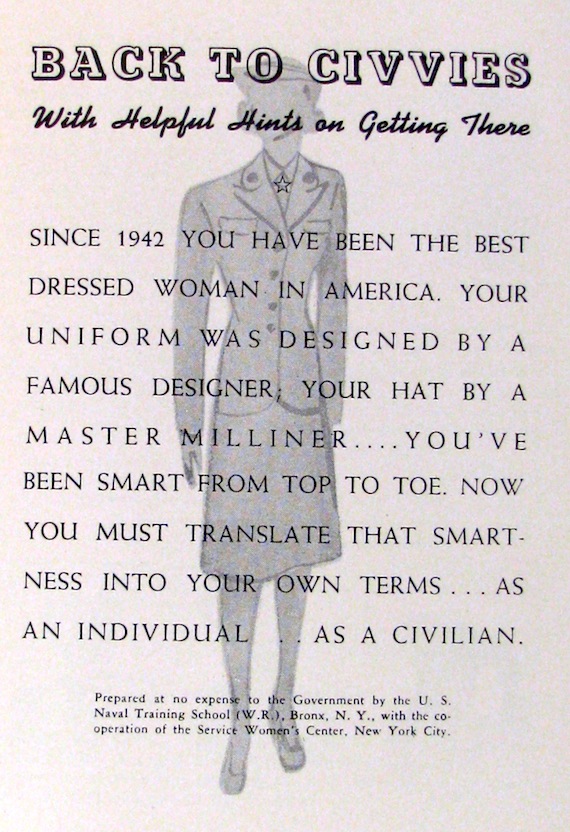
Back to Civvies

The Navy’s help for women heading back to civilian life extended beyond just the practical information needed to muster out of service.  Remember, the WAVES were consider the most fashionable and best dressed branch of the service, with couture uniforms designed by Mainbocher.

So it should come as no surprise that the Navy offered women suggestions for how the former WAVES could remain fashionable after they returned home.

This booklet is held by the The Betty H. Carter Women Veterans Historical Project at the University of North Carolina Greensboro.

Arriving Home

The Navy also offered advice to help women keep track of their military records after returning to civilian life:

Have the Recorder of County Clerk record your discharge certificate. You can then obtain a certified copy any time in the future if the original is lost or destroyed.

This image comes from the Women’s Reserve Information Separation Pamphlet. It is held by the The Betty H. Carter Women Veterans Historical Project at the University of North Carolina Greensboro.
Personal Interview

Just as potential WAVES received a personal interview when they began in the service, the soon-to-be civilians would have an interview about options after they left the service.

The sage advice from the Navy?

Make sure you are fully informed.

This image comes from the Women’s Reserve Information Separation Pamphlet. It is held by the The Betty H. Carter Women Veterans Historical Project at the University of North Carolina Greensboro.