Here’s the exciting news: the rough edit of the film is done (!!!) and our fabulous composer Andy Forsberg should have our music composed by mid-February.
So what’s up in the New Year for the Homefront Heroines crew?
Champagn and celebration with Navy WAVES at San Francisco's Fairmont Hotel.
We have some resolutions in place.
Blog a WAVES picture a day for 2012
Submit the film for ITVS and American Documentary Film Fund financing in January. Then, on to American Experience, who we’re hoping will agree that the story of the WAVES is worth a place on PBS. The funding will help us with our other resolutions.
License film footage and archival music
Find a firm to do color correction
And, find a narrator. We love the idea of :
Zooey Deschanel – because of her work with Hello Giggles advocating strong storytelling by women
Geena Davis – she’s a huge advocate for strong female role models, was a part of the film Women, War and Peace and was a speaker last year at the Joint Women’s Leadership Symposium, where we’ll be talking about the film in March
Mila Kunis – The Black Swan and Friends with Benefits star made news this year for going to the Marine Corps Ball after being asked out on Twitter. How about supporting the accomplishments of military women?
What do you think?
Here’s to a fabulous 2012 and the debut of Homefront Heroines both for the WAVES at the WAVES National Annual Conference and (ideally) at a film festival or on a television screen near you!
The U.S. National Film Registry announced its latest selections late yesterday, and included on the list is a World War II-era documentary propaganda classic. The film is called The Negro Soldier. It follows soldiers from pre-enlistment through basic training.
What was remarkable about the film wasn’t that it included African American soldiers in training (though that was indeed unusual at the time). But what was really incredible is that the filmmakers were specifically instructed to avoid Hollywood stereotypes about African Americans. So the men featured were shown coming from a variety of jobs (lawyers, musicians, athletes). According to film historians Thomas Cripps and James Culbert, the cautions included to:
Avoid stereotypes such as the Negroes’ alleged affinity for watermelon or pork; also avoid strong images of racial identity (‘play down colored soldiers more Negroid in appearance’ and omit ‘Lincoln, emancipation, or any race leaders or friends of the Negro’).
While initially intended for African American military audiences, people who saw the film thought the film should be shown to African American and white audiences, civilian and military, a response which surprised the filmmakers.
The Negro Soldier was directed by Frank Capra, who also directed the famous “Why We Fight” series of propaganda films (1942-1945). These films were designed to raise morale in the U.S. film audience and help people understand the complexities of the war. Capra began working on the films shortly after the attack on Pearl Harbor. Capra saw them as the American answer to German filmmaker Leni Riefenstahl’s powerful Triumph of the Will. He used footage mostly produced by the U.S. Office of War Information to craft his seven-film series.
The first film in the “Why We Fight” series, 1942′s Prelude to War, won the Academy Award for Best Feature Documentary in 1943. The “Why We Fight” series became part of the National Film Registry in 2000. With the addition of The Negro Soldier, this means that another important part of World War II-era domestic propaganda will be restored and preserved in the Library of Congress for future generations.
World War II women didn’t get the Capra treatment. However, this OWI film Glamour Girls of 1943 does show how the government was trying to get women to participate in the war effort as well.
In case you missed our series of holiday pin-ups on Facebook, here they all are (and a few more), put to the tune of “Baby It’s Cold Outside,” sung by Zooey Deschanel and Leon Redborn. Have a wonderful wonderful Christmas, Hanukkah, Kwanzaa, Solstice or whatever winter holiday you celebrate!
The plan was to not blog until after Christmas. After the holiday season. After the rough edit of the film was done. A few blogs were stashed to release between now and Christmas (all done, like our Christmas shopping, thank you) and on Christmas Eve-eve there would be a link to the YouTube channel clip of our holiday card.
Then came this post from Feminist Frequency on the creepiest Christmas songs of all time:
Wait – Baby It’s Cold Outside is creepier than Santa Baby (which is about crass commercialism but fun in a campy sort of way when sung by Eartha Kitt)? And it’s rapey? Really????
But it’s not even as if there is any clear cut consensus on in the feminist trenches. There are arguments that since she says “the answer is no” and he continues to try and convince her otherwise, that means the guy is a predator. Or that the line “say, what’s in that drink” means that he’s slipped her a date rape drug (uhm, sorry, Rohypnol was developed in the 1970s; the song dates back to the 1930s). Or that we’re all misunderstanding things and need to take the lyrics in their entirety and not excerpt phrases here and there. Or that while the Dean Martin version is fine, it’s the Zooey Deschanel duet with Leon Redbone that is REALLY creepy.
So since our plan is to post our holiday greeting not only using Baby It’s Cold Outside but featuring pin-ups, we though we’d need to explain a bit.
Let’s start with the notions of flirtation and sexuality in the 1930s and ’40s. While in 21st-century America “no means no,” we’re also living in a time of extreme freedom for women in terms of sexuality. Tabloids speculate if America’s favorite (unmarried) Friend is pregnant. Teen Mom follows the travails of unwed teenage mothers. An episode of Glee is all about the virgins in the club loosing their virginity.
In other words it’s not a taboo for a woman (or even a teen girl) to have sex outside of marriage.
That wasn’t the case in the 1940s. It wasn’t that women didn’t have sex – it was that they didn’t talk about it. Or admit (at the time) that they liked it. “Good” girls needed to be “convinced” by their boyfriends to stay the night, and worried if they did what might happen to their reputation afterwards. Slay Belle offers a very compelling argument to this point in her post on Persephone.
Assessing the “rapey-ness” of the song outside of its temporal context is ignoring something academic-types call “historicism”: the idea that you need to judge something within the cultural and social context when it was created. In other words, we can’t call Baby It’s Cold Outside rapey in the 21st century because by 1930s standards it may not be. It may be a song about a flirtation ritual with its own rules and expectations – a ritual we have abandoned in our modern world.
Ditto the idea of pin-ups. As Maria Elena Buszek has persuasively argued, pin-ups were seen by women in 1940s culture as not some over-sexualized representation, but rather as a way to express their (forbidden) sexuality. Women made their own pin-ups and shared them not with their boyfriends but with each other. They read Esquire and appreciated the Petty and Varga-designed centerfolds.
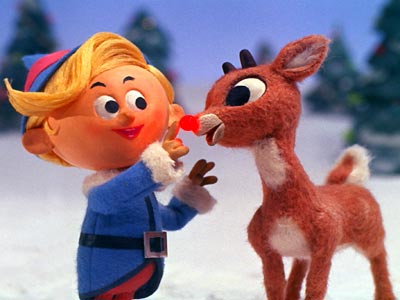
A far cry from the world of Rudolph where the men (human and reindeer) need to “get the women back to Christmastown.”
So yes, we’re using Baby It’s Cold Outside with 1940s-era pin-ups for our holiday greeting – not as a way to reinforce sexual stereotypes (man as predator, woman as victim; man as “beholder of the gaze” and woman as the one gazed upon), but rather as a way to challenge those very norms. To make us think if a woman can seemingly relinquish control to a man – while actually being very much in control of what is happening and when. To celebrate the season as well as the powerful women we’ve come to know as Homefront Heroines.
Can a pin-up be a form of sexuality and female empowerment? We’d love to know what you think.
Oh, and Zooey, we personally love your duet and think you’d make a fabulous narrator for the film. Have your people call our people.
WAVES could, of course, get leaves to spend time with family and friends. But holiday leave – that was another thing. It was highly desirable and tough to get. And the Navy, unlike civilian businesses, didn’t take a day off because it was Christmas.
Betty Bruns Lord in Uniform
It wasn’t until 1945 that Betty Bruns Lord would be allowed home – to Mason City, Iowa – for the holidays.
You didn’t get a lot of leave and sometimes you couldn’t get off because you were so busy. Just couldn’t take it when you wanted to. And I know when the boys started coming home — the last year, in ’45, I did get home for Christmas which was something you didn’t get at that time. A lot of the boys said, “Well, uh, uh?” He said, “These girls haven’t been home for Christmas since they joined.” “Oh.” And so Commander Fair, we did get our leaves. We thought for sure we were going to get cancelled. But no no no no. He said, “No, you girls are going home. You haven’t had yours.”
On the airstrip with Betty Bruns Lord
Betty was stationed at Mustin Air Field in Philadelphia working on planes. She was one of the WAVES who not only worked on planes, but knew how to fly them. Her uncle had trained her as a pilot before the war.
Virginia Gilmore was married when she joined the WAVES in 1943. Her husband was a handsome Marine. But in their first Christmas as a married couple they were thousands of miles apart. He was just back from a two-and-a-half year stint in the Pacific, stationed at the Puget Sound Navy Yard in Bremerton, Washington. Virginia was at the other end of the country at WAVE boot camp in Hunter College.
We were there on Christmas Eve. And huge Navy trucks pulled up and they unloaded a filled stocking for every recruit and hung them — they came in and hung them on the corner of our bunks.
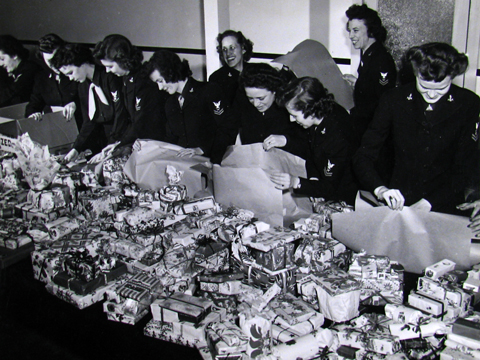
WAVE Wraps Presents, U.S. Navy Photograph
We had candy and gum and cookies and little presents. Can you imagine all the thousands — I don’t know what the Navy word is for Navy warehouse, but Navy stores where you could find all those things but we had them.
Joyce Fish Sherwood joined the WAVES in 1942. Like Helen Edgar Gilbert, she was part of the first class of WAVES, who skipped the Hunter College boot camp experience. After enlistment, Joyce was sent to Indiana University in Bloomington for orientation and storekeeper training.
Joyce was stuck in training and Christmas was approaching. So since she couldn’t get home to her family, her family brought Christmas to her.
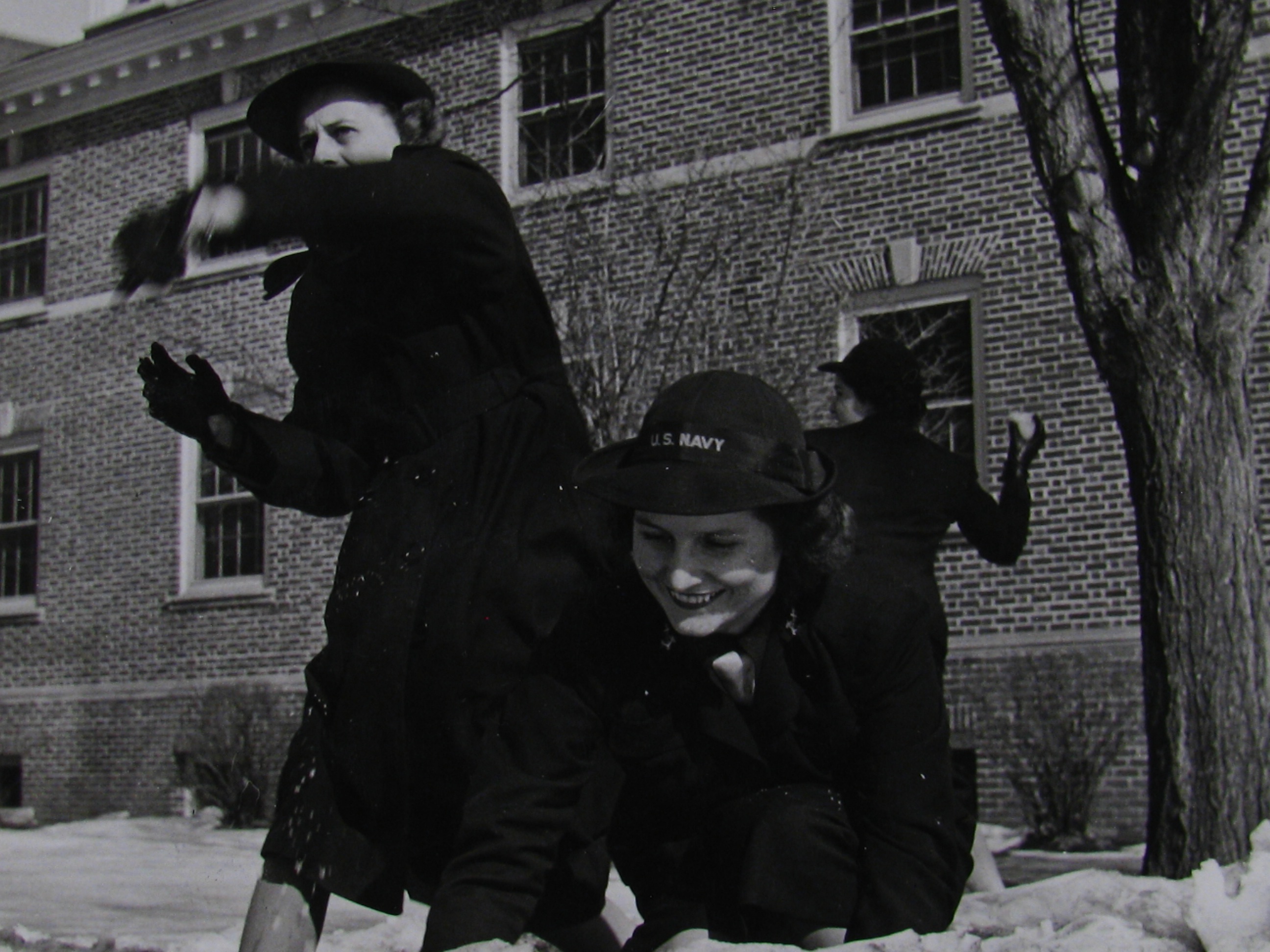
US Navy Photograph
The three of them came down and stayed in Bloomington and came onto what we called the ship (laughs) to visit and they were allowed to do that. I really don’t have much of a recollection of gift giving or anything like that. Because we had our uniforms by then. We had sent all out civilian clothes home. So there wasn’t much they could give me except stationary (laughs) or things like shampoo and stuff that you would always need.
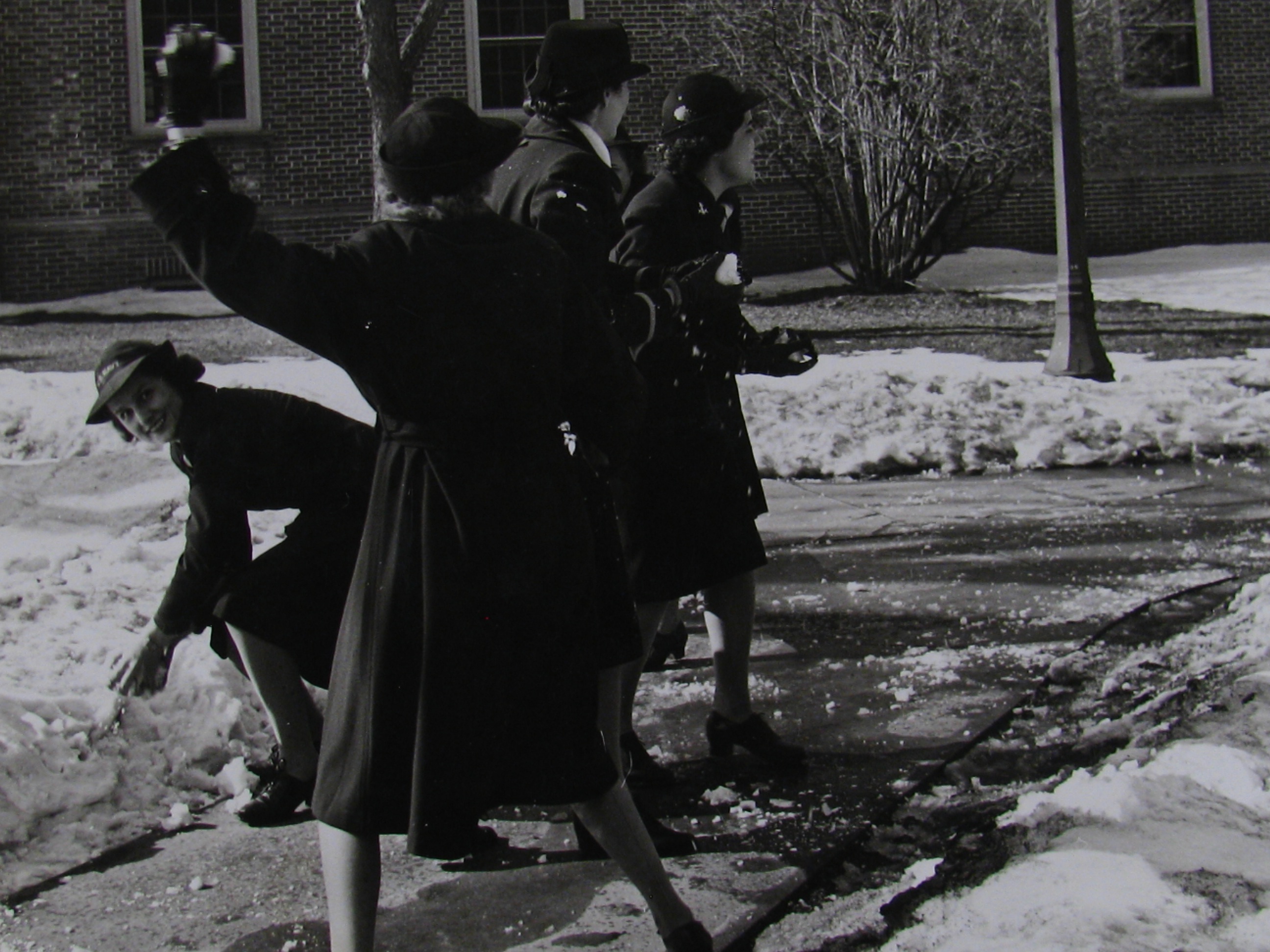
US Navy Photograph
They were proud. They were proud. I think that had something to do with this patriotism blast we were on, too. All the civilians were, “Oh! You’re in the military!” You know, they were glad to see us and they were appreciative of what we were trying to do.
We’ve been humming Bing Crosby’s White Christmas a lot lately – likely because there’s no risk of not having Christmas snow this year in Colorado. The song first premiered on an NBC radio show in 1941 and was initially released on an album for the film Holiday Inn, about a pair of song and dance men who create a country inn that featured holiday-themed performances.
By October of 1942, White Christmas was released as a single and it quickly shot to the top of the “Your Hit Parade” radio charts. The song perfectly captured the mood of the time. In it, the singer pines for the perfect Christmas:
I’m dreaming of a white Christmas, just like the ones I used to know
Where tree tops glisten, and children listen to hear sleigh bells in the snow…
Those first classes of WAVES were in training during the Christmas of 1942. Helen Gilbert was training to be a radio coder at the University of Wisconsin in Madison:
I remember Bing Crosby’s White Christmas. Every time it went on we were just sobbing. It was crazy…The first Christmas in Wisconsin, it was very sad. We were all homesick. We were just a bunch of young girls who wanted to go home.
White Christmas would later be the inspiration for the film of the same name – featuring former Army buddies (and Broadway stars) who head up to Vermont in the years after the war to help their beloved General’s struggling Vermont inn.
White Christmas is the biggest selling single of all time.
Three thousand miles of widely varied terrain – from mountains to deserts, swamps to farmland. Another three thousand miles or so across the Pacific Ocean. That’s the distance that separates Pearl Harbor from Washington, DC.
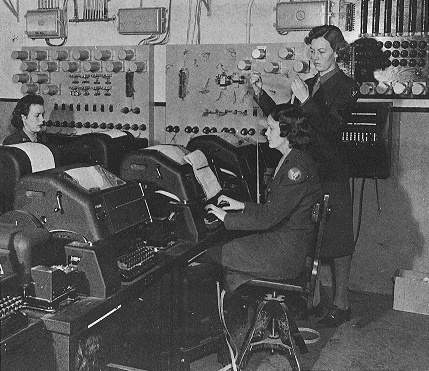
WACs operate a teletype machine during World War II.
While today communication across the world is nearly instantaneous, in 1941 there were some challenges. Starting with the time difference. When the attack began in Pearl Harbor at 8am local time, it was 1pm on the east coast – it ended close to 3pm. And forget the immediacy of the internet: news was spread by telephone, morse code or telegraph machines, which transmitted news stories via a cable. In this case, a cable stretched for miles underneath the Pacific Ocean.
The initial reports about the attack spread on December 7th, through breaking news updates on local radio stations (remember these were the days before television). And the next day, December 8th, President Franklin Roosevelt announced that the United States was at war.









 Hinges of History