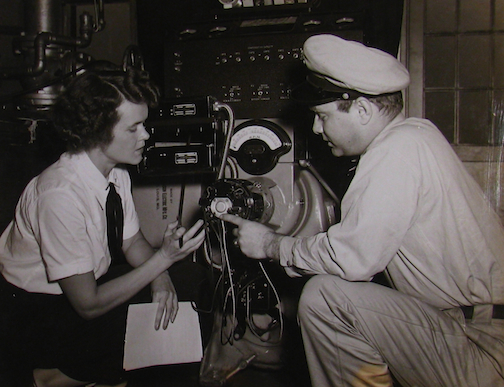
Ensign Helen Shepard, shown with Chief J.W. Nussbaumer, studies a machine in the radio laboratory at the NAS Squantum, Massachusetts.
The photo comes from the National Archives.
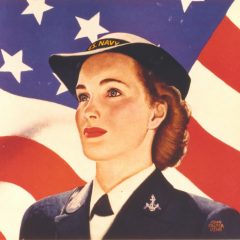
A Blog About Women Who Were Homefront Heroines: the WAVES of World War II
Ensign Helen Shepard, shown with Chief J.W. Nussbaumer, studies a machine in the radio laboratory at the NAS Squantum, Massachusetts.
The photo comes from the National Archives.

From the Navy caption of this July 1943 photograph:
Margaret Cherry, Sp(T) 3c is shown at one of the most important and helpful jobs the Waves are doing in aviation activities. She teaches aviation cadets and flight students instrument flying on the ground at NAAS Whiting Field, Pensacola, Fla.
The photograph comes from the National Archives.

How about a stop in the soda shop for your summer Saturday? Here, WAVE Lillian Baker, a Link trainer instructor, shares a shod with Mike Yapp, a celestial Link instructor, at Ship’s Service NAS Seattle.
The 1944 photo comes from the National Archives.
Love this.
 Photographer: Ralph Morgan. USAF.
Doolittle Raider Major John Hilger minutes after receiving his Distinguished Flying Cross, the fifth highest US combat decoration at the time, Bolling Field, Washington DC, United States, 27 Jun 1942.
The Doolittle Raid, also known as the Tokyo Raid, on 18 April 1942, was an air raid by the United States on the Japanese capital Tokyo and other places on Honshu Island during World War II, the first air raid to strike the Japanese Home Islands. It demonstrated that Japan itself was vulnerable to American air attack, was retaliation for the Japanese attack on Pearl Harbor on 7 December 1941, provided an important boost to U.S. morale, and damaged Japanese morale. The raid was planned and led by Lieutenant Colonel James “Jimmy” Doolittle, U.S. Army Air Forces.
Sixteen U.S. Army Air Forces B-25B Mitchell medium bombers were launched without fighter escort from the U.S. Navy’s aircraft…
View original post 125 more words
Here’s another photo of the “Firecracker War Bond Booth,” this one in color, from June 26, 1944 (70 years ago this week), set up to sell War Bonds in advance of the July 4th holiday at Naval Air Station Seattle. The goal was to earn enough to fund two PT Boats; the boats cost about $300,000 each. 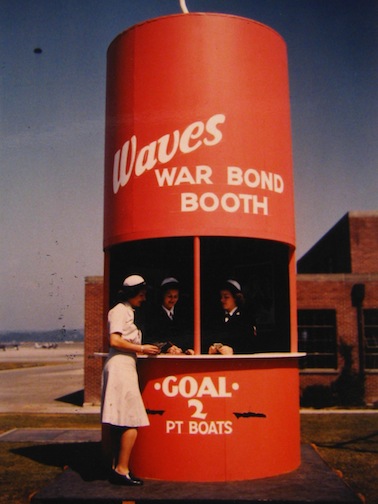
The photo comes from the National Archives.

WAVES were part of War Bond Campaigns at bases around the nation. This one at the Naval Air Station in Seattle was dubbed the “Firecracker War Bond Booth.” Given that the photo was first published on June 26, 1944 (70 years ago today!), we wonder if it had anything to do with the upcoming July 4th holiday?
Here, Mary Lindenmuth and Mary Daily, two WAVE officers, buy the first bonds for sale at the booth. Lindenmuth was Executive Officer of the WAVES at NAS Seattle and Daily was the 13th Naval District Director of the WAVES.
The photo comes from the National Archives.

From the Navy caption of this photograph:
Good chow for the WAVES, and for all navy personnel – Livingston of Minneapolis stops for a helping of dessert from the ship’s cook.
The photo comes from the National Archives.

WAVES in Washington, DC, go aboard the ferry to commute to work.
The photograph comes from the National Archives.
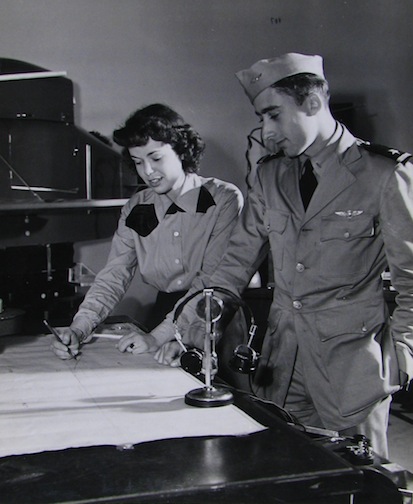
WAVE Link instructor Emily Jump goes over with Ens. Charles Harrison the course he has just flown and points out his errors. Blind flying if difficult because students prefer to trust their instincts rather than instruments.
The photograph comes from the National Archives.
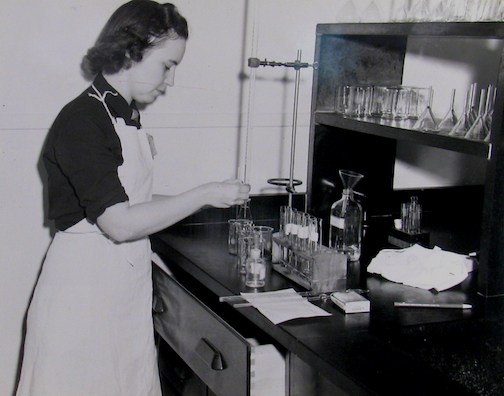
WAVE Marjorie Irwin, a Pharmacist’s Mate 2nd class, works on a gastric analysis in blood chemistry at the U.S. Naval Hospital in Oakland, California in May 1943.
The photograph comes from the National Archives.

 Hinges of History