Keeping Romance Alive

Ruth Kinman used the power of letters to keep romance alive while serving as a WAVE during the war.

My sister, who is 13 months older than I, she decided she was going to go into the WAVES. And I hadn’t thought anything about it. But she decided and she joined. And then this young man I was going with, he was drafted into the Marine Corps. So I thought, “I’m not going to stay here by myself.  I’m going to go into the WAVES too.” So that’s why I enlisted.

Ruth stayed in touch with her young Marine, Carl Gaerig, throughout the war. But it wasn’t until the war was nearly over that they began talking seriously about marriage.

He had been discharged because he had been wounded, had been in the hospital and recovered.  Then he came to Washington, where I was stationed and so we decided to get married. When we decided to get married I had to get permission from my superior to wear a wedding gown and veil and all that. And my mother came to the wedding and Carl’s mother came tot he wedding from Duquoin, Illinois. It was quite a spectacular occasion for us.

This was in September of 1945, after V-J Day. Shortly after the wedding, Ruth was discharged. She can Carl moved back to Illinois, where they both went to college. We met them aboard the WAVES National Convention Cruise in 2006.

We’ve been married 61 years now,  I don’t know where the years have gone.

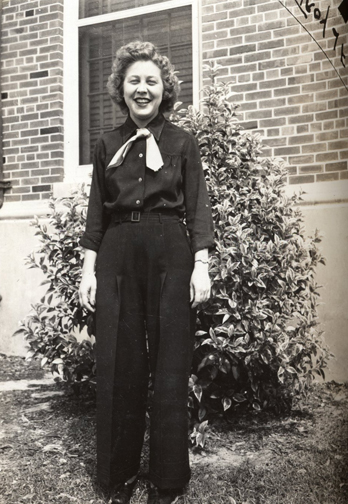
This photograph was taken of Ruth in 2006 aboard the WAVES National Convention Cruise. It comes courtesy of Mel Kangleon.
A Whirlwind Romance

Romance often moved quickly during World War II. Phyllis Jensen Ankeney grew up in the same neighborhood as her husband-to-be. She remembered admiring his Navy uniform after he enlisted in the service, but romance didn’t blossom until after she had joined the WAVES and they were home on leave together.

He got pretty upset when he found out I had gone in the service (laughs). He didn’t think a woman shouldn’t be there either at that point. But anyway, we came on home on leave together, not knowing it. He came from the South Pacific and I came from Florida.  We happened to come home at the same time. We went together for the few days we were  at home. Other than that, I had not dated him.  And he said that we’d get married — that I’d get a ring for my birthday in January. This was in September.  We were married the seventh of October.

We talked every night. And he wanted to get married. I said, “I don’t have any leave coming, If we’re going to get married you’re going to have to come here.” So he came right on down there. But we did have a church wedding in Pensacola.  A Lutheran church.  No family, no one around.  Just the ones from the base that came in. The minister had a youth class there on Sunday night and he asked if I would invite them to be at the wedding, so I did.

They ended up moving back to their home town after World War II and Phyllis got pregnant almost immediately after she was discharged. Her husband did get called up into the Navy again, during the Korean War.

The photograph comes from the collection of Phyllis Ankeney.

Hunter College: Living Quarters

Hunter College was primarily a commuter college; there weren’t any dorms on the campus grounds. The Navy needed housing for 8,000-10,000 women at a time (plus instructors), so it turned to the Bronx neighborhood for help. Apartments surrounding the campus were commandeered by the Navy for the duration of the war.

An article in the New York Times talked about this development:

While … merchants on Kingsbridge Road, the nearest shopping center, all claimed their businesses would suffer, none complained.  Businessman Max Steubens, who ran a self-serve market, depended on the 13 apartments for most of his business, but when interviewed said, “I’m more than willing to do my share toward the war effort” (1.13.43) A few days after this, complaints arose because nearby apartments were raising rent for the occasion. The situation was investigated and The New York Times made sure to note that, “The complaints they received were logical and natural and not at all unpatriotic” (1.14.43)

This photograph comes from a postcard booklet designed for WAVES recruits to send it home to their parents, families and friends. It shows the converted apartments, where women lived 8-10 to a one bedroom unit.  It is from the Betty H. Carter Women Veterans Historical Project at the University of North Carolina Greensboro.

Honorable Discharge

V-J Day happened August 9, 1945. Jean Clark’s husband, Lou, returned to Seattle from his assignment soon after and was to be immediately discharged. Jean’s commander decided to help her out as well.

He said, “I’ll put you down for 30 days leave. You come back and your discharge will be complete.”  So I went home with my husband and we — then we came back in a month. That was in August, I think. By the time we got back the discharge was complete. We went back to Lebannon where my parents were living. We didn’t have a house or anything. While we were there, we decided, I guess maybe we ought to find a job. We did. We went to the school district and both of us were hired. Because then teachers were in short supply and we both had our degrees and our certificate.

This is a photograph of Jean’s honorable discharge from the Navy, dated September 6th, 1945. It comes from the collection of Jean Clark.

Growing Up

Jean Clark was stationed at NAS Lake Washington for two and a half years. She said her experience in the Navy changed her outlook on life:

Well, I think it helped me to grow up a little bit. You know. I said, you know, I was 19 when we were married and well, ’45 I was 24. And during that time, I think was pretty green, I was, you know, about the rest of the world and after that,  we sort of took advantage of some things and got to go a little farther then we might’ve before.

This is a photograph taken at NAS Lake Washington of WAVES and a sailor relaxing between assignments. It comes from the collection of Jean Clark.

NAS Lake Washington

Jean Clark was stationed at NAS Lake Washington for the duration of the war. The facility is no longer a Naval Air Station, but is a public park. It’s located in Seattle, along the shores of the lake near the University of Washington’s Seattle campus.

Jean was in charge of the Link Trainer Instructors.

I think probably because I was one of the first ones there.  I had a little more training than, I guess, well I had been retained for instructor, too, there. So the commander decided I was going to be in charge of the whole group. We didn’t have that many at first, only four. But then we increased to nine. We had a full complement of all we could use. By that time, when we had nine, we were pretty loaded with personnel.

We were all good friends. All nine of us, still, went out to Seattle when we had liberty and we also after we were discharged, I was the first one to be discharged, we were writing letter. I think we wrote letters for 35 years probably. They came maybe twice a year. We called them a round robin letter. They were sent to the next person you know and we had a mailing list that you followed. It’s interesting. I used to keep all these letters, but I don’t have them any more.

The photograph comes from the collection of Jean Clark.

Learning the Ropes

Jean Clark was sent to Atlanta in order to learn how to give proper instruction to potential pilots via the Link Trainer. But it wasn’t enough to simply learn how to give instruction. They had to learn everything about the trainer from top to bottom.

We also had to check the trainer. While we were at the air base, not only did we learn how to operate the trainer, we also learned how to repair it if anything went wrong.  There was an engine just outside of the building, the main, that had to be dismantled and cleaned every now and again so it was operating efficiently.  That was part of our duty.

At the end of the training session, the women received a certificate saying that they were qualified in their ranking.

This certificate comes from the Jean Clark collection.

Coveted Assignment

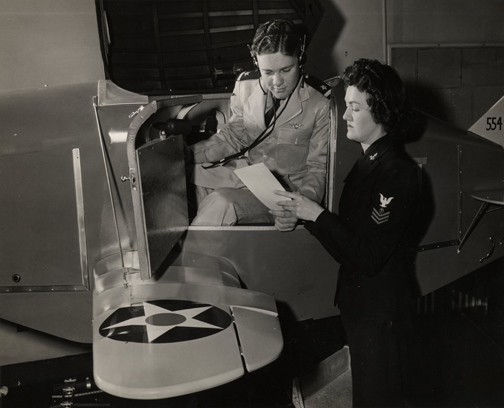
WAVES worked in a wide variety of jobs, but many of the women with teaching experience like Jean Clark ended up in instructional positions. Jean wanted to become a Link Trainer, which used an early form of flight simulation to train men in piloting skills.

We had to take aptitude tests.  Now, I’m going to brag a little bit. Partly, I think, because I’d been a teacher. All of the girls who were chosen to go to Link School had been in education. I think they felt, “They’ve already learned how to teach.  After that, we can teach them the subject matter and they can teach it.” That was their theory I’m sure. They said it was the top thing and if it was the top thing, that’s what I want (laughs).  So, everybody was envious if we got it. There were only 50 of us I think that got it. So not too many.

This is a photo of Jean training a man in the Link flight simulator. It comes from the collection of Jean Clark.

WAVES Do Swim!

One of the rumors swirling about the military women was the various qualifications they’d need in order to join the different branches. Since the WAVES’ name evoked water, and the WAVES were part of the Navy, one rumor about the WAVES was that a woman had to know how to swim in order to join. Some members of the Women’s Army Corps even now say they didn’t join the WAVES in World War II because they couldn’t swim!

The rumor was false; a woman didn’t have to be a swimmer to join the WAVES.  But swimming was one of the activities women could do to keep in shape.

These WAVES are swimming in the pool at Yeoman Training School at the University of Northern Iowa in Cedar Falls, circa March 1943. The photograph can be found in the National Archives.

Keeping New Year’s Resolutions

What’s your resolution this year? Do a search on the web and you’ll find any number of resolution ideas. The top ten resolutions for small businesses. The top ten anti-aging resolutions for seniors. Top resolutions for a first-time pregnant mom (and isn’t that redundant – I mean, can you be a pregnant dad?). Top vacation resolutions.

According to USA.gov, some of the most popular resolutions in the U.S. revolve around getting into shape (physical or financial):

  • Get fit
  • Lost weight
  • Manage debt
  • Drink less
  • Save money
  • Reduce stress
  • Quit smoking
  • Get a better job
  • Eat healthy food
  • Get a better education

Since this is the week when most people give up their resolutions, it may be time for some inspiration from the WAVES. For WAVES, physical activity was part of their daily routine, with a number of exercise choices to stay in shape on the job.

This photograph from the National Archives was taken at the WAVES Radio School at the University of Wisconsin in Madison. It dates from March, 1943. According to the caption:

The Navy knows that these girls will attain top efficiency in their work only if they are in perfect condition, so building a sound body plays an important part in the day’s routing at the WAVE Radio School.