Getting the Uniform

The second image in the photo essay of Maria Ramona Espinosa at boot camp at Hunter College followed as she was fitted for her Navy uniform.

The caption reads:

Apprentice Seaman Esponosa, her hair done up in regulation style, has her first uniform fitted.

The photograph comes from the National Archives. It dates from September 1943.

A Girl Joins the Navy

Part of the WAVES recruitment efforts were to show the experiences of women in the Navy, and boot camp was no exception. This photo essay followed one woman, Maria Ramona Espinosa, through boot camp at Hunter College.

In this photo, she arrives at the gate of the Navy facility, dressed in her civilian clothes. The caption reads:

Maria Ramona Espinosa goes thru some of the steps necessary to become a WAVE at Hunter College, Bronx, N.Y. Arriving at school she gets her first directions from a Shore Patrolman at the gate.

The photograph comes from the National Archives. It dates from September 1943.

The Map

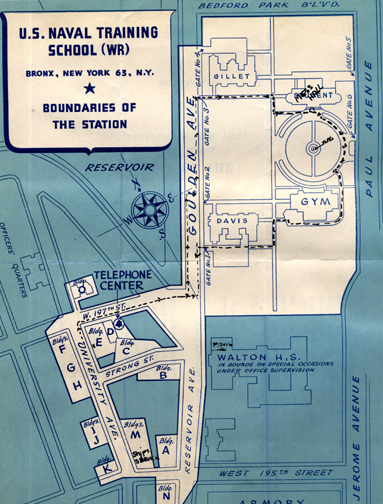
When women were stationed at the Hunter College boot camp, they received a map as part of their orientation packet. The map showed where the key buildings were, and included the surrounding apartment buildings.

This copy of the map comes from the collection of WAVE Margaret Anderson Thorngate. It shows the path she would take from the building where her quarters were located (Building D, a former apartment complex) to the Mess Hall, where meals were served.

Honorable Discharge

V-J Day happened August 9, 1945. Jean Clark’s husband, Lou, returned to Seattle from his assignment soon after and was to be immediately discharged. Jean’s commander decided to help her out as well.

He said, “I’ll put you down for 30 days leave. You come back and your discharge will be complete.”  So I went home with my husband and we — then we came back in a month. That was in August, I think. By the time we got back the discharge was complete. We went back to Lebannon where my parents were living. We didn’t have a house or anything. While we were there, we decided, I guess maybe we ought to find a job. We did. We went to the school district and both of us were hired. Because then teachers were in short supply and we both had our degrees and our certificate.

This is a photograph of Jean’s honorable discharge from the Navy, dated September 6th, 1945. It comes from the collection of Jean Clark.

Learning the Ropes

Jean Clark was sent to Atlanta in order to learn how to give proper instruction to potential pilots via the Link Trainer. But it wasn’t enough to simply learn how to give instruction. They had to learn everything about the trainer from top to bottom.

We also had to check the trainer. While we were at the air base, not only did we learn how to operate the trainer, we also learned how to repair it if anything went wrong.  There was an engine just outside of the building, the main, that had to be dismantled and cleaned every now and again so it was operating efficiently.  That was part of our duty.

At the end of the training session, the women received a certificate saying that they were qualified in their ranking.

This certificate comes from the Jean Clark collection.

Dance, Dance, Dance

Physical education took many different forms. These WAVES are square dancing their way to fitness.

The photograph dates from April of 1943. It was taken at the U.S. Naval Training School for Radio Operators at the University of Wisconsin in Madison. It’s held in the collection of the National Archives.

WAVES also participated in sports teams which traveled to other bases and competed with women in various sports, like volleyball or basketball. Janette Shaffer Alpaugh helped organize those teams in the south. Read more about her work in physical activities for WAVES here.

WAVES Do Swim!

One of the rumors swirling about the military women was the various qualifications they’d need in order to join the different branches. Since the WAVES’ name evoked water, and the WAVES were part of the Navy, one rumor about the WAVES was that a woman had to know how to swim in order to join. Some members of the Women’s Army Corps even now say they didn’t join the WAVES in World War II because they couldn’t swim!

The rumor was false; a woman didn’t have to be a swimmer to join the WAVES.  But swimming was one of the activities women could do to keep in shape.

These WAVES are swimming in the pool at Yeoman Training School at the University of Northern Iowa in Cedar Falls, circa March 1943. The photograph can be found in the National Archives.

Lost Her Voice

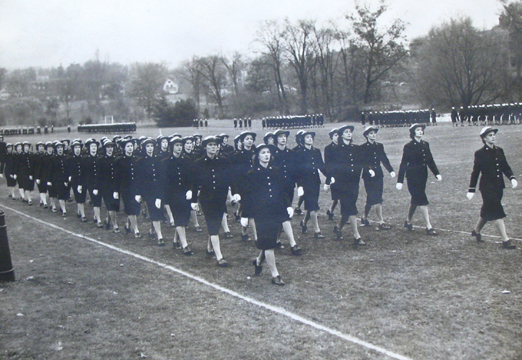
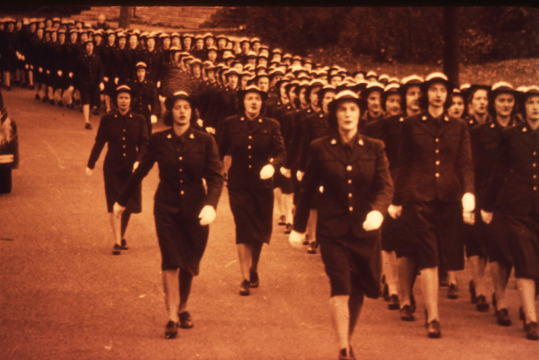
Part of learning military protocol for WAVES including marching in formation. At Smith College, the officers in training marched across the fields on the Smith campus, led by officers like Franny Prindle Taft.


You have to go down by the waterfall to get down to the fields. And hupping the troops over the waterfall. I lost my voice then and it’s never really come back … went down and octave and stayed there.

Taft also remembers marching in formation for dignitaries who would come to visit and learn about the WAVES, such as First Lady Eleanor Roosevelt.

This photograph is courtesy of Franny Prindle Taft.

“Hupping” the Troops

WAVES stayed in dorms on the Smith College campus when in officer training at Northampton, but they ate all of their meals at the Wiggins Tavern in the historic Hotel Northampton. Wiggins was an area landmark and popular with locals, but it became WAVES-central during the war.

Franny Prindle Taft says she was named as company commander when at Smith. That meant it was her job to get the troops the half mile from the campus down Main Street to Wiggins on King Street three times a day to eat – and then back again after the meals for training or to quarters.

I hupped the troops down the hill and then I had to be the last one in line to see that they all went through. And then I had to be the first one out. So I think what I got in the Navy was the ability to eat very fast.

This photograph is courtesy of Franny Prindle Taft.

Love and Marriage

Franny Prindle met her husband-to-be Seth Taft while she was still in college. Seth was the grandson of the former U.S. President William Harding Taft.  They were both officers in the Navy.

Initially, WAVES weren’t allowed to be married. But the Navy discovered that they were losing out on some qualified women (or were forcing them to resign upon marriage). So first women were only allowed to marry outside of the Navy. Then that policy too changed, and WAVES were allowed to marry Navy men.

This photograph is of Franny on her wedding day: June 19, 1943. She and Seth were both Ensigns at the time – he wore his dress whites to the ceremony. She had a half-dozen bridesmaids and changed into her Navy uniform before departing on her honeymoon.

This photograph is courtesy of Franny Prindle Taft.