Drawings and Such

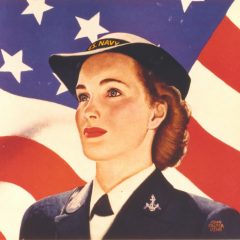
We’re beginning a series on cartoons and other WAVES drawings for the HH blog.  This image (from an orientation booklet) is typical of the images made during the time. The WAVE looks young and a little overwhelmed or excited by her new experience at WAVE Quarters D (which was in Washington, DC).

It comes from the Schlesinger Library at the Racliffe Institute for Advanced Studies.

Flag Day

June 14th is Flag Day, the day celebrating the adoption of the U.S. Flag in 1777 by the Second Continental Congress. It was officially established in 1914 via a proclamation by President Woodrow Wilson and was reaffirmed by an Act of Congress in 1949.

Flag Day isn’t an official federal holiday, but it is a state holiday in Pennsylvania (the only state to recognize Flag Day as a holiday).

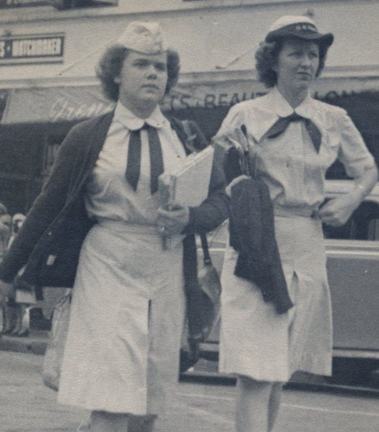
This photograph shows the retreat ceremony at the WAVES Yeoman School in Cedar Falls. It comes from the Naval History and Heritage Command.

Happy Flag Day!

Extra Pay

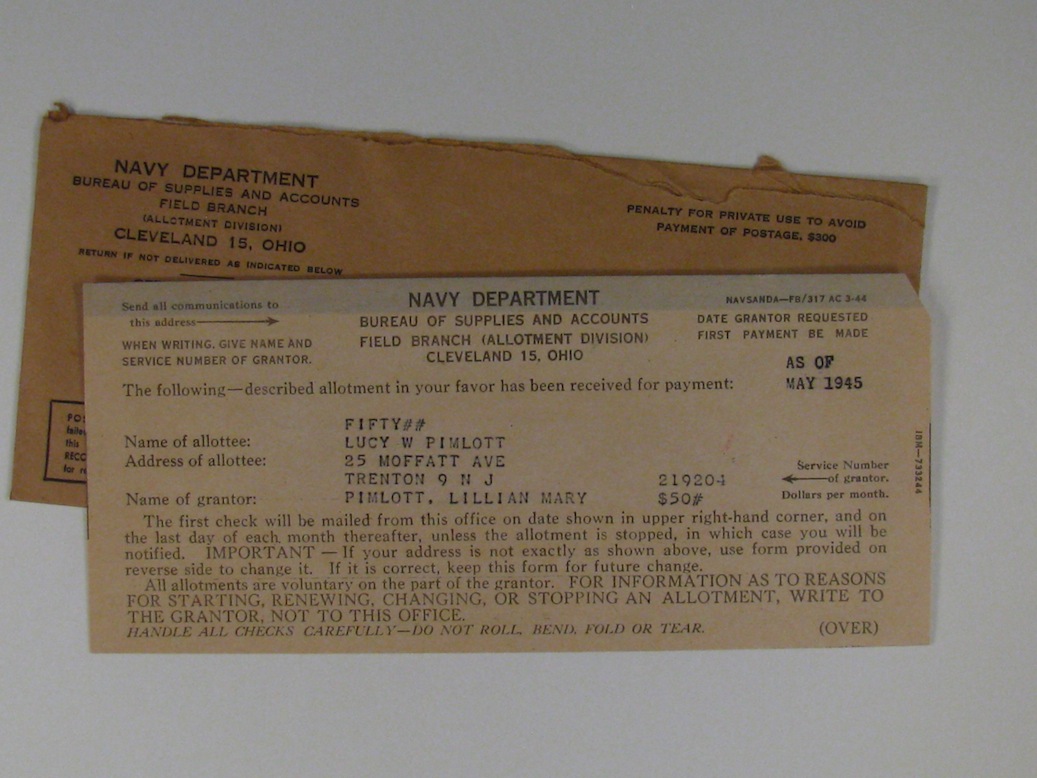
This is a really fascinating document found in the Betty H. Carter Women Veterans Historical Project at the University of North Carolina Greensboro. It is a receipt for extra pay ($50) disbursed to Lucy W. Pimlott, on behalf of WAVES Lillian Pimlott. WAVES received the same pay as men, and like men often received extra money to pay for uniforms and uniform updates. It’s likely this is for a uniform or other supplement, as the $50 amount is much lower than all but one of the Navy pay rates (only an Apprentice Seaman, the lowest rank in the Navy,  made $50 a month).

At this time of this disbursement, WAVE Lillian Pimlott was stationed in Hawaii working in the District Personnel office. She had been in the WAVES since 1943 and would later become a part of the post-World War II Navy.

This disbursement was likely a portion of Pimlott’s monthly base pay, sent home to help support her family.

Special Edition

This is a photo of a commemorative stamp honoring the U.S. Coast Guard. It was released after World War II had ended, on November 10, 1945. The Coast Guard itself was originally founded on August 4th, 1790.

The stamp comes from the Better H. Carter Women Veterans Historical Project at the University of North Carolina Greensboro.

The Legacy

Merrily Kurtz served in the WAVES until 1947, then eventually got married and had a family. She later joined WAVES National, the group for female sea services veterans.

She says of her time in the Navy and WAVES National:

I wanted to get away from home.  I wanted to get out and see the world.  And I did, I really did.  And I have since.  I’ve been lucky.  I’ve gone to conventions and stuff. Met a lot of good people. That’s something.  And I don’t know, isn’t that enough?

This photograph comes from the collection of Merrily Kurtz Hewett.

A Roundabout Journey

After boot camp, Merrily Kurtz headed to training to become a Storekeeper, the Navy parlance for a bookkeeper. Training took three months, and then Kurtz got her first assignment, in San Francisco. She had a week before her job began, and was traveling with several other WAVES across country by train. The group stopped in Chicago, and Kurtz and three other women spent a day on the town – and ended up getting left behind.

They were all gone.  Except for the four of us girls.   Nobody’s there. They hadn’t left a note for us or anything. So we went down to the train and finally got connections. One of the girls took over and asked about it.  And then, so, our tickets were gone but they put us on a train.  I guess they knew we weren’t lying.  We were military or something. So they let us on the train and let us pick out the car we wanted to be on. So we went through two or three and said, “Oh, this will do.”  And it was the worst one!  (laughs)  No air conditioning or anything.  Oh, golly, and this was summer!  So one of the girls, this Margaret Chan who lived here in Portland, she and I got off the train in Cheyenne. Which is definitely not the thing to do in the Navy.  And we took the train home.  Instead of going on to San Francisco, we took the train from Cheyenne to Portland and came home that way.  Which made sense to a normal person (laughs).  We paid for it.  Oh, gee.  I think we got bawled out for it but they didn’t do anything else to us.

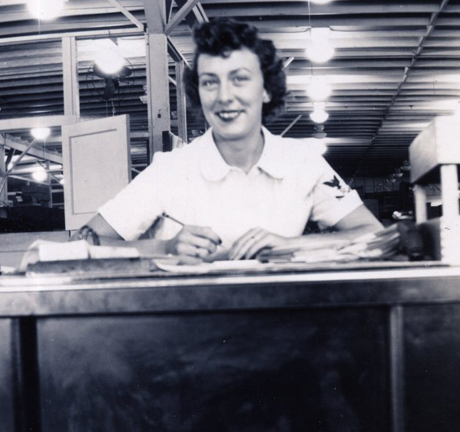
This portrait of Kurtz in her Navy summer uniform comes from the collection of Merrily Kurtz Hewett.
Snappy Uniforms

One reason Merrily Kurtz selected the Navy was because of the fashionable Mainbocher-designed uniform.

We had measurements and tried them on. They came up to us, oh gee!  You know, “What size are you?”  They’d look at you and give you a size approximately (laughs).  I didn’t have to have my altered. They gave me a buxom, and I’m glad.  I don’t think that I’m a buxom, but they through I was.  Evidently it gave me a little bit more room in the front.  I don’t remember having to be altered.  Then we got our shoes, and our hose and — it was so cold back in New York.  We went in February.  You marched everywhere, and the wind blowing off the reservoir was colder than blazes.  I don’t know what the temperature was, but it was awful cold.

This photograph shows Merrily Kurtz and another WAVE marching. It comes from the collection of Merrily Kurtz Hewett.


Following in Daddy’s Footsteps

For Merrily Kurtz, joining the Navy was a family affair.

My dad had been in the Navy and he kind of encouraged me to go in the Navy. When we’d talk about it, he’d say what a good time he had. Saw the world.  Well, he didn’t see much of the world, Chicago, mostly, and the Great Lakes.  But he encouraged me to go in, through it would be good for me to see some of the world.  I signed up to go in the WAVES.

This photo shows Merrily Kurtz on the job. It comes from the collection of Merrily Kurt Hewett.

Working Girl

After Merrily Kurtz graduated from high school, she began working at a local department store.

Well, every girl in town almost worked in Meyer and Franks.  My first job was J.C. Penney’s. I went to a business college for awhile and got some training that way and  improved my typing.

Eventually, Kurtz was hired by Meyer and Franks, but by that time the country was at war.

Just outside of the building in the next block they (the military) had their stand where the people came up for the bond drives and you know encouraged people to sign up and they had famous people come and I remember seeing the three sisters… the Andrews Sisters I guess it was, you know, and you would go out and see that stuff and hear that “Rah rah.”

The photo comes from the collection of Merrily Kurtz Hewett.
Family Ties

The Depression put stresses on many families. For Merrily Kurtz, whose mother had died when she was just five years old, the Depression first meant her father working at a series of jobs trying to keep his family together. When he realized that the work was too much, he asked his wife’s parents to help raise his young children. They first lived in a Portland, Oregon, neighborhood, but then later moved to a farm in the country.


I don’t think I was aware the Depression was going on. I enjoyed life as it was. I had a good time. I had my meals, I never had to go hungry. Of course I didn’t have some of the niceties, but this is out in the country. There were a lot of blackberry vines.  I got to wear shoes that came up over your ankle and I had the largest size at that time and the next time, when my feet grew they couldn’t fit me. That hurt (laughing).

This photograph shows Merrily and her brother with her grandmother. It comes from the collection of Merrily Kurtz Hewett.