On the Town

It wasn’t all hard work for the WAVES. Even officers tasked with training fellow officers, like Franny Prindle Taft, could find time to break away for the occasionally bit of entertainment.

In this picture, Franny (center) is with another WAVE and an military man. They’re at a place called Pine Orchard, in summer of 1943.

Pine Orchard appears to be a country club or a nightclub or restaurant with an outside patio. We’ve done some basic research and can’t find out anything about it, but would love to know more if anyone has any details.

The photograph is courtesy of Franny Prindle Taft.

Lost Her Voice

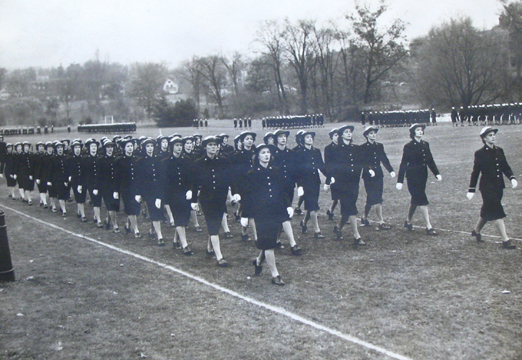
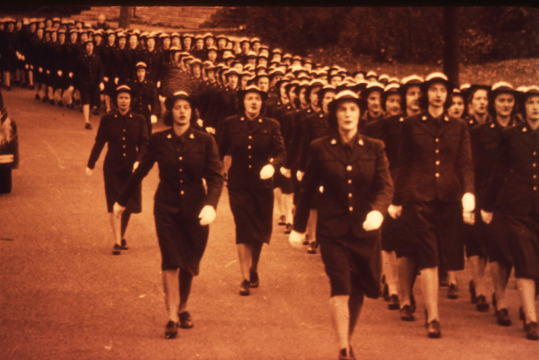
Part of learning military protocol for WAVES including marching in formation. At Smith College, the officers in training marched across the fields on the Smith campus, led by officers like Franny Prindle Taft.


You have to go down by the waterfall to get down to the fields. And hupping the troops over the waterfall. I lost my voice then and it’s never really come back … went down and octave and stayed there.

Taft also remembers marching in formation for dignitaries who would come to visit and learn about the WAVES, such as First Lady Eleanor Roosevelt.

This photograph is courtesy of Franny Prindle Taft.

“Hupping” the Troops

WAVES stayed in dorms on the Smith College campus when in officer training at Northampton, but they ate all of their meals at the Wiggins Tavern in the historic Hotel Northampton. Wiggins was an area landmark and popular with locals, but it became WAVES-central during the war.

Franny Prindle Taft says she was named as company commander when at Smith. That meant it was her job to get the troops the half mile from the campus down Main Street to Wiggins on King Street three times a day to eat – and then back again after the meals for training or to quarters.

I hupped the troops down the hill and then I had to be the last one in line to see that they all went through. And then I had to be the first one out. So I think what I got in the Navy was the ability to eat very fast.

This photograph is courtesy of Franny Prindle Taft.

Special Recommendation

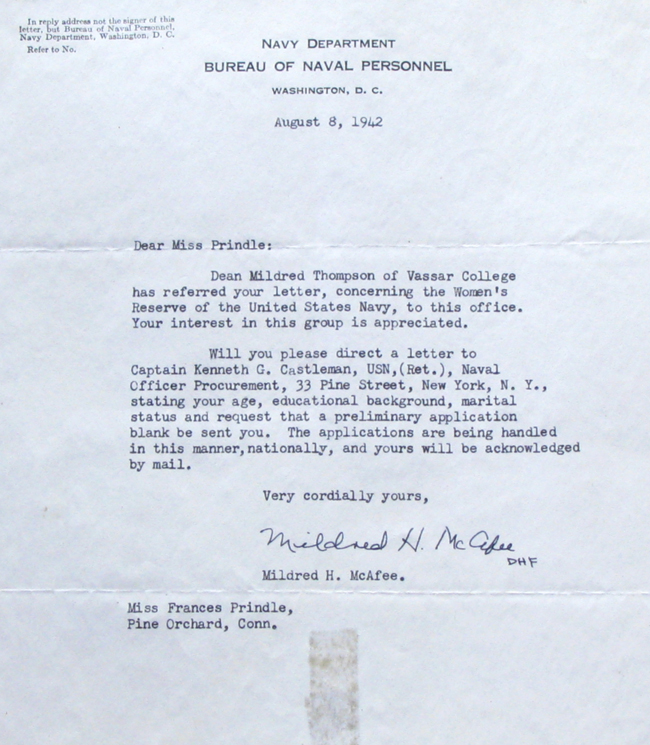
The first class of WAVES officers were gathered on special recommendation from people who knew the women who would serve. This was done to make sure that the Navy had women in command who were, in essence, a “known” quantity: women who held certain values, were smart, driven, and would represent the Navy well.

Franny Prindle was one of those women. This is the letter she received from WAVES’ leader Mildred McAfee, inviting her to become a WAVE officer in August of 1942. Prindle was recommended by Vassar College Dean Mildred Thompson, a woman McAfee knew personally from her tenure as dean of Wellesley College.

Prindle returned the application and was a member of the first WAVE officer training class at Smith College. She remained at Smith for the duration of the war, training other officers.

Love and Marriage

Franny Prindle met her husband-to-be Seth Taft while she was still in college. Seth was the grandson of the former U.S. President William Harding Taft.  They were both officers in the Navy.

Initially, WAVES weren’t allowed to be married. But the Navy discovered that they were losing out on some qualified women (or were forcing them to resign upon marriage). So first women were only allowed to marry outside of the Navy. Then that policy too changed, and WAVES were allowed to marry Navy men.

This photograph is of Franny on her wedding day: June 19, 1943. She and Seth were both Ensigns at the time – he wore his dress whites to the ceremony. She had a half-dozen bridesmaids and changed into her Navy uniform before departing on her honeymoon.

This photograph is courtesy of Franny Prindle Taft.

Special Permission

Navy WAVES were active, regular military. That meant they were expected to wear their uniforms during all public functions. Including weddings.

Franny Prindle, like other WAVES of the era, had to get a special dispensation from the Executive Officer of the Naval Reserve to wear something other than her uniform on her wedding day.  But note the special conditions: no photographs of Prindle outside of her uniform could be released to the press.

Getting the News

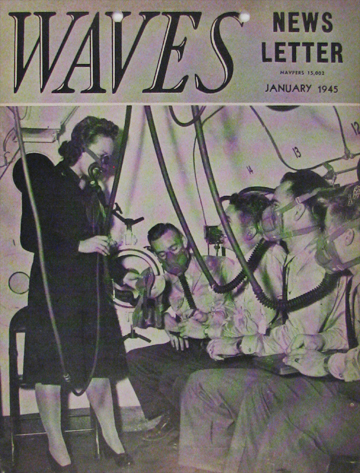
The Navy put out newsletters to keep the WAVES up to date. The newsletters at first started out quite simple – just a copied sheet or two of paper with a few sketches – but ultimately the publications became quite polished, featuring in-depth articles, photographs and even comics.

This newsletter was published in January of 1945. It was a national publication that was designed to go out to all WAVES regardless of where they served. The photo on a cover shows a WAVE working with sailors who are learning how to use pressurized masks for high-altitude flying.

The national newsletter focused on news of interest to any WAVE. But individual bases also put out newsletters, with location-specific information.

This newsletter is held in the Betty H. Carter Women Veterans Historical Project at the University of North Carolina Greensboro.

New Year’s Resolutions

Here’s the exciting news: the rough edit of the film is done (!!!) and our fabulous composer Andy Forsberg should have our music composed by mid-February.

So what’s up in the New Year for the Homefront Heroines crew?

Champagn and celebration with Navy WAVES at San Francisco's Fairmont Hotel.

We have some resolutions in place.

  • Blog a WAVES picture a day for 2012
  • Submit the film for ITVS and American Documentary Film Fund financing in January. Then, on to American Experience, who we’re hoping will agree that the story of the WAVES is worth a place on PBS. The funding will help us with our other resolutions.
  • License film footage and archival music
  • Find a firm to do color correction
  • And, find a narrator. We love the idea of :

What do you think?

Here’s to a fabulous 2012 and the debut of Homefront Heroines both for the WAVES at the WAVES National Annual Conference and (ideally) at a film festival or on a television screen near you!

Stockings and candy and presents, oh my!

Virginia Gilmore was married when she joined the WAVES in 1943. Her husband was a handsome Marine. But in their first Christmas as a married couple they were thousands of miles apart. He was just back from a two-and-a-half year stint in the Pacific, stationed at the Puget Sound Navy Yard in Bremerton, Washington. Virginia was at the other end of the country at WAVE boot camp in Hunter College.

We were there on Christmas Eve.  And huge Navy trucks pulled up and they unloaded a filled stocking for every recruit and hung them — they came in and hung them on the corner of our bunks.

WAVES at Christmas
WAVE Wraps Presents, U.S. Navy Photograph

We had candy and gum and cookies and little presents.  Can you imagine all the thousands —  I don’t know what the Navy word is for Navy warehouse, but Navy stores where you could find all those things but we had them.

What We’re Thankful For, Part I – The Four Freedoms

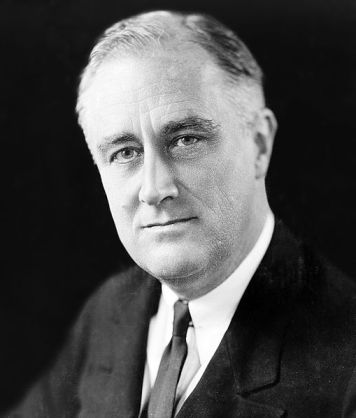
In January of 1941, months before the United States would become officially involved in World War II, President Franklin Roosevelt gave one of his radio addresses.

Roosevelt was an innovator in using mass media to help bring his message to the public. His speech about the banking crises in 1933 was the first time a President had used the power of the radio to speak directly to the American public (in this case to attempt to stop the bank runs which nearly destroyed the nation’s economic system in 1933).  That speech would lay the groundwork for the Fireside Chats, 31 radio addresses on a variety of topics, ranging from the New Deal to the War in Europe.

The Four Freedoms speech wasn’t one of those Fireside Chats. It was the official State of the Union Address for 1941. But it nonetheless illustrates Roosevelt’s skill at using the public airwaves to speak to the American public:

In the future days, which we seek to make secure, we look forward to a world founded upon four essential human freedoms…That is no vision of a distant millennium. It is a definite basis for a kind of world attainable in our own time and generation. That kind of world is the very antithesis of the so-called new order of tyranny which the dictators seek to create with the crash of a bomb. To that new order we oppose the greater conception—the moral order. A good society is able to face schemes of world domination and foreign revolutions alike without fear.

Roosevelt included two Constitutionally-mandated freedoms (Freedom of Speech and Freedom of Worship) in his speech, and then added two freedoms which he said should be a part of the social contract we have with our fellow Americans. Freedom from Want means that Americans shouldn’t go hungry or be without basic human needs (food, shelter, etc.) – and that a modern society had a responsibility to provide for those in need.  Freedom from Fear means that we should live in a country where we don’t have to worry about our safety. Roosevelt went on to say that these weren’t just American values, but should be values available to everyone in the world.

The Four Freedoms would later be illustrated by Norman Rockwell in a series of drawings for the Saturday Evening Post.

The Four Freedoms wasn’t a Thanksgiving speech, but nonetheless we’re thankful this time of year for Roosevelt and his identification of the Four Freedoms.