Aboard the Red Rover

During the Civil War, the the USS Red Rover. a hospital ship based in the Mississippi River, became the first Navy vessel to have women on board. The Catholic Sisters of the Holy Cross served as nurses aboard the ship.

This engraving from Harper’s Bazaar shows  a sister nurse attending a patient bedside in one of the wards. It comes from the U.S. Naval History and Heritage Command.

The First Shipboard Women

By the Civil War, the U.S. Navy realized that it would need help from women. And since nursing was an accepted profession for women, the Navy decided that women could serve aboard ships as an experiment.

But not just any women. Nuns. Specifically the Catholic Sisters of the Holy Cross, who served in aboard the pioneer Naval hospital ship the USS Red Rover.  The ship was based in the Mississippi River.

This engraving from Harper’s Bazaar shows at left a sister nurse attending a patient bedside. It comes from the U.S. Naval History and Heritage Command.

The Mystery of Lucy Brewer

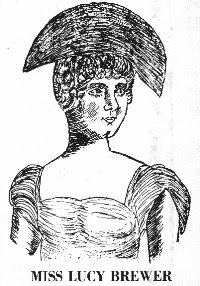
While Deborah Samson is a historically verifiable person, somewhat more mysterious is Lucy Brewer. According to legend, she enlisted in the Marines during the War of 1812, dressed as a man. She was reportedly based onboard the USS Constitution and participated in at least three dramatic sea battles as an expert marksman(woman?).

Brewer later published an autobiographical account of her “experiences.” The Marine Corps regards Brewer’s story as false, because the close living quarters aboard a ship would have made it near impossible to maintain the ruse.

But true or not she does weave a good tale.

This image is from the Marine Corps Web Log.

Who Was First?

Prior to World War II, women weren’t officially allowed in military services (except for nursing, which we’ll talk about in an upcoming blog). That doesn’t mean they didn’t serve. There are stories of women disguising themselves as men in order to serve as early as the Revolutionary War.

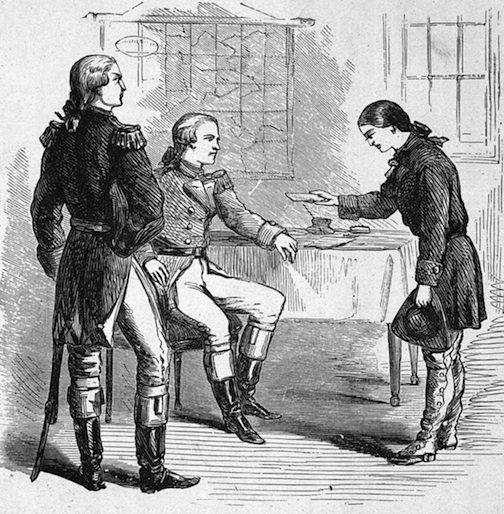
Deborah Samson was one of those women. She dressed up as a young man and volunteered to serve in the American Army in 1778. Samson, now known as Robert Shurtleff (or Shirtliff), served for three years and was wounded twice But she went undetected until she became sick with a fever. After that, she received an honorable discharge and eventually received a military pension.

Langston Hughes & Joining the WAVES

Frances Wills began working for the writer Langston Hughes after her graduation from Hunter College. While she was working for him, she began attending Pitt to get an M.A. in social work. She later began working in social work, placing children in adoptive homes.

It wasn’t until fall of 1944 that the Navy finally agreed to accept African American women in fully integrated units doing the same jobs as white women. The issue was a lack of vision on the part of the Navy: some assumed that since African American men mostly worked as cooks and janitors (i.e. non-fighting positions), African American women wouldn’t be needed to “free a man to fight.” It would take two long years of negotiations to convince the naysayers that African American women could replace white and “colored” men.

As Frances wrote in her memoirs:

In October 1944 when the Navy said it was ready for me and I said, ‘Take me,’ I was not consciously making a statement about race relations.  It was true that in the adoption agency where I was employed I was one of only two non-white social workers.  My African-American colleague and I were probably in the same numbers to total staff as we were in the population overall.  I doubt that this ratio had been planned, but since the numbers of person of color who applied to adopt children were small, we experienced minimal pressures from work demands in contrast to the rest of the staff which was obliged to handle a large volume of applications.

This photograph of Willis swearing in come from the National Archives.

Frances Wills Thorpe

Frances was one of two African American female officers in the Navy during World War II. She grew up in Philadelphia, but eventually moved to Spanish Harlem in New York City with her mother.

In her memoirs, she recalled getting little or no guidance about college.

When I learned that without high Regents grades in both geometry and algebra, I would have no chance at all of beings considered for college, I was devastated.  I do not recall feeling, at the time, that I had been overlooked by the school system.  Later, when I realized that there were people called guidance counselors in all the schools and that there must have been one or two in George Washington (high school), especially since it was among the more highly rated schools, I was angry.  Whoever had the job had not cared at all that I was there.  It must have been true — what people in the African American community always said — that no effort was made to ‘guide’ us because it was assumed that we would go to trade school or get a job — any job — on leaving high school.  It had never occurred to me that I would not go to college.  I wanted to be a journalist and heard that the University of Pennsylvania had an excellent school of journalism.

She ended up taking remedial courses and qualified to attend Hunter College in Manhattan.

This photograph of Frances Wills being sworn into the Navy comes from the National Archives.

“Do For Yourself”

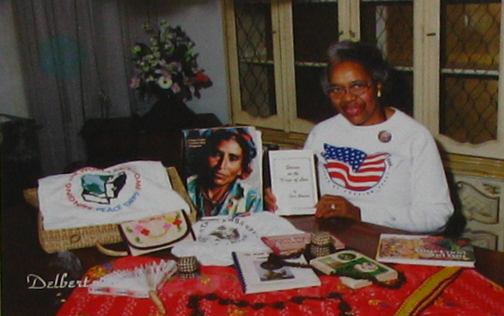
Even after her years with the Peace Corps, Jean Byrd Stewart still kept volunteering and giving. She shaded her stories. Wrote a book.

There was a to-do in Washington, DC, after the women had been in 50 years. I had to write of my involvement at the Navy. All of us that spoke at that particular affair, that was supposed to have been put together in a book form. Some of  them sent it back typed up and some didn’t.  I still have mine.  You should see the paper.  Even when I went to Africa, that was something.  I saved that.  I can add that to my book.  All those things blend together and come to something decent.

It wasn’t until late 2006 that Jean finally decided to stop volunteering.

I’ve done for others. As someone said, “Do for yourself.”   And that’s not being selfish because I’ve given a lot of years to other people.

This is a copy of a commendation Jean received from the state of New Jersey. It comes from the collection of Jean Byrd Stewart.

Peace Corps

In 1982, Jean Byrd Stewart volunteered yet again – this time with the Peace Corps. She was assigned to travel to the Philippines.

I went in as an agriculturist.  Agriculturist, that’s what was needed. My father had a place and with eight children, 200 feet deep on both sides and you learned to plant and this and take care of it and keep the ground nourished and keep the weeds out. So I went in as an agriculturist.  I have to work with the, around city hall, that was number one.  Then work with the farmers, upgrading them, so that they could raise a good crop of rice and this and that and the other thing. Green grass and shrubbery to hold the dirt whenever it rained. That was all a part of it too.

They had a day care center and I had to help with the children. There was some that were malnourished. We had to give them a one bone meal to keep them alive and going.  One lady was going to have a baby. She wanted me to deliver her baby because I had been in health.  You were here, you were there and the other place.  They had a day care center.  I could hardly pass there, they were waving to me.  I could hardly stop, because I had to go to the office and work.  You were needed in so many places.  The school needed someone to help raise money. Being from America, they knew I could touch and money would pop up.  Money for tables, money for chairs, for the children to do their homework.  The places they needed you and wanted you to work was endless.

This photograph comes from the collection of Jean Byrd Stewart.

“You’re Needed in the Government”

Jean Byrd Stewart found that her service to the United States didn’t end after World War II. When New Jersey began its urban renewal in the latter part of the 20th century, she was asked to represent the state in health matters. Then she volunteered with Title One, helping to improve opportunities for children at two economically disadvantaged Catholic schools. Next thing she knew, she was asked to volunteer with Service for America.

A lady who worked for the government said, “You’re needed in the government.” I was sent to, up to Hannibel, Missouri.  It was interested working with senior citizens.  Then there were some handicapped, disabled children there. And that was a learning experience. Being in the Navy, that’s an insignia that follows you through it seems.

When she returned home, her mother was sick, so Jean took care of her while attending college to help supplement her degree.

This photograph comes from the collection of Jean Byrd Stewart.

Post-War Romance

Jean Byrd began working after the war, returning to the job she had before entering into service. When her brother returned home from his stint in the Navy, he brought along a friend. Bill Stewart.

You just don’t up and get familiar with a person.  You have to learn something about them. If they’re nice, or you can be congenial, or get along with them.  So I’m minding my business, going to work.  I hate to say it, but they served me a drink that I just thought was light soda or something or other, because I was going to work.  I wasn’t going to be home and talk with them.  I was going to work. And they said, “You can’t go to work because we put something in that, and you just have to take the day off and go on.”  Well, I didn’t like that.  Because every day counted, right? Yeah, that’s what they did to me. So I didn’t go to work that day.  I got to learn something more about him.

After he had been over a couple of times, Bill suggested that he and Jean might want to think about getting married near his birthday in June. It was May.
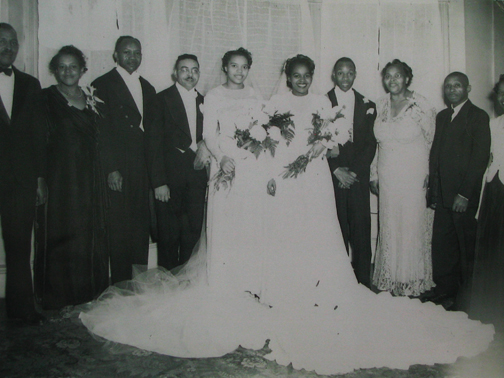
I said to myself, “This is moving in a hurry.”  Well I had a sister who was supposed to get married in September.  As time when on, I don’t even know how long it was, but come to find out he appeared to be nice and I didn’t know anything that was against him (laughs).  I said, “Well, we’ll talk to Lina and Johnny.”  I said, “It would be rough on my mother to have a wedding for them and have a wedding for us at another time too.  What if we get together and have a double wedding?”  And so it ended up, that we had a double wedding and got married.

This photograph comes from the collection of Jean Byrd Stewart.