While in school to become a teacher Jean Clark met her husband, Louis.
He was in one of my psych classes and he was a year ahead of me. He had grown up in Corvallis (Oregon) on the farm there, and he decided that he needed to earn some money, some extra money for school, so he joined the National Guard. He was the youngest of six in his family and he had four brothers who were in the National Guard. He wanted to be in and as soon as he was 16 he joined the National Guard. He was still in in college, at Monmouth. In 1940, the United States decided to mobilize the Guard because of the trouble in Europe. So he spent a year in training. In the meantime we had developed a sort of a relationship. When I was teaching at Brownsville (Oregon), we became engaged in 1940. So I was waiting for him to come back from his training.
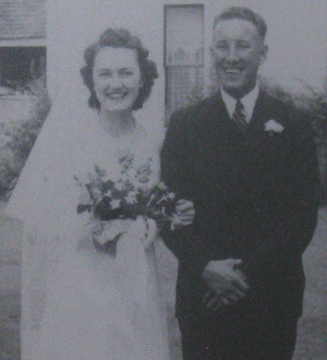
They got married in July of 1941. Jean was just 19 years old.
This photograph comes from the collection of Jean Clark.
SPARs, the Coast Guard women, had similar training as WAVES. SPAR Dorothy Riley Dempsey remembers the physical training as being extremely taxing.
We were not prepared for boot camp. We had to jump through the tires, you know. Then the next thing we had to do was we had to scale a wall. We couldn’t do it. I said to the girl in back of me, “Quinn, push, because I’ll never get over that wall.”
There was a big rope and it had a knot on it. And there was a pit with mud here. We had to back up and jump and my friend Quinn who was with me, I said, “Quinn, I’m never going to make that pit.” And she said, “Neither am I.” So we sneaked over to another line. We never had to go over it. We didn’t get caught. I said, “If we’re caught, we’re out. They’ll get rid of us.”
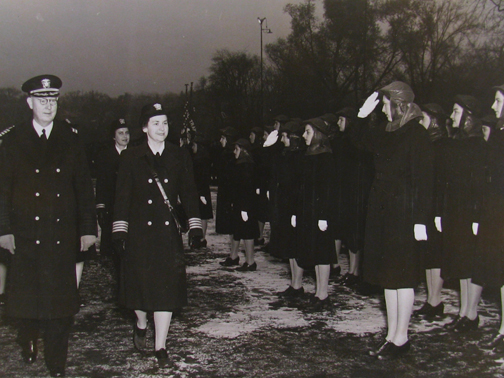
Navy WAVES were active, regular military. That meant they were expected to wear their uniforms during all public functions. Including weddings.
Franny Prindle, like other WAVES of the era, had to get a special dispensation from the Executive Officer of the Naval Reserve to wear something other than her uniform on her wedding day. But note the special conditions: no photographs of Prindle outside of her uniform could be released to the press.
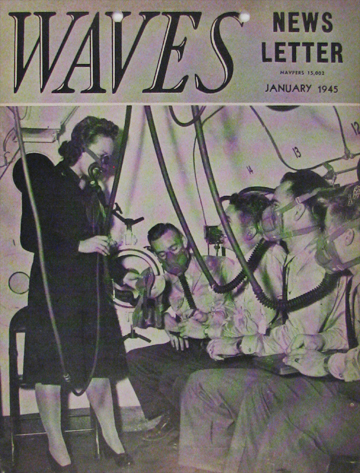
The Navy put out newsletters to keep the WAVES up to date. The newsletters at first started out quite simple – just a copied sheet or two of paper with a few sketches – but ultimately the publications became quite polished, featuring in-depth articles, photographs and even comics.
This newsletter was published in January of 1945. It was a national publication that was designed to go out to all WAVES regardless of where they served. The photo on a cover shows a WAVE working with sailors who are learning how to use pressurized masks for high-altitude flying.
The national newsletter focused on news of interest to any WAVE. But individual bases also put out newsletters, with location-specific information.
Homefront Heroines director Kathleen Ryan and producer David Staton are at the Rose Bowl today. So in honor of the game and parade, we’re showing not roses but… cherry blossoms. After all, in the Tournament of Roses Parade everything on the floats is made of natural materials: flowers, seeds, leaves, etc.
This is WAVE Liane Galvin, an aerographer’s mate (weather forecaster) based in Washington, D.C. smelling the cherry blossoms during a D.C. spring in World War II.
The U.S. National Film Registry announced its latest selections late yesterday, and included on the list is a World War II-era documentary propaganda classic. The film is called The Negro Soldier. It follows soldiers from pre-enlistment through basic training.
What was remarkable about the film wasn’t that it included African American soldiers in training (though that was indeed unusual at the time). But what was really incredible is that the filmmakers were specifically instructed to avoid Hollywood stereotypes about African Americans. So the men featured were shown coming from a variety of jobs (lawyers, musicians, athletes). According to film historians Thomas Cripps and James Culbert, the cautions included to:
Avoid stereotypes such as the Negroes’ alleged affinity for watermelon or pork; also avoid strong images of racial identity (‘play down colored soldiers more Negroid in appearance’ and omit ‘Lincoln, emancipation, or any race leaders or friends of the Negro’).
While initially intended for African American military audiences, people who saw the film thought the film should be shown to African American and white audiences, civilian and military, a response which surprised the filmmakers.
The Negro Soldier was directed by Frank Capra, who also directed the famous “Why We Fight” series of propaganda films (1942-1945). These films were designed to raise morale in the U.S. film audience and help people understand the complexities of the war. Capra began working on the films shortly after the attack on Pearl Harbor. Capra saw them as the American answer to German filmmaker Leni Riefenstahl’s powerful Triumph of the Will. He used footage mostly produced by the U.S. Office of War Information to craft his seven-film series.
The first film in the “Why We Fight” series, 1942′s Prelude to War, won the Academy Award for Best Feature Documentary in 1943. The “Why We Fight” series became part of the National Film Registry in 2000. With the addition of The Negro Soldier, this means that another important part of World War II-era domestic propaganda will be restored and preserved in the Library of Congress for future generations.
World War II women didn’t get the Capra treatment. However, this OWI film Glamour Girls of 1943 does show how the government was trying to get women to participate in the war effort as well.
WAVES could, of course, get leaves to spend time with family and friends. But holiday leave – that was another thing. It was highly desirable and tough to get. And the Navy, unlike civilian businesses, didn’t take a day off because it was Christmas.
Betty Bruns Lord in Uniform
It wasn’t until 1945 that Betty Bruns Lord would be allowed home – to Mason City, Iowa – for the holidays.
You didn’t get a lot of leave and sometimes you couldn’t get off because you were so busy. Just couldn’t take it when you wanted to. And I know when the boys started coming home — the last year, in ’45, I did get home for Christmas which was something you didn’t get at that time. A lot of the boys said, “Well, uh, uh?” He said, “These girls haven’t been home for Christmas since they joined.” “Oh.” And so Commander Fair, we did get our leaves. We thought for sure we were going to get cancelled. But no no no no. He said, “No, you girls are going home. You haven’t had yours.”
On the airstrip with Betty Bruns Lord
Betty was stationed at Mustin Air Field in Philadelphia working on planes. She was one of the WAVES who not only worked on planes, but knew how to fly them. Her uncle had trained her as a pilot before the war.
Virginia Gilmore was married when she joined the WAVES in 1943. Her husband was a handsome Marine. But in their first Christmas as a married couple they were thousands of miles apart. He was just back from a two-and-a-half year stint in the Pacific, stationed at the Puget Sound Navy Yard in Bremerton, Washington. Virginia was at the other end of the country at WAVE boot camp in Hunter College.
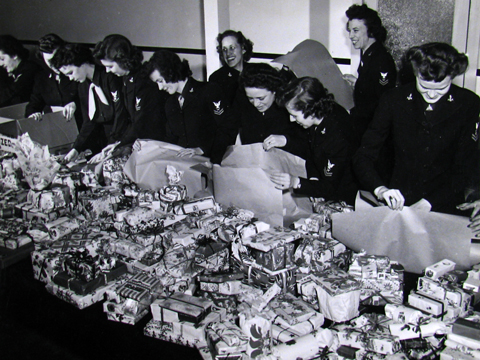
We were there on Christmas Eve. And huge Navy trucks pulled up and they unloaded a filled stocking for every recruit and hung them — they came in and hung them on the corner of our bunks.
WAVE Wraps Presents, U.S. Navy Photograph
We had candy and gum and cookies and little presents. Can you imagine all the thousands — I don’t know what the Navy word is for Navy warehouse, but Navy stores where you could find all those things but we had them.
Joyce Fish Sherwood joined the WAVES in 1942. Like Helen Edgar Gilbert, she was part of the first class of WAVES, who skipped the Hunter College boot camp experience. After enlistment, Joyce was sent to Indiana University in Bloomington for orientation and storekeeper training.
Joyce was stuck in training and Christmas was approaching. So since she couldn’t get home to her family, her family brought Christmas to her.
US Navy Photograph
The three of them came down and stayed in Bloomington and came onto what we called the ship (laughs) to visit and they were allowed to do that. I really don’t have much of a recollection of gift giving or anything like that. Because we had our uniforms by then. We had sent all out civilian clothes home. So there wasn’t much they could give me except stationary (laughs) or things like shampoo and stuff that you would always need.
US Navy Photograph
They were proud. They were proud. I think that had something to do with this patriotism blast we were on, too. All the civilians were, “Oh! You’re in the military!” You know, they were glad to see us and they were appreciative of what we were trying to do.







 Hinges of History