Coveted Assignment

WAVES worked in a wide variety of jobs, but many of the women with teaching experience like Jean Clark ended up in instructional positions. Jean wanted to become a Link Trainer, which used an early form of flight simulation to train men in piloting skills.
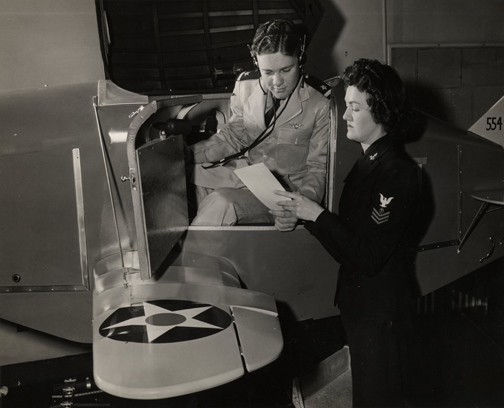
We had to take aptitude tests.  Now, I’m going to brag a little bit. Partly, I think, because I’d been a teacher. All of the girls who were chosen to go to Link School had been in education. I think they felt, “They’ve already learned how to teach.  After that, we can teach them the subject matter and they can teach it.” That was their theory I’m sure. They said it was the top thing and if it was the top thing, that’s what I want (laughs).  So, everybody was envious if we got it. There were only 50 of us I think that got it. So not too many.

This is a photo of Jean training a man in the Link flight simulator. It comes from the collection of Jean Clark.

Indoctrinization

Jean Clark was in the first class of recruits to be trained at Hunter College in the Bronx. The women were bunked in what were formerly civilian apartments surrounding the campus. There were 12 in her room, all sharing a single shower.

We had to take turns taking showers. One day it was my turn to take my shower and they called — while I was in the shower, hey called from the downstairs “Inspection!”  We had been there a little while and we were supposed to have the room shipshape. Everything neat and clean and dusted and at attention in full dress.  Here I am in the nude in the shower and here it is five floors down. My bunkmates all start handing me clothes (laughs). I thought, “I’ll make it” and I did, except I didn’t’ get my shoes tied.  And I was standing there at attention with my shoelaces dangling.  The WAVE officer didn’t notice (laughs).

This photograph shows the WAVES-in-training standing outside of the Bronx apartment building where they were stationed. It comes from the collection of Jean Clark.
Enlisting in the WAVES

Jean Clark enlisted in the WAVES in December of 1942 at a recruiting station in Portland, OR, after her husband was sent overseas for the war. She heard about the WAVES through an article in her local newspaper.

And I just thought, “That’s what I’m going to do.” My husband said,  “Please don’t join the WAAC (Women’s Army Auxiliary Corps), because that’s what was going on around right then. He says they’ll probably send you overseas and you’ll be overseas when I get home!

Clark told the recruiter that she was teaching in Sweet Home, a small town in central Oregon. She asked the recruiter to let her finish out the school year, which would end in May.

He grinned and said, “Don’t worry about that.”  (laughs).  Well, then in January, I think it was, I got my first letter. It told me what things to expect. In February I got one, “Report.”

This photograph comes courtesy of Jean Clark.

Sneaking Onto Base

Jean Clark’s husband, Lou, had enlisted in the National Guard before the war. By December of 1941, he was in training at Fort Lewis outside of Tacoma, Washington. They got word they were shipping out in February, so Jean decided to head up to the base and visit.

At night they called a muster and they lined up with all their gear in line and we just watched them as they marched by. They came close enough that they could give us a hug and say goodbye but that was it. I stood there thinking, “Boy, I feel like I’m in a movie just (laughs)”

But there was a problem with this cinematic scene. The base was shut down and Jean was stuck inside with another woman who had also come to see her husband off.

We decided, “We might as well stay here. There’s no bus at this time of night.”  So, went into the place. There wasn’t a scrap of anything.  We found an old blanket. We said we didn’t want to sleep on the floor because it looked a little bit chewed (laughs).  My friend said, “My husband says they have rats in this place.”  So we got up on the meat block and spread out and put the blanket over us and went to sleep until morning when we heard this guard going — he was supposedly guarding. I don’t know what he was guarding, but everybody was gone (laughs).  But he was on guard duty.

He’d go one side of the building. Click. Turn in a military manner. Down the other side of the building. Click.  Down the other side. We watched him. We thought, “Wheres’ he going to be?” So while he was on the back side, we went out the door.  (laughs) And headed to the gate. She said, “Maybe they’ll think we’re civilian employees.”  And I think they did. We just walked out and got a bus.

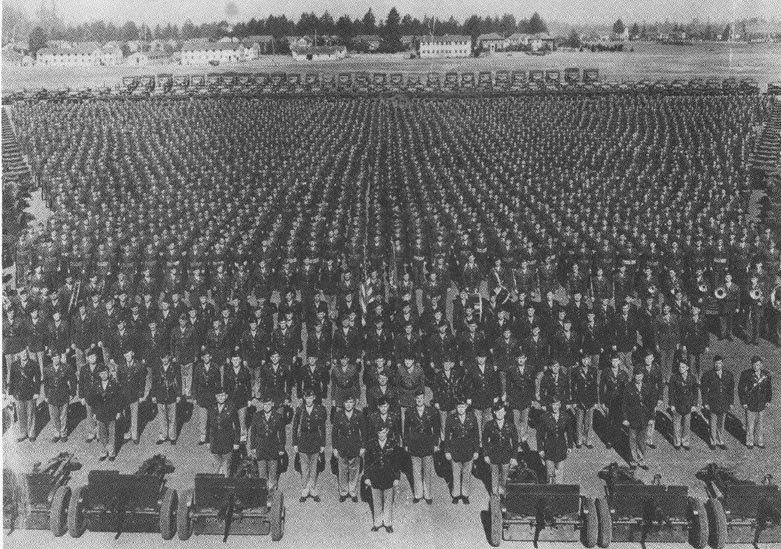
This photograph comes the California State Military Museum.

Love During Wartime

While in school to become a teacher Jean Clark met her husband, Louis.

He was in one of my psych classes and he was a year ahead of me.  He had grown up in Corvallis (Oregon) on the farm there, and he decided that he needed to earn some money, some extra money for school, so he joined the National Guard. He was the youngest of six in his family and he had four brothers who were in the National Guard. He wanted to be in and as soon as he was 16 he joined the National Guard.  He was still in in college, at Monmouth.  In 1940, the United States decided to mobilize the Guard because of the trouble in Europe. So he spent a year in training. In the meantime we had developed a sort of a relationship.  When I was teaching at Brownsville (Oregon), we became engaged in 1940. So I was waiting for him to come back from his training.

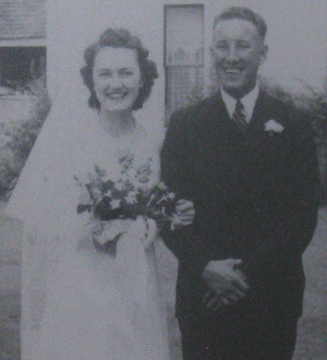
They got married in July of 1941. Jean was just 19 years old.

This photograph comes from the collection of Jean Clark.
Why No Team Sports?

Janette Shaffer Alpaugh helped to organize sports teams for WAVES in the south. But she also helped to start alternatives to traditional exercises at the training centers as well.

We were at Smith, with a nice gymnasium. I kept thinking, “Why don’t we have some sports?”  Because we took classes and we’d go down for marching and some calisthenics. But that was that.  So I kept thing, “Well, you’ve got all these other young people. Why can’t we be trying basketball or something?”  So I went to the lady, head officer, “Isn’t there some time we could schedule some basketball?  Anybody who shows up could just play.”  And she said, “Oh, that’s a good idea.  I don’t know why we don’t do it.” So they fixed something up for Sundays when you had free time.

I think because I did that (laughs) — I didn’t think that was anything unusual. I did that because I wanted to play.

The photo comes from a Navy post card set produced about the Hunter College boot camp. It’s from the Betty H. Carter Women Veterans Historical Project at the University of North Carolina Greensboro.

Dance, Dance, Dance

Physical education took many different forms. These WAVES are square dancing their way to fitness.

The photograph dates from April of 1943. It was taken at the U.S. Naval Training School for Radio Operators at the University of Wisconsin in Madison. It’s held in the collection of the National Archives.

WAVES also participated in sports teams which traveled to other bases and competed with women in various sports, like volleyball or basketball. Janette Shaffer Alpaugh helped organize those teams in the south. Read more about her work in physical activities for WAVES here.

On the Town

It wasn’t all hard work for the WAVES. Even officers tasked with training fellow officers, like Franny Prindle Taft, could find time to break away for the occasionally bit of entertainment.

In this picture, Franny (center) is with another WAVE and an military man. They’re at a place called Pine Orchard, in summer of 1943.

Pine Orchard appears to be a country club or a nightclub or restaurant with an outside patio. We’ve done some basic research and can’t find out anything about it, but would love to know more if anyone has any details.

The photograph is courtesy of Franny Prindle Taft.

“Hupping” the Troops

WAVES stayed in dorms on the Smith College campus when in officer training at Northampton, but they ate all of their meals at the Wiggins Tavern in the historic Hotel Northampton. Wiggins was an area landmark and popular with locals, but it became WAVES-central during the war.

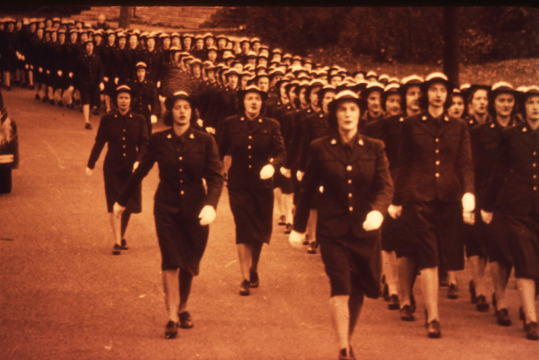
Franny Prindle Taft says she was named as company commander when at Smith. That meant it was her job to get the troops the half mile from the campus down Main Street to Wiggins on King Street three times a day to eat – and then back again after the meals for training or to quarters.

I hupped the troops down the hill and then I had to be the last one in line to see that they all went through. And then I had to be the first one out. So I think what I got in the Navy was the ability to eat very fast.

This photograph is courtesy of Franny Prindle Taft.

Special Recommendation

The first class of WAVES officers were gathered on special recommendation from people who knew the women who would serve. This was done to make sure that the Navy had women in command who were, in essence, a “known” quantity: women who held certain values, were smart, driven, and would represent the Navy well.

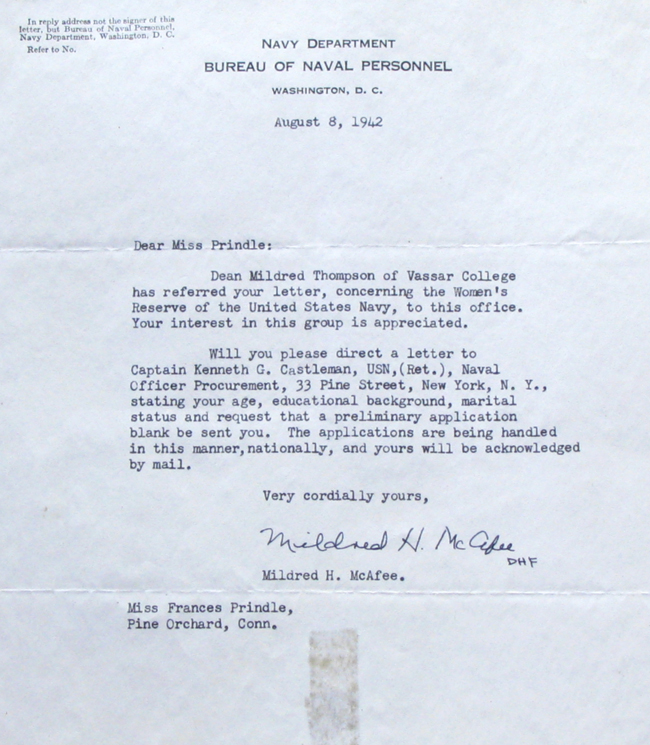
Franny Prindle was one of those women. This is the letter she received from WAVES’ leader Mildred McAfee, inviting her to become a WAVE officer in August of 1942. Prindle was recommended by Vassar College Dean Mildred Thompson, a woman McAfee knew personally from her tenure as dean of Wellesley College.

Prindle returned the application and was a member of the first WAVE officer training class at Smith College. She remained at Smith for the duration of the war, training other officers.